Building Greening Systems in Cities: Classifying Urban Green Spaces & Design Principles
 libre
libre
Building Greening Systems in Cities
A building greening system is the network of interconnected green spaces — parks, gardens, street plantings, green roofs, and protective plantations — that is woven into the planning structure of a city to improve the urban environment. In an ideally planned city, the greening system is organically "woven" into the urban fabric, with the natural landscape serving as the basis for its planning.

The purpose of a building greening system is to connect each green facility to the city's daily functioning, so that vegetation is not a decorative afterthought but a structural layer of urban planning. The more functions a green element performs — recreational, sanitary, microclimatic, aesthetic, ecological, and urban-planning — the higher the efficiency of the overall system.
What Is a Building Greening System?
A building greening system is a coordinated arrangement of all urban vegetation designed to function as one ecological and recreational network rather than a scatter of isolated parks. It links every green facility — from a courtyard garden to a suburban forest park — to the planning structure of the city, ensuring continuous coverage and shared environmental benefit. The concept underpins the broader idea of a Green City, where green infrastructure becomes as fundamental to planning as roads or utilities.
Definition and Types of Green Spaces
Green spaces are vegetated areas within and around a city that serve recreational, ecological, and protective roles, ranging from formal parks to incidental street plantings. The main types of urban green space include public parks and gardens, squares and boulevards, green roofs, vertical gardens and green facades, courtyard gardens, sports greenery, water-protective and wind-protective plantations, cemeteries, and tree nurseries. Each type contributes differently to the city, and a well-built greening system combines them so their functions overlap and reinforce one another.
Linking Greening Facilities to Urban Planning Structure
Greening facilities are most effective when their location is closely linked to the planning structure of the city. In an ideally planned city, the greening system is organically woven into the city structure, and the natural landscape forms the basis for its planning. This linkage means parks, gardens, and plantings are positioned to follow the city's residential hierarchy, transport routes, and natural features such as rivers and slopes, rather than being placed wherever land happens to remain.
Classification of Green Spaces
Urban green spaces are classified on two axes: their territorial location and their functional purpose. This dual classification lets planners account both for where a green space sits relative to the built-up area and for the role it plays in the life of the city.
Territorial Classification: Inner-City and Suburban
On the basis of territory, green spaces divide into inner-city objects and suburban objects. Inner-city green spaces are located within the administrative boundaries of the city, inside the built-up area. Suburban objects lie outside the city in the green or suburban zone. This distinction matters because growing conditions, maintenance intensity, and exposure to pollution differ sharply between a city-centre square and a forest park beyond the urban edge.
Functional Classification of Greening Facilities
According to their functional purpose, greening facilities are divided into general use, restricted use, and special purpose groups. Each group carries a distinct mandate, from mass public recreation to environmental protection around industrial sites.
General Use Facilities: Parks, Gardens, Squares, Boulevards
General use facilities are the green spaces open to all residents for recreation and environmental improvement, and they account for the largest share of urban greenery. They include:
- city and district parks and specialized parks;
- city gardens and gardens of residential areas, inter-quarter gardens, or gardens at a group of residential buildings;
- squares in plazas and in building setbacks;
- boulevards along streets, pedestrian routes, and on embankments.
The largest general-use objects are city parks (parks of culture and recreation), sports and children's district parks, forest parks, exhibitions, and zoological and botanical parks.
Restricted Use Facilities
Restricted use facilities are green spaces tied to specific institutions or sites where access is limited to their users. They are located on the plots of residential buildings, children's institutions, schools, universities, colleges, cultural and educational institutions, sports facilities, health care facilities and sanatoriums, industrial enterprises, and warehouse areas.
Special Purpose Plantations
Special purpose plantations are green facilities created for a protective or technical function rather than recreation. They include plantings along highways and streets; water-protection, wind-protection, and erosion-control plantations; cemetery plantations; nurseries; and facilities located in the suburban area within the sanitary protection zones around industrial enterprises.
Organizing Greening by Levels of Public Service
Public landscaping facilities are organized to mirror the stepwise structure of cultural and household services for the population, so that green space is available at every scale of daily life. The overall level of greenery in a city depends on the location, purpose, layout, use, and condition of these citywide facilities. The hierarchy runs from the smallest unit beside a group of homes up to citywide parks and sports complexes.
Courtyard-Gardens and Neighborhood Gardens
The courtyard-garden is the primary element of the greening system, located within a group of residential buildings and serving residents immediately at their doorstep. At the next level, within a neighborhood, the neighborhood garden and inter-quarter garden provide daily services to the population, offering everyday recreation within a short walk of home.
Residential Area Gardens and District Parks
At the residential-area level, a garden of a residential area with a sports base serves as an element of periodic maintenance, used regularly but less frequently than the daily courtyard garden. In the administrative and planning districts of large cities, parks of planning districts and stadiums extend this provision to a wider catchment.
Citywide Parks and Sports Complexes
City parks and sports complexes serve the whole urban population as elements of occasional maintenance — destinations visited less often but covering the largest area and offering the broadest range of activities. Together with the smaller daily and periodic facilities, they complete a continuous ladder of public green space from doorstep to city scale.
Connecting Elements: Green Streets, Boulevards, Embankments
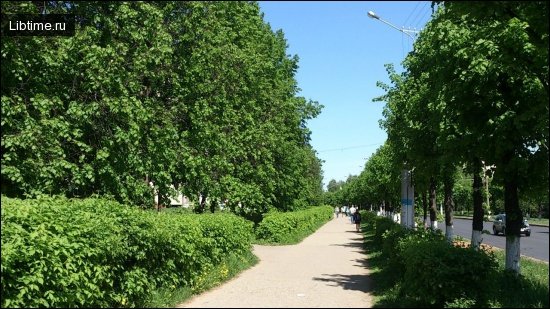
Green streets, squares, boulevards, and embankments are the connecting tissue that complements and links the entire system of green facilities within the city. These linear elements carry pedestrians and wildlife between larger green spaces, extend tree canopy along travel routes, and ensure the greening network functions as a connected whole rather than a set of islands. Public facilities such as suburban parks, forest parks, meadow parks, and hydroparks are joined to the rest of the system by this network of green transport and pedestrian links.
Green Wedges and Large Vegetation Areas in Urban Development
To improve the urban environment and create conditions for living and recreation in large cities, modern urban planning recommends incorporating large areas of vegetation of 500–1000 hectares — "wedges" at least 0.5 km wide — into the development. These green wedges drive cooler air into the city core, provide major recreation grounds, and protect ecological corridors. Where the acute shortage of land for development makes wedges impossible, planners are advised to enlarge planting areas so that consolidated plantations cover 10 to 40% of all green areas.

Requirements for Building a Greening System
Building an effective greening system requires that its facilities be distributed and connected according to a consistent set of planning principles. The core requirements are:
- uniform placement of public landscaping facilities across residential areas, public centres, industrial and warehouse areas, and along highways and streets;
- unification of urban and suburban facilities into a single system tied together by a network of green pedestrian promenades, highways, and boulevards;
- interconnection of the urban landscape with the surrounding terrain, water bodies, buildings, structures, and improvement equipment;
- incorporation of the greening system into the wider programme of nature protection and environmental rehabilitation.
When designing a greening system, each element should perform defined functions while remaining interconnected with the others, with stepwise maintenance and continuity across levels serving as the foundation. Additional resources can be drawn on to create new landscaping facilities:
- restored disturbed areas, which remain effective despite their small size thanks to their proximity to housing, community centres, and pedestrian paths;
- agricultural land in non-forested areas occupied by gardens, where special agro-parks can be created;
- alluvial areas in coastal and riverside cities, where large park areas can be formed.
Planning proceeds sequentially — first at the level of the city master plan, then the planning-district plan, and finally the detailed planning project for the residential area and microdistrict. Two approaches exist: in the first, the greening system is subordinate to and depends on the planning structure of the city; in the second, the green areas themselves shape the city's layout. Green areas in the city plan also take several geometric forms — central, peripheral, group, and linear strip — and older cities with historically built-up areas tend toward distinct greening systems of their own.
Functions of Urban Greening Systems
Urban greening systems perform recreational, aesthetic, sanitary, microclimatic, and ecological functions simultaneously, and their value rises with the number of functions each element delivers. These functions are the reason green infrastructure is treated as essential urban infrastructure rather than ornamentation.
Recreational and Aesthetic Functions
The recreational and aesthetic functions of urban greenery give residents accessible places to rest, exercise, and gather while shaping the visual character of the city. Parks, gardens, boulevards, and squares provide settings for daily relaxation and organised sport, and their planting design frames views, softens hard architecture, and gives neighbourhoods a distinct identity. Because the primary recreational facilities sit closest to housing, even small restored plots deliver outsized recreational value through proximity.
Sanitary, Hygienic, and Microclimatic Functions
The sanitary, hygienic, and microclimatic functions of urban vegetation include moderating temperature, filtering air, reducing noise, and improving humidity. Tree canopy and planted ground shade surfaces and lower air temperatures through evapotranspiration, directly countering the heat island effect in which built-up areas trap warmth. Dense plantings along busy roads also reduce noise pollution by absorbing and deflecting traffic sound, and they trap airborne dust and particulates before it reaches homes and lungs.
Environmental and Ecological Functions
The environmental and ecological functions of greening systems include capturing carbon, supporting wildlife, protecting soil and water, and rehabilitating degraded land. Water-protection and erosion-control plantations stabilise slopes and riverbanks, protective belts shield residential zones from industrial pollution, and connected green corridors allow species to move through the urban landscape. These ecological roles tie the greening system directly into a city's broader programme of nature protection and environmental rehabilitation.
Environmental Benefits of Urban Greening
Urban greening delivers measurable environmental benefits across air quality, climate, and biodiversity, which is why green infrastructure now features in the sustainability plans of cities worldwide. These benefits accrue at every scale of the greening hierarchy, from a single street tree to a 1000-hectare green wedge.
Air Quality Improvement Through Vegetation
Vegetation improves urban air quality by intercepting particulate matter, absorbing gaseous pollutants, and releasing oxygen. Leaves and bark trap dust and fine particles, while foliage takes up pollutants such as nitrogen dioxide and ozone, helping cities move toward published air quality standards. Street trees and green facades positioned along high-traffic corridors place this filtering capacity exactly where pollution concentrations are highest and where residents are most exposed.
Carbon Capture and Climate Mitigation
Urban trees and plants mitigate climate change through carbon sequestration, storing atmospheric carbon dioxide in wood, roots, and soil. This carbon capture contributes to a city's carbon footprint reduction alongside cuts to greenhouse gas emissions from buildings and transport. While individual urban trees store modest amounts, an expanded and well-maintained canopy across a whole city accumulates a meaningful carbon sink and simultaneously lowers cooling-energy demand by shading buildings.
Biodiversity Enhancement in Urban Design
Biodiversity enhancement in urban design means deliberately planting and connecting habitats so that a wider range of species can live in the city. Diverse native plantings, green roofs, vertical gardens, and linked green corridors give birds, pollinators, and small mammals food and shelter, turning the greening system into urban habitat. Connecting elements such as green streets and embankments are critical here, because isolated patches support far less wildlife than a network that lets species move between them.
Climate Resilience and Adaptive City Design
Green infrastructure is a central strategy for climate resilience, helping cities absorb floods, cool extreme heat, and adapt to a changing climate. Adaptive city design treats vegetation, soils, and water as active systems that buffer climate shocks, an approach increasingly visible in Northwest cities of the United States such as Seattle, Washington and Portland, Oregon, as well as colder cities like Boise, Idaho and Fairbanks, Alaska that face their own climate stresses.
Green Infrastructure as an Adaptation Strategy
Green infrastructure serves as an adaptation strategy by using soft landscape solutions — trees, green roofs, permeable surfaces, and rain gardens — to reduce climate risks rather than relying on hard engineering alone. Green roofs lower roof and ambient temperatures while retaining rainfall, vertical gardens and green facades cool building exteriors, and replacing impervious surfaces with porous paving and permeable materials lets water soak into the ground. Together these measures form an adaptation toolkit that planners can layer into existing districts during urban regeneration and renewal.
Stormwater Management and Waterway Restoration
Modern stormwater management replaces piped runoff with surfaces and basins that capture, slow, and reuse rainwater, in contrast to traditional drainage that channels water straight to sewers. The sponge city concept, advanced by landscape architect Kongjian Yu, designs urban areas to absorb and store rainfall through permeable surfaces, wetlands, and multifunctional detention basins that double as parks in dry weather. Practical measures include rainwater harvesting systems, roof-to-tap water recycling schemes, creek and waterway restoration that re-naturalises buried streams, and street-tree irrigation fed by captured runoff — all reducing urban flooding while supporting water conservation.
Green Spaces and Environmental Equity
Access to urban green space is unevenly distributed, and historical discriminatory practices such as redlining left many low-income communities and communities of color with less tree canopy and higher exposure to heat and pollution. Because these neighbourhoods often have more impervious surface and fewer parks, they experience the heat island effect and urban flooding more severely, compounding climate change impacts on already vulnerable populations. Building an equitable greening system means directing new parks, street trees, and green infrastructure toward the areas that were historically deprived of them, so that the environmental benefits of greening reach the residents most exposed to urban climate risk.
Community Engagement and Governance
Durable greening systems depend on community engagement and clear governance, because residents maintain, use, and advocate for the green spaces near them. Involving communities in design and stewardship — through neighbourhood planting programmes, participatory budgeting, and local monitoring — produces green spaces that match real needs and are cared for over time. Governance structures coordinate the many actors involved, from municipal planners to specialist firms such as CLOUSTON Associates and Beveridge Williams, and tie individual projects into a long-term framework like a city-wide Climate Action Roadmap.
Building Certifications and Standards for Green Design
Building certifications and standards give green design measurable benchmarks for energy, water, materials, and ecological performance, turning broad sustainability goals into verifiable requirements. Certification schemes assess factors such as energy efficiency, sustainable building materials, indoor environmental quality, and the integration of green roofs and vegetation, allowing projects to demonstrate compliance and compare performance. Standards also feed environmental sustainability metrics that let cities track progress across their building stock and report against climate commitments.
Integrating Greening with Sustainable Urban Systems
A greening system reaches its full value when integrated with the other systems of a sustainable city — transport, energy, water, and waste. Treating these together, rather than as separate projects, is what distinguishes genuinely sustainable cities from those that simply add isolated green features, and it underpins broader sustainable city transformation.
Eco-Friendly Transportation and Pedestrian Links
Eco-friendly transportation links greening systems to low-carbon mobility through tree-lined pedestrian promenades, cycle routes, and clean public transport. Green boulevards and embankments double as walking and cycling corridors that connect parks, while public transportation systems running electric buses cut street-level emissions and reduce the road space needed for cars. Shaded, planted pedestrian routes make walking and transit more attractive, reinforcing the shift away from private vehicles that the greening network physically supports.
Energy Efficiency and Eco-Sustainable Building Design
Eco-sustainable building design reduces energy demand by combining efficient architecture with on-site generation and vegetation. Green architecture pairs measures such as solar panels and LED lighting with green roofs and vertical gardens that insulate buildings and cut cooling loads, improving energy efficiency in architecture and across the wider city. The adoption of sustainable technology — efficient lighting, renewable generation, and advanced waste management systems that recover materials and energy — extends the same logic from individual buildings to whole districts.
Best Practices for Designing City Greening Systems
Best practice in greening-system design combines continuous coverage, multifunctional spaces, ecological connection, and community ownership into a single coordinated plan. The following principles summarise an effective approach:
- Plan hierarchically: provide green space at every level from courtyard garden to citywide park, so recreation is available within walking distance of every home.
- Connect, don't isolate: link parks and plantations with green streets, boulevards, and embankments so the system functions as a continuous ecological and pedestrian network.
- Make spaces multifunctional: design detention basins, green roofs, and parks to deliver recreation, stormwater control, cooling, and habitat at once.
- Replace hard surfaces: substitute porous paving and permeable materials for impervious surfaces to cut runoff and reduce the heat island effect.
- Prioritise equity: direct investment to neighbourhoods historically underserved by redlining and similar practices.
- Integrate with city systems: coordinate greening with transport, energy, water, and waste management rather than treating it in isolation.
- Engage the community: involve residents in design and stewardship so spaces are used, maintained, and valued.
Designing for resilience also means accepting constraints. Where land is scarce, enlarging and consolidating planting areas, reclaiming disturbed and alluvial land, and greening rooftops and facades extend the system without demanding new ground.