Sumganskaya Cave: Exploring the Largest Cave in the Ural Mountains
 libre
libre
Sumganskaya Cave, also known as Sumgan-Kutuk, is the largest cave system in the Ural Mountains, located on the western slope of the Kibiz Ridge about 12 km west of Maksyutov in Bashkortostan, Russia.

Cave Location and Geography
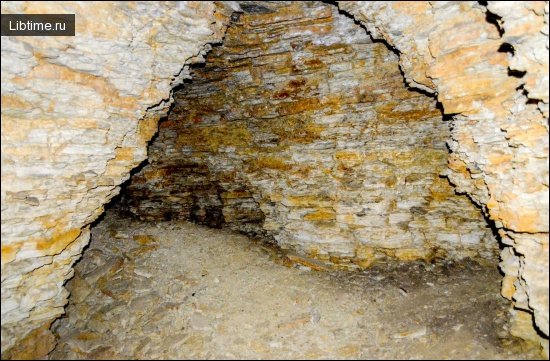
Sumganskaya Cave sits within Bashkiriya National Park in the Burzyansky District of Bashkortostan, a republic of the Russian Federation in the southern Ural Mountains. The cave is carved into limestone on the western slope of the Kibiz Ridge, a setting that places it among the karst landscapes that characterise this part of the Urals. Its remote position, surrounded by protected forest and river valleys, has helped preserve it as a near-pristine natural monument.
Geographic Coordinates and How to Reach the Cave
The cave lies approximately 12 km west of the settlement of Maksyutov, deep within the Burzyansky District. Reaching Sumganskaya Cave typically requires travelling through Bashkiriya National Park, often combined with river travel, as the surrounding terrain is rugged and largely roadless. Visitors generally approach on foot or by water along the river valleys that drain the western slope of the Kibiz Ridge, and the journey itself is part of why the cave remains the preserve of prepared expeditions rather than casual tourists.
Cave Entrance and Surface Landmarks
The entrance to Sumganskaya Cave is a 70-metre vertical shaft that drops directly into the system from the forest floor, an opening that doubles as the cave's defining surface landmark. This shaft is not a gentle walk-in entrance but a sheer well that demands rope work to descend. The mouth of the shaft acts as a funnel for cold air in winter, a feature that shapes the cave's unusual internal climate and the ice formations found far below.
Cave System Structure and Geology
Sumganskaya Cave is a multi-level labyrinth of horizontal and inclined limestone galleries and grottoes, organised chiefly into two main levels at depths of 75 and 110 metres below the surface. The system combines vertical shafts, broad galleries, and large chambers, reflecting the slow dissolution of limestone by flowing water over geological time. Its scale and layered structure are what earned it the status of the largest cave in the Urals.
The Entrance Shaft and Vertical Wells
The cave begins with a 70-metre entrance shaft, and two further internal wells of 30 to 35 metres connect the upper and lower levels. These vertical sections divide Sumganskaya Cave into its characteristic stacked structure and make descent a technical undertaking. Negotiating the shaft and the connecting wells requires rope-climbing and descending techniques, since there are no constructed stairways or walkways inside the cave.
Upper and Lower Levels
The cave's galleries are mostly confined to two levels, the upper at a depth of about 75 metres and the lower at about 110 metres from the surface. The two levels are linked by the pair of 30–35-metre wells, allowing movement between the higher horizontal passages and the deeper river gallery. This vertical separation of levels is a defining feature of the Sumgan-Kutuk system and influences both its airflow and its ice distribution.
Underground River and Central Gallery
An underground river roughly 5 metres wide and 2 metres deep flows through the central gallery of the lower level of Sumganskaya Cave. This watercourse is the active agent that continues to shape the limestone passages, and it dominates the lowest reaches of the system. The river gallery is among the most striking parts of the cave, combining flowing water with the large chambers typical of the lower level.
Halls, Chambers and Grottoes
Sumganskaya Cave is distinguished by the large size of its grottoes and the abundance of mineral formations decorating them. The chambers vary from broad inclined halls to galleries that descend steeply toward the underground river, and their scale is one of the cave's most memorable qualities. The combination of spacious grottoes and dramatic level changes gives the system its labyrinthine character.
Naklonniy Grotto and the Underground Glacier
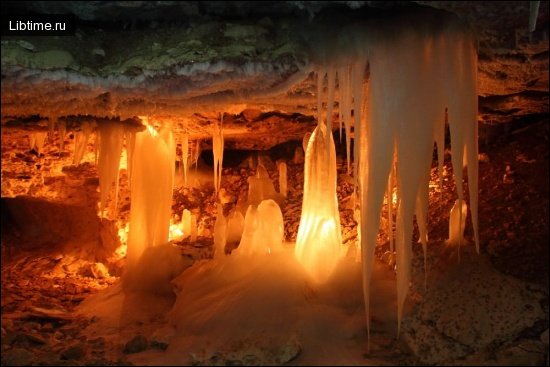
The Naklonniy Grotto holds a permanent glacier that survives year-round, the most famous single feature inside Sumganskaya Cave. In one of the galleries descending toward the river, a powerful ice mass about 160 metres long forms and persists through all seasons. Because this grotto stays cold even in summer, the ice never fully melts, making it a rare example of a permanent subterranean glacier in the Urals.
Geological Formations Inside the Cave
Sumganskaya Cave contains a rich assortment of formations, from classic dripstone features to ice-based structures and delicate atmogenic crystals. The cave is characterised by the abundance of these formations across its grottoes, the product of mineral-rich water and the cave's peculiar cold microclimate. For a broader explanation of how such features develop, see Cave Formation.
Stalactites and Stalagmites
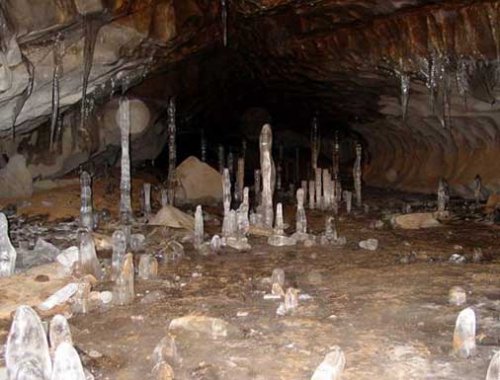
Stalactites and stalagmites form in Sumganskaya Cave through the slow deposition of calcium carbonate from dripping mineral-rich water. Stalactites grow downward from the ceiling where water droplets leave behind tiny rings of calcite, while stalagmites build upward from the floor beneath them; where the two meet over millennia they fuse into columns. Alongside these calcite formations, the cave's cold zones produce large ice stalagmites, a feature less common in warmer cave systems.
Ice Crystals and Atmogenic Formations
The cave produces beautiful crystals of atmogenic origin on the walls of its grottoes, formed as warm air is displaced through the cave and moisture freezes onto the cold rock surfaces. These atmogenic crystals are created from airborne water vapour rather than dripping water, distinguishing them from ordinary calcite formations. Together with the large ice stalagmites that appear in many areas, they give the colder galleries of Sumganskaya Cave a striking, glittering appearance.

Cave Temperature and Climate
The temperature regime of Sumganskaya Cave is unusual and is dictated by the structure of the system itself, particularly its deep entrance shaft. Cold air flows down the shaft in winter and strongly supercools the lower galleries, producing a thermal pattern very different from caves with a more stable internal climate. This cold-trap behaviour is the reason the cave can maintain a permanent glacier despite lying in a region with warm summers.
Winter and Summer Temperature Regimes
In February, the air temperature in parts of Sumganskaya Cave drops to around −10°, and the difference between the coldest and warmest sections of the cave reaches 15.5°. In summer the temperatures rise somewhat, ranging from about 1° to 5.8° in different parts of the cave during August. This wide seasonal and spatial range is a direct consequence of the cave acting as a reservoir for cold winter air.
Air Circulation Throughout the Seasons
A defining peculiarity of Sumganskaya Cave is its intensive air circulation in all seasons of the year. The vertical shaft and connecting wells drive continuous airflow, drawing cold air downward in winter and allowing warmer air to displace through the system in summer. This circulation is what carries the moisture that freezes into atmogenic crystals and what keeps the lower galleries persistently chilled.
Ice Accumulation and the Permanent Glacier
The significant supercooling of Sumganskaya Cave causes the accumulation of large masses of ice in its lower galleries. The most notable result is the 160-metre glacier that forms in one of the galleries descending to the underground river and persists in the Naklonniy Grotto throughout the year. Because winter cold is trapped faster than summer warmth can dissipate it, the ice survives the warm season and renews each winter, sustaining one of the few permanent cave glaciers in the Ural Mountains.
Cave Discovery and History
Sumganskaya Cave was systematically explored and documented by Soviet-era speleologists who mapped its multi-level structure and recorded its unusual climate. As the largest cave in the Urals, it became a focus for caving expeditions seeking to chart its 8,000 metres of passages and measure its 135-metre depth. The cave's documented dimensions and temperature records stem from these expedition surveys rather than from any developed tourist operation.
Naming and Local Folklore
The name Sumgan-Kutuk comes from the local Bashkir language, with "Kutuk" referring to a well or pit — a fitting description for a cave that begins with a 70-metre vertical shaft. The dual naming, Sumganskaya in its Russified form and Sumgan-Kutuk in the local tradition, reflects the cave's place in the regional landscape of Bashkortostan. The pit-like entrance has long made the cave a notable landmark in Burzyansky District folklore.
Exploration Expeditions
Exploring Sumganskaya Cave is a vertical caving expedition rather than a guided tour, requiring descent of the 70-metre entrance shaft and the internal wells of 30 to 35 metres. The full system of 8,000 metres of galleries spread across two levels means thorough exploration can occupy several days of underground work. The combination of vertical pitches, an underground river, and a permanent glacier makes the cave a demanding objective even for experienced speleologists.
Notable Expeditions and Duration
Surveying the complete Sumganskaya system involves rigging ropes down the entrance shaft and the connecting wells, then traversing both the upper galleries at 75 metres and the lower river level at 110 metres. Expeditions must account for the supercooled lower galleries and the permanent ice of the Naklonniy Grotto, which demand cold-weather equipment even in summer. The scale of the labyrinth and its vertical complexity mean expeditions are planned around multi-day underground stays.
Archaeological Excavations and Findings
Sumganskaya Cave is valued primarily as a geological and speleological monument rather than as a major archaeological site, in contrast to some other famous Ural caves. The most renowned prehistoric cave in the region is the nearby Shulgan-Tash Cave, also called Kapova Cave, located in the Shulgan-Tash Nature Reserve near the Belaya River in the same Burzyansky District. Shulgan-Tash is celebrated for its Paleolithic rock paintings of prehistoric animals and geometric signs, attributed to Cro-Magnon peoples and studied by researchers such as Otto Bader and Alexander Ryumin.
Cave Difficulty Rating and Safety Classification
Sumganskaya Cave is a technically difficult vertical cave suited only to trained and equipped speleologists. Its 70-metre entrance shaft, internal wells, underground river, and supercooled glaciated galleries combine to place it well beyond the reach of casual visitors. Anyone entering must be prepared for vertical rope work, cold temperatures that can fall to around −10°, and the navigational challenge of an 8,000-metre labyrinth on two levels.
Caving Equipment and Preparation
Safe exploration of Sumganskaya Cave requires full vertical-caving equipment and cold-weather gear because of its shafts, wells, and permanent ice. Essential preparation includes:
- Single Rope Technique gear — harness, ascenders, descenders, and rigged ropes for the 70-metre shaft and 30–35-metre wells.
- Helmet with a reliable headlamp and backup lighting for the dark, multi-level galleries.
- Insulated and waterproof clothing to cope with temperatures near freezing and the underground river.
- Boots suitable for ice and wet rock, given the permanent glacier in the Naklonniy Grotto.
- Navigation aids and a clear survey of the upper and lower levels before descent.
Safety Risks and Past Rescue Attempts
The principal hazards in Sumganskaya Cave are the vertical pitches, the cold-trapped lower galleries, and the underground river, all of which demand respect and proper technique. Falls on the shaft or wells, hypothermia in the supercooled passages, and flooding linked to the underground watercourse are the realistic dangers caving teams plan against. Deep and vertical caves elsewhere illustrate these stakes — the world's deepest known cave, Veryovkina Cave in the Gagra mountain range of Abkhazia, Georgia, has been the site of flood incidents and difficult rescue situations that underscore why thorough preparation is essential.
Cave Photography and Documentation Tips
Photographing Sumganskaya Cave is challenging because of its darkness, scale, and cold, ice-filled galleries, so success depends on bringing portable lighting and protecting equipment from condensation. Documenting the large grottoes, the 160-metre glacier, the ice stalagmites, and the atmogenic crystals requires off-camera flashes or powerful lamps to reveal the size of the chambers. Cave photographers such as Robbie Shone, whose underground work has appeared in National Geographic, have demonstrated how careful lighting and long exposures can capture the true depth and texture of cave environments like these.
Key Facts and Statistics
The core measurements that define Sumganskaya Cave, the largest cave system in the Ural Mountains, are summarised below:
- Other name: Sumgan-Kutuk
- Location: Western slope of the Kibiz Ridge, ~12 km west of Maksyutov, Burzyansky District, Bashkortostan, Russia
- Protected area: Bashkiriya National Park
- Total length: 8,000 metres
- Depth: 135 metres
- Volume: ~200,000 cubic metres
- Entrance shaft: 70 metres deep
- Internal connecting wells: two wells of 30–35 metres
- Main levels: upper at 75 metres, lower at 110 metres
- Underground river: ~5 metres wide, ~2 metres deep, in the central lower gallery
- Permanent glacier: ~160 metres long, in the Naklonniy Grotto, year-round
- February temperature: down to around −10°, with a 15.5° spread across the cave
- August temperature: 1° to 5.8° in different sections
For more on cave systems, formations, and underground exploration, browse the Speleology section, or explore related Travel articles for destinations and trip planning.