Sukhoatinskaya Cave: A Silurian Limestone Wonder Near the Atya River in Russia
 libre
libre
Sukhoatinskaya Cave is a 1,150-metre-long limestone cave on the right bank of the Atya River near the village of Sukhaya Atya in Russia.

Overview of Sukhoatinskaya Cave
Sukhoatinskaya Cave is a horizontal-to-inclined limestone cave whose total surveyed length reaches 1,150 metres. The cave takes its name from the nearby village of Sukhaya Atya and the Atya River, on whose right bank it opens. Most of the cave lies below the modern level of the Atya River, which makes it an unusually water-influenced system, with a stream flowing through its largest chamber.
The cave is best understood as three connected levels, or "storeys," each formed at a different stage in the river's history. Its scale, multi-level structure, and active hydrology make Sukhoatinskaya Cave a significant site for Russian speleology and a recurring subject in cave documentation and exploration literature.
Geographic Location and Setting
Sukhoatinskaya Cave is located in Russia, opening on the right bank of the Atya River close to the settlement of Sukhaya Atya. Its position is tied closely to the river: the cave's upper level corresponds to the first floodplain terrace of the Atya, while the bulk of the system descends below the river's present water level.
Location on the Atya River
The cave entrance sits on the right bank of the Atya River, and the river governs the cave's vertical structure. The uppermost storey is confined to the first floodplain terrace of the Atya, meaning the highest passages were shaped when the river ran at a higher level than it does today. As the river cut down over time, lower levels of the cave were exposed and developed.
Proximity to Sukhaya Atya Village
The cave lies near the village of Sukhaya Atya, from which it draws its name. This proximity to a named settlement is typical of documented Russian cave sites, where the nearest village serves as the reference point for the cave's location and naming. The village provides the most practical orientation marker for anyone trying to locate the cave in the surrounding terrain.
How to Reach the Cave
Reaching Sukhoatinskaya Cave means first navigating to the village of Sukhaya Atya and then following the Atya River to its right bank, where the horizontal entrance slit is found. Because the cave is a natural, undeveloped site rather than a commercial show cave, visitors should note the following practical points:
- Access: The cave is a wild cave with no developed infrastructure, ticketing, or fixed operating hours.
- Lighting: There is no artificial lighting; reliable headlamps and backup light sources are essential.
- Safety: Much of the cave lies below the river level and contains an active stream, so water levels and flooding risk must be considered before entering.
- Guidance: No formal guided tours operate here; local speleological clubs are the usual source of experienced guides.
Geology and Formation
Sukhoatinskaya Cave formed in Silurian limestones through the dissolution of soluble carbonate rock by water — the classic process behind karst caves. The cave's three-level layout records the gradual downcutting of the Atya River, with each storey marking a former position of the local water table.
Silurian Limestone Origins
The host rock of Sukhoatinskaya Cave is Silurian limestone, a carbonate sedimentary rock laid down hundreds of millions of years ago. Limestone is highly susceptible to dissolution by slightly acidic groundwater, which is why so many of the world's large cave systems — including this one — develop within it. The presence of limestone blocks and clay on the cave floor is a direct consequence of this carbonate setting.
Cave Formation Processes
The cave developed primarily through karst processes, in which water charged with dissolved carbon dioxide slowly dissolves limestone along joints and bedding planes to open passages. At Sukhoatinskaya Cave, this karst dissolution was closely linked to the Atya River: as the river progressively lowered its bed, it controlled where and how each level of the cave formed. The result is a stacked, three-storied geometry in which the highest passages are the oldest and the lowest, water-filled passages are the youngest.
Physical Characteristics and Layout
Sukhoatinskaya Cave consists of several grottoes connected by horizontal and inclined passages, arranged over three storeys and totalling 1,150 metres in length. Its defining features are a long, low entrance slit, a very large central chamber called the Resonance Grotto, and an underground stream.
The Cave Entrance
The entrance to Sukhoatinskaya Cave is a horizontal slit measuring 15 metres long and 2.5 metres high. This wide, low opening is characteristic of caves whose entrances follow a horizontal bedding plane in the limestone, and it leads inward to the system of interconnected grottoes.
Three-Storied Structure
Sukhoatinskaya Cave is a three-storied cave, meaning its passages are organised into three distinct vertical levels. The upper floor is confined to the first floodplain terrace of the Atya River, fixing the top level to a former river stage. Most of the cave, however, lies below the modern level of the river, so the lower storeys sit beneath the present water table. This vertical layering is the cave's most distinctive structural feature and a direct record of the river's downcutting history.
Resonance Grotto and Other Grottoes
The largest chamber in Sukhoatinskaya Cave is the Resonance Grotto, which measures 120 metres long and 80 metres wide. Beyond this central grotto, the cave contains several additional grottoes connected to one another by horizontal and inclined passages. Together these chambers and connecting passages make up the navigable interior of the cave.
Underground Stream and Hydrology
A stream flows through the Resonance Grotto, giving Sukhoatinskaya Cave an active underground hydrology. Because most of the cave lies below the modern level of the Atya River, the system is intimately connected to the river and the local water table. This active water flow shapes the cave environment, transports clay and sediment, and is a key safety consideration, since water levels can change with seasonal river conditions.
Total Length and Dimensions
The total surveyed length of Sukhoatinskaya Cave is 1,150 metres. Its headline dimensions can be summarised as follows:
- Total length: 1,150 metres
- Entrance: horizontal slit, 15 m long and 2.5 m high
- Resonance Grotto: 120 m long and 80 m wide
- Levels: three storeys, with most passages below the modern river level
Cave Formations and Minerals
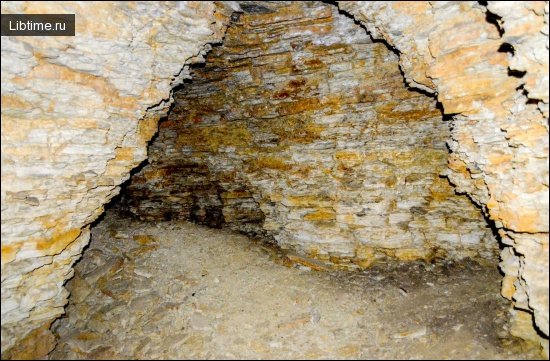
The interior of Sukhoatinskaya Cave is shaped by limestone blocks, thick clay deposits, and concretionary mineral formations. These features reflect both the breakdown of the limestone host rock and the slow chemical deposition of minerals carried by water through the cave.
Concretionary Formations
Sukhoatinskaya Cave contains concretionary formations — mineral masses built up where dissolved carbonate precipitates out of cave water onto surfaces. Such concretions are a direct product of the same water chemistry that dissolves the limestone elsewhere in the cave, recording the slow movement of mineral-laden water through the passages. To understand how these features develop in the wider context of speleogenesis, read more: Cave Formation.
Limestone Blocks and Clay Deposits
The floor of Sukhoatinskaya Cave is covered with blocks of limestone, and in some places it is overlain by a thick layer of clay. The limestone blocks are breakdown material that has fallen from the cave's walls and ceiling, while the clay represents fine sediment deposited by water moving through the system. Together they make up the principal floor cover throughout much of the cave.
How Minerals Are Used
The minerals that form in and around limestone caves like Sukhoatinskaya have practical applications beyond their geological interest. Limestone and its derived minerals are widely used in construction, industry, and agriculture, and cave deposits illustrate the same carbonate chemistry on a small scale. For more information: How minerals are used.
Historical Habitation and Naming
Sukhoatinskaya Cave takes its name from the nearby village of Sukhaya Atya and the Atya River, following the common Russian convention of naming caves after the closest settlement or watercourse. This naming ties the cave firmly to its local geography and to the community that has long used the surrounding land. The use of a village name as the cave's identifier reflects how local people have historically related to and recorded these natural features.
Cave Exploration and Research
Sukhoatinskaya Cave belongs to the broader tradition of Russian speleology, in which caves are surveyed, mapped, and documented by clubs, researchers, and academic institutions. The cave's measured length of 1,150 metres and its detailed three-level description are themselves products of this exploration and documentation work.
Academic Research and Documentation
Academic cave research in Russia is carried out by universities, regional speleological societies, and institutions such as the Russian Academy of Sciences and Moscow State University, which study cave geology, hydrology, and stratigraphy. Documenting a cave like Sukhoatinskaya involves surveying passage dimensions, mapping the connections between grottoes, and recording features such as the underground stream and concretionary formations. This kind of systematic documentation is what allows a wild cave to be described precisely and compared with other sites. You can explore more cave science through the Speleology section.
Cave Photography
Cave photography is a core part of documenting sites like Sukhoatinskaya Cave, capturing the scale of chambers such as the Resonance Grotto and the texture of limestone blocks, clay floors, and concretions. Photographing a wild cave demands portable lighting, since there is no installed illumination, and careful technique to convey depth in total darkness. Good cave photography preserves a visual record of fragile underground environments and supports both research and public understanding of these places.
Visiting and Exploration Resources
Sukhoatinskaya Cave is an undeveloped natural cave, so visiting it differs sharply from touring a commercial show cave with fixed hours, admission fees, and guided tours. Anyone planning to explore it should treat it as a wild caving objective and prepare accordingly:
- No admission or operating hours: as a natural site, there are no tickets, set opening times, or visitor desk.
- Bring your own light: there is no artificial lighting anywhere in the cave.
- Respect the hydrology: with most passages below river level and a stream in the Resonance Grotto, water conditions must be checked before entry.
- Go prepared and ideally guided: experienced local speleologists are the best source of access guidance and safety advice.
For broader articles on travel and the outdoors, see the Travel section, and for more on the science of caves visit the Speleology directory.
Related Caves in Russia and Central Asia
Sukhoatinskaya Cave sits within a wider landscape of significant caves across Russia and Central Asia, several of which are far better known internationally for their geology or archaeology. Cataloguing efforts such as the speleo link directory maintained on showcaves.com by Jochen Duckeck place individual Russian caves in this broader context, and online communities on platforms like Reddit and YouTube frequently discuss them.
Notable caves and cave regions in this part of the world include:
- Denisova Cave — located in the Altai Mountains of Altai Krai, this is one of the most important archaeological sites in the world. It gave its name to the Denisovans, an extinct human population identified through ancient DNA analysis led by researchers including Svante Pääbo at the Max Planck Institute for Evolutionary Anthropology. The cave has also yielded the Altai Neanderthal, the hybrid specimen Denisova 11 (a first-generation cross between Neanderthals and Denisovans), prehistoric fauna remains, ancient figurines and decorative bone artifacts, and Paleolithic tools, making it central to debates on interbreeding between Homo sapiens sapiens, Neanderthals, and Denisovans, and to wider questions touching Homo longi, the Ust'-Ishim man, and the Ancient North Eurasian woman.
- Dakhovskaya Cave — situated near Dakhovskaya village in Adygea, southern Russia, this cave is part of the karst landscape of the region and has its own record of archaeological interest.
- Pinega area caves — the Pinega region of northern Russia is famous for its extensive gypsum karst cave systems.
- Kugitangtau caves — the Kugitangtau (Köýtendag) range in Turkmenistan hosts notable Central Asian cave systems within a limestone escarpment landscape.
Discoveries at sites like Denisova Cave illustrate how excavation history, dating methods and stratigraphy, paleoclimate research using pollen, and the study of extinct fauna such as the horse species Equus ovodovi can transform a single cave into a globally significant scientific record — a reminder of the research potential that the careful documentation of caves like Sukhoatinskaya helps support.