Mlynki Cave: Ukraine's Spectacular Gypsum Cave System
 libre
libre
Mlynky Cave is a horizontal gypsum labyrinth located near the village of Mlynky, roughly 8 km south-southeast of the town of Chortkiv in Ternopil Oblast, western Ukraine. The cave formed in Neogene gypsums overlain by chemogenic limestones of the same age, and today its mapped passages extend 14,120 metres, making it one of the major show caves of the Ternopil region. Two side-by-side entrances open among the limestone outcrops crowning a hilltop and lead directly into the large Vestibule Grotto.

Where is Mlynky Cave and how do you get there?
Mlynky Cave sits beside Mlynky village in Chortkiv Raion, Ternopil Oblast, with the nearest town being Chortkiv about 8 km to the north-northwest. The cave belongs to the dense cluster of gypsum karst caves of the Podillia uplands in western Ukraine, a region that also contains the world-famous Optimistic Cave and Atlantida Cave. Visitors usually reach the cave by road via Chortkiv, then continue the short distance to Mlynky and the wooded hilltop where the twin entrances are found.
The region around Chortkiv district is one of the richest cave landscapes in Europe, and Mlynky is among the most accessible of these labyrinths for guided tourism. Travellers exploring Ternopil Oblast natural attractions often pair a visit here with the nearby gypsum caves, since the limestone-capped hills concentrate several systems within a small area.
Geological formation and features
Mlynky Cave was created by karst processes dissolving a thick bed of Neogene gypsum that lies beneath a protective cap of chemogenic limestone. This gypsum was laid down when the ancient Sarmatian Sea covered Podillia, and the slow circulation of groundwater along joints and bedding planes carved the maze of interconnecting passages that characterise the cave today. Because the limestone roof is harder than the gypsum below, it has preserved the labyrinth as a broadly horizontal network rather than allowing it to collapse.
Neogene gypsum and limestone composition
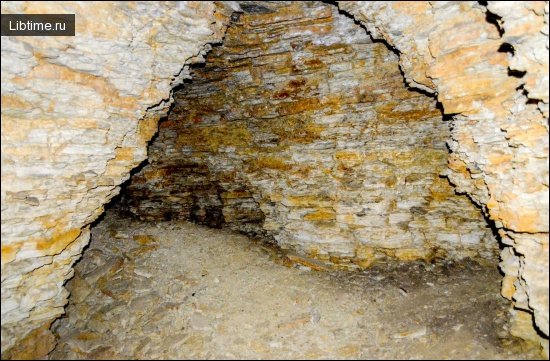
The cave's walls are predominantly secondary gypsum, while the ceilings in several grottoes are formed of overlying carbonate rocks. Gypsum karst forms readily because gypsum is far more soluble in water than limestone, which is why Ternopil Oblast — sitting on these Neogene gypsum beds deposited by the Sarmatian Sea — hosts the largest gypsum caves in the world. The interplay of soluble gypsum below and resistant limestone above gives Mlynky its distinctive blocky grottoes roofed in carbonate stone.
Cave length and dimensions
The total surveyed length of Mlynky Cave is 14,120 metres of passages, galleries and grottoes arranged as a horizontal labyrinth. Among Ukrainian gypsum caves this places Mlynky in the larger class, though it remains far shorter than neighbouring Optimistic Cave, the longest gypsum cave on Earth. The morphometric character is overwhelmingly horizontal: the system spreads sideways through a single gypsum stratum rather than descending in vertical shafts, which keeps the physical demands moderate compared with deep alpine caves.
Cave layout and internal structure
The internal structure of Mlynky Cave divides into a network of narrow connecting passages opening into named grottoes and broad galleries, branching from the Vestibule Grotto toward distinct eastern and western districts. The eastern part is defined by large grottoes and wide galleries, while the western part consists of tighter passages lavishly decorated with stone flowers and coloured secondary gypsum. This contrast between roomy eastern halls and ornate western corridors is the defining feature of the cave's geography.
The Vestibule Grotto and entrances
The Vestibule Grotto is the large entry chamber reached immediately from the two side-by-side entrances set among the limestone outcrops on the hilltop. From this grotto the cave's passage system fans out, with one route leading east into the big halls and another heading west into the decorated corridors. The twin entrances make the Vestibule Grotto the natural assembly point where guided groups gather before descending into the labyrinth.
The Big Grotto
The Big Grotto is the largest chamber in Mlynky Cave, measuring 130 metres long and 7–8 metres high, and lies in the eastern part of the system. Its floor and walls are piled with fantastically heaped blocks of gypsum, giving the hall a dramatic, chaotic appearance. Its scale makes the Big Grotto one of the highlights of any tour through the eastern galleries.
The Silver Ringing Grotto
The Silver Ringing Grotto is notable because its ceiling is composed of carbonate rocks rather than gypsum, a feature that sets it apart from most chambers in the cave. The name reflects the resonant quality of the chamber, where the carbonate roof contrasts with the gypsum below. It is one of the named landmarks visitors look for while moving through the labyrinth.
Eastern and western galleries
The eastern galleries of Mlynky Cave hold the large grottoes and wide passages, including the Big Grotto, while the western galleries are narrower and far more heavily decorated with mineral formations. From the Vestibule Grotto a system of narrow passages connects these two districts. The eastern district rewards visitors with volume and spaciousness; the western district rewards them with the cave's most delicate gypsum ornamentation, making the two halves complementary experiences within a single trip.
Cave passages and navigation challenges
Navigation through Mlynky Cave is challenging because the labyrinth consists of many similar-looking interconnecting passages, some of which narrow to crawls between larger grottoes. Several corridors are partially filled with loess-like loam containing small fragments of secondary gypsum and pieces of limestone, which can make the floor uneven and the going low. Because the layout is a true maze, visitors must always move with an experienced guide who knows the routes, as it is easy to lose orientation among the repeating gypsum walls.
Crystal formations and mineral deposits
The mineral wealth of Mlynky Cave lies in its secondary gypsum, which decorates the western passages as stone flowers, crusts and multicoloured deposits. These secondary gypsum crystals grew slowly from mineral-rich films of water long after the passages themselves were dissolved, and they range in colour from translucent white to amber and grey tones. It is this ornamentation, rather than classic dripstone, that gives Mlynky its reputation as a crystal cave.
Secondary gypsum and stone flowers
Stone flowers are the signature formation of Mlynky Cave: fanciful, petal-like clusters of secondary gypsum crystals that bloom from the walls and ceilings of the narrow western passages. Unlike the stalactite formations of limestone caves, these gypsum blooms develop through crystallisation from thin water films and capillary seepage, producing intricate radiating shapes. Coloured deposits of secondary gypsum accompany them, painting the corridors in subtle bands of white, yellow and rust.
Crystal preservation and conservation
Preserving the gypsum crystals of Mlynky Cave depends on visitors never touching the formations, because gypsum is soft and the delicate stone flowers break or dull at the slightest contact. The skin's natural oils and humidity changes can permanently damage the crystals, so conservation rules ask groups to keep strictly to established routes and avoid brushing against decorated walls. Responsible caving keeps these slow-growing formations intact for future visitors, since a crystal cluster broken in seconds may have taken centuries to form.
Environmental conditions inside the cave
Conditions inside Mlynky Cave are stable, dry and cool year-round, which is typical of an enclosed gypsum labyrinth insulated from surface weather. The cave is described as dry overall, though the air is highly humid, and the passages hold a constant cool temperature regardless of the season outside. These steady conditions are part of what makes the underground environment so different from the world above.

Temperature and humidity
The temperature inside Mlynky Cave stays at a constant 9–10 °C, while relative humidity ranges from 88 % up to 100 %. This means visitors should dress warmly even in summer, since the cave never warms with the seasons, and should expect damp air despite the dry floors. The combination of cool air and very high humidity is a defining environmental signature of the gypsum labyrinth and influences both clothing choices and how long groups stay underground.
Wildlife and bat species
The most important wildlife in Mlynky Cave are bats, which use the stable, humid, predator-free passages as a roosting and hibernation habitat. Caves of this kind across Ternopil Oblast shelter colonies of bats that depend on the constant temperature and undisturbed darkness, which is why their habitat is protected. Visitors may also notice patches of fungal growth on organic debris and timber within the cave, a natural part of the underground ecosystem that should be left undisturbed.
Because bats are highly sensitive to disturbance during their winter rest, seasonal access restrictions can apply when colonies are hibernating, and tours are managed so that lights and noise do not rouse the animals. Protecting the bat habitat is one of the main reasons the cave is entered only with guides and along controlled routes.
Discovery history and exploration timeline
Mlynky Cave was systematically explored and surveyed by Ukrainian speleologists who pushed and mapped its passages through the second half of the twentieth century, gradually building the picture of a 14-kilometre labyrinth. The cave became a focus for the Chortkiv club of speleologists Krystal and the wider Ternopil section of speleology, whose members documented its grottoes, named its landmarks and extended the known survey. Their decades of work turned a little-known hilltop opening into one of the best-documented gypsum systems in the region.
The gypsum caves of Podillia hold a celebrated place in the history of speleology: nearby Optimistic Cave entered the Guinness Book of World Records as the longest gypsum cave in the world, and the region drew the attention of pioneering cave explorers across Europe. Ongoing speleological research continues to refine the maps of Mlynky and its neighbours, with findings shared through scientific platforms such as ResearchGate.
Cave diving and caving expeditions
Caving expeditions in Mlynky concentrate on horizontal exploration, surveying and crystal documentation rather than vertical descents, because the system is a flat labyrinth rather than a deep shaft cave. Teams of speleologists work the passages to refine the map, study the secondary gypsum, and connect newly found sections to the known network. For sports speleology and caving enthusiasts, Mlynky offers technical route-finding and tight passages that reward experience, and the surrounding district hosts caving meets where competitors test navigation and endurance underground.
Visiting Mlynky Cave
Mlynky Cave is visited on guided excursions that range from short weekend tours to longer expeditions deeper into the labyrinth, always accompanied by an experienced guide. Tours can be arranged for organised groups or as individual trips, with the route and duration matched to the visitors' fitness and experience. Because the cave is a genuine maze, independent entry is not permitted — every visit is led along established routes.
Cave exploration and spelunking adventure
A spelunking adventure in Mlynky takes visitors through a mix of spacious grottoes and tight, low passages, offering a real underground exploration experience rather than a paved tourist walkway. Routes vary in difficulty, so groups can choose an easier loop through the eastern galleries or a more demanding traverse into the narrow decorated western corridors. The cave's horizontal layout keeps the physical challenge manageable while still delivering the thrill of moving through a true natural labyrinth.
Children and family cave tours
Family-friendly tours of Mlynky Cave follow the easier, wider sections so that children can experience the underground world safely, while more strenuous crawling routes are reserved for fit adults. Guides adapt the pace and the chosen passages to the group, making shorter family excursions possible without entering the tightest squeezes. Parents should still dress children warmly for the constant 9–10 °C temperature and ensure everyone is comfortable with darkness and enclosed spaces before going underground.
Equipment rental and what to bring
Essential equipment for Mlynky Cave includes a helmet, a reliable headlamp with spare batteries, sturdy footwear and warm, durable clothing you don't mind getting muddy. Visitors should bring or rent the following:
- Helmet to protect against low ceilings and gypsum blocks
- Headlamp plus a backup light source and spare batteries
- Warm layers suited to a constant 9–10 °C and very high humidity
- Gloves and tough trousers for crawling through loam-filled passages
- Closed, grippy footwear for uneven, slippery floors
- Water and a small snack for longer routes
Basic caving gear can typically be rented locally through the tour operators, so visitors without their own equipment can still join an excursion.
Cave photography and documentation
Photographing Mlynky Cave requires bringing your own light, since the labyrinth is in total darkness and the gypsum crystals only reveal their colour under artificial illumination. The most effective technique is long-exposure photography on a tripod, painting the grotto with a headlamp or off-camera light during the exposure to bring out the texture of the stone flowers and gypsum walls. Documenting the cave responsibly means avoiding any contact with formations while setting up shots and keeping lighting brief near roosting bats, so that photography records the cave without harming it.
Accommodation at Speleohouse hostel
Visitors staying overnight near Mlynky Cave can lodge at the Speleohouse hostel, a base catering specifically to cavers and tourists exploring the gypsum labyrinths of the region. Speleohouse — also known locally as Speleokhata — provides simple, practical accommodation close to the cave, making it easy to start a multi-day caving trip without a long commute. Staying on site also lets groups coordinate with guides and equipment more conveniently than travelling in from Chortkiv each day.
Dietary options and meal planning
Meal planning at the Speleohouse hostel is straightforward, with hearty food suited to the energy demands of a day underground, and dietary preferences can usually be arranged in advance. Because caving burns considerable energy in cool conditions, warm meals and hot drinks before and after excursions are an important part of the stay. Visitors with specific dietary needs should mention them when booking so the hostel can plan accordingly.
Safety rules and visitor ethics
The core safety rule for Mlynky Cave is that no one enters without an experienced guide, because the labyrinth's repeating passages make it dangerously easy to become lost. Beyond guided entry, safe and ethical caving in Mlynky rests on a few principles:
- Always stay with your guide and group and keep to established routes
- Never touch, break or remove gypsum crystals or stone flowers
- Carry at least two independent light sources
- Do not disturb bats, especially during hibernation
- Take all litter out with you and leave no marks
- Move carefully on uneven, loam-covered floors to avoid slips
These rules protect both the visitors and the cave, ensuring the fragile underground environment survives repeated tourism.
Cave conservation status
Mlynky Cave is a protected natural landmark, valued both as a rare gypsum karst wonder and as a wildlife habitat for bats, which is why access is controlled and routes are managed. Conservation here focuses on preventing damage to the soft secondary gypsum formations and on shielding bat colonies from disturbance, so seasonal restrictions and guide-led entry are part of the protection regime. Treating the cave as a fragile, finite natural monument — not a renewable attraction — is the ethic that keeps Mlynky's crystals and wildlife intact.
Customer reviews and testimonials
Visitors to Mlynky Cave consistently describe the experience as a memorable underground adventure, praising the variety between spacious grottoes and intricately decorated crystal passages. Many reviews highlight the knowledge of the local guides, the genuine sense of exploration compared with more commercial show caves, and the striking stone flowers of the western corridors. Families note that easier routes made the cave accessible for children, while keen cavers value the tighter passages and the chance to see a true horizontal labyrinth up close.
Nearby karst caves and other regional destinations
Mlynky Cave sits within a remarkable cluster of gypsum caves in Ternopil Oblast, so visitors often combine it with nearby systems such as Optimistic Cave, Atlantida Cave and Verteba Cave, the last famous for its archaeological significance. The wider region of western Ukraine offers some of the most important cave tourism destinations in Europe, and transfers between caves are short enough to fit several into one trip. For travellers building an itinerary around these underground wonders, exploring more guides in the Speleology section and the broader Travel collection helps in planning a full caving holiday.
Far to the south, in a quite different setting, the North Crimean speleological province offers a contrasting type of karst: on the southern coast of the Tarkhankut peninsula near Otlesh Bay, twelve karst caves up to 100 m long have been investigated. These were formed in Sarmatian limestones at approximately sea level, between 2 and 10 m, and contain water-mechanical and water-chemogenic formations. Unlike the dry gypsum labyrinth of Mlynky, some of these coastal caves are completely or partially flooded by sea water, illustrating how varied Ukraine's cave heritage is across its regions.