Kulogorskaya Cave in Pinega: Exploring Lower Permian Gypsum Caves and Ice Formations
 libre
libre
Kulogorskaya Cave is a gypsum cave system located near the village of Kulogory, about 5 km northeast of the town of Pinega in the Arkhangelsk region of Russia. It formed in gypsum and anhydrite of the Lower Permian and ranks among the longest sulfate caves in the Pinega karst district, with a surveyed length exceeding 1 km. The cave is known for its complex network of grottoes, underground lakes, and persistent ice formations in its colder sections.
Where is Kulogorskaya Cave located?
Kulogorskaya Cave lies in the Pinega district of Russia's Arkhangelsk region, on the left bank of the Pinega River near the settlement of Kulogory, roughly 5 km northeast of the town of Pinega. The cave belongs to one of the most concentrated gypsum karst areas in the world, where dozens of caves have developed within the Lower Permian sulfate deposits that outcrop along the river valleys.
The surrounding landscape is a classic gypsum karst terrain marked by sinkholes (dolines), blind valleys, disappearing streams, and collapse depressions. Surface water repeatedly sinks underground and re-emerges as springs, a hydrological pattern typical of soluble sulfate bedrock. This setting places Kulogorskaya among the Pinega and Arkhangelsk karst cave systems that have drawn speleologists to northern Russia for decades.
How to get there
Reaching Kulogorskaya Cave begins with travel to the town of Pinega, the main settlement of the district, after which the village of Kulogory lies a short distance to the northeast. Visitors typically approach from Arkhangelsk along regional roads toward Pinega, then continue to the Kulogory area near the riverbank where the cave entrances open in the gypsum outcrops. Because gypsum caves are prone to collapse and flooding, entry should only be attempted with experienced guides and proper caving equipment.
How did Kulogorskaya Cave form?
Kulogorskaya Cave formed through the dissolution of soluble sulfate rocks by circulating groundwater, a process known as speleogenesis. In gypsum and anhydrite terrains, water moving along bedding planes and fractures dissolves the rock far faster than it does in limestone, producing extensive cave passages over relatively short geological timescales. The speleogenesis of Kulogorskaya reflects the broader behaviour of gypsum karst, studied internationally by researchers such as Alexander Klimchouk and Derek C. Ford.
Gypsum and anhydrite of the Lower Permian
The cave developed within gypsum and anhydrite beds of the Lower Permian, sulfate rocks deposited in shallow evaporite basins hundreds of millions of years ago. Gypsum (calcium sulfate dihydrate) and anhydrite (its anhydrous form) are highly soluble, which makes them ideal hosts for rapid karst development. The Pinega gypsum sequence is among the thickest and most cave-rich sulfate formations in Europe.
Dissolution and leaching of sulfate rocks
Rapid leaching of the sulfate rocks under conditions of abundant moisture, combined with the low load-bearing capacity of the cave roof, drives the continual enlargement and reshaping of Kulogorskaya Cave. Gypsum dissolves readily even in cold water, and the dissolution rate is far higher than in carbonate rocks where carbon dioxide dynamics in cave streams govern the slower solution of limestone. This high solubility explains why gypsum caves like Kulogorskaya extend quickly but are also short-lived and structurally unstable compared with limestone systems.
The chemistry of sulfate dissolution differs fundamentally from carbonate karst. In limestone caves, dissolved carbon dioxide forms carbonic acid that slowly attacks the rock, so dissolution rates depend strongly on CO₂ concentration in the cave streams. In gypsum, the mineral dissolves directly into undersaturated water without needing acid, allowing passages to widen rapidly wherever flowing water contacts fresh rock surfaces.
Caves in non-karst and sulfate rocks
Kulogorskaya belongs to the family of caves formed in highly soluble sulfate rocks rather than in classic limestone karst, and it sits within a wider spectrum of cave types that includes non-karst settings. Caves also form in rocks that do not dissolve readily — sandstone and granite caves develop largely through erosion and weathering, while pseudokarst features such as lava tube cave systems form when molten rock drains from beneath a solidified crust. Hypogene speleogenesis, where caves are dissolved by deep rising waters rather than surface infiltration, accounts for another major group of cave systems across varied geological settings.
Among soluble rocks, the world's longest gypsum caves are dominated by the systems of Ukraine. Optymistychna in Ukraine is the longest gypsum cave on Earth, with surveyed passages exceeding 260 km, and several other giant maze caves occur in the same Ukrainian gypsum belt. Karst also develops in salt and other evaporites, but gypsum and carbonate rocks host the overwhelming majority of the world's documented cave length.
What is the structure and layout of Kulogorskaya Cave?
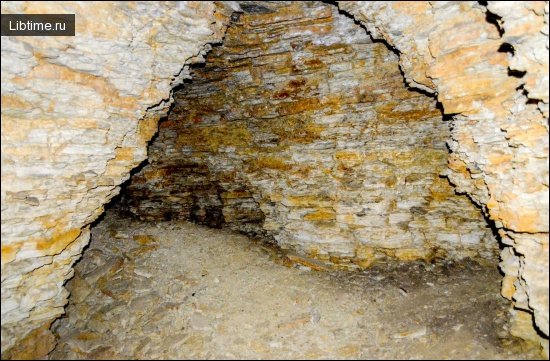
Kulogorskaya Cave is a complex system of underground grottoes and connecting passages developed broadly at the same hypsometric level, giving it a maze-like horizontal plan typical of gypsum caves. Almost everywhere the floor is covered with a thick layer of clay or strewn with collapse blocks, reflecting both the insoluble residue left by dissolved gypsum and the frequent roof falls that reshape the passages.

Cave length and measurements
The total surveyed length of Kulogorskaya Cave is 1,028 meters — about 0.64 miles — making it one of the more substantial gypsum caves of the Pinega district. Cave length is measured by surveyors who tape or use laser rangefinders to record the distance between survey stations along every passage, then sum these legs to produce the total. Depth is reported separately as the vertical difference between the highest and lowest surveyed points; gypsum caves like Kulogorskaya tend to be shallow and horizontal, with limited vertical relief compared with the deep limestone systems of the Caucasus or the Vercors in France.
Grottoes of the cave
Kulogorskaya Cave contains 22 grottoes — enlarged chambers connected by narrower passages — distributed through the system at roughly the same level. These grottoes vary considerably in size, and their dimensions are recorded as part of the cave survey.
Shrenk's grotto
Shrenk's grotto is the largest chamber in Kulogorskaya Cave, measuring 30 meters long, 20 meters wide, and 4 meters high. Its broad, low form is characteristic of gypsum cave chambers, where wide spans develop until roof collapse limits further enlargement.
Underground lakes
Seven lakes occupy the lower parts of Kulogorskaya Cave, and their water level coincides with the regional groundwater table, so the lakes rise and fall with the water table outside the cave. The largest of these, in the speleologists' grotto, is about 6 meters long. These lakes make the cave a useful site for studying karst hydrogeology and groundwater tracing, since the relationship between cave water and the surrounding aquifer is directly visible underground.
What is the microclimate inside Kulogorskaya Cave?
The microclimate of Kulogorskaya Cave varies sharply between its sections, with air temperatures ranging from about +2 °C in the western and eastern parts during summer to between −1 °C and −2 °C in the middle section. This cold central zone allows ice to persist year-round, a feature that defines the cave's character. The temperature contrast results from how outside air circulates through the entrances and pools in the colder interior.
Humidity and environmental conditions
Kulogorskaya Cave is very damp throughout, with humidity kept high by the underground lakes, seeping groundwater, and the continual dissolution of gypsum. These saturated conditions, combined with sub-zero temperatures in the central zone, create the specific habitat in which the cave's ice formations grow and survive. High humidity also accelerates the dissolution and collapse that constantly reshape the passages.
What ice formations occur in Kulogorskaya Cave?
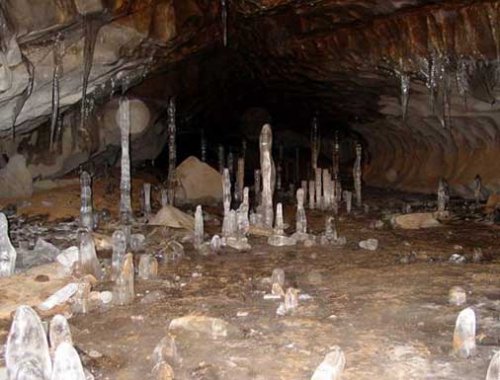
In the cold part of Kulogorskaya Cave, ice formations are widespread (more information: Ice of caves), occurring as ice stalactites and stalagmites, bizarre ice crystals, and an icing crust on the walls. These features form because the central section of the cave holds temperatures below freezing while remaining extremely humid, allowing water vapour and dripping water to freeze into varied shapes.
Ice stalactites and stalagmites
Ice stalactites and stalagmites form in Kulogorskaya Cave where water seeping through cracks freezes on contact with the sub-zero air, building hanging icicles from the ceiling and rising mounds on the floor. These mirror the way mineral stalactites and stalagmites grow in warmer caves, except that the building material is ice rather than calcite. Unlike permanent mineral speleothems, the ice forms can grow and disappear with the seasons.
Icing crust and seasonal changes
The icing crust is especially prevalent in winter, when it forms both by the sublimation of water vapour onto cold surfaces and by the solidification of water flowing down cracks. As temperatures shift through the year, the extent of the crust and the ice stalactites changes, making the cave's frozen decoration a seasonally dynamic feature rather than a fixed one.
Why does Kulogorskaya Cave collapse and change shape?
Kulogorskaya Cave frequently collapses and alters the configuration of its underground cavities because the rapid leaching of sulfate rock undermines a roof that has only limited capacity to support itself. As gypsum dissolves away along bedding planes and fractures, sections of ceiling lose support and fall, shifting passage shapes and opening or sealing connections between grottoes. This instability is inherent to gypsum karst and means the cave's map is never permanent — surveys record a snapshot of a system in constant change.
Who explored and surveyed Kulogorskaya Cave?
Kulogorskaya Cave has been documented through the systematic survey work that produced its 1,028-meter length and its catalogue of 22 grottoes and seven lakes. Cave prospection and survey methodologies in such systems combine mapping of passages, measurement of grottoes and lakes, recording of microclimate, and monitoring of how collapse changes the cavities over time. Updating these surveys matters especially in gypsum caves, where the layout can shift between visits.
Speleological research and researchers
Speleologists studying the Pinega gypsum caves contribute to a body of international research on sulfate karst, a field advanced by figures such as Alexander Klimchouk and Derek C. Ford and shared through bodies like the International Union of Speleology, the International Congress of Speleology, and national groups including the Czech Speleological Society and the NSS in the United States. Czech researchers such as Pavel Bosák and Michal Filippi have published widely on gypsum and karst processes. Much of this scholarship is distributed through platforms such as ResearchGate, operated by ResearchGate GmbH, and the Karst Information Portal maintained with the University of South Florida. You can explore more cave and karst topics in our Speleology section.
How does Kulogorskaya compare with other caves in the region and worldwide?
Kulogorskaya is a mid-sized gypsum cave by global standards, far shorter than the world's longest sulfate systems but a significant member of the Pinega karst. It is dwarfed by Ukraine's Optymistychna, the longest gypsum cave on Earth, and by famous limestone systems such as Lechuguilla Cave in the United States, Postojna Cave and Baradla Cave in Europe, and the Puerto Princesa Underground River. These comparisons highlight how cave length and type vary with the host rock and the speleogenetic process across global regions.
Pinega and Arkhangelsk karst cave systems
Within the Pinega and Arkhangelsk karst, Kulogorskaya is one of many gypsum caves formed in the same Lower Permian sulfate beds, and the district as a whole contains some of the most extensive gypsum karst in Russia. The caves here share the maze-like layouts, underground lakes, ice formations, and frequent collapse that characterise Kulogorskaya, making the area a natural laboratory for studying sulfate speleogenesis. Russia's cave heritage extends from these northern gypsum mazes to the limestone caves of the Caucasus and the renowned Paleolithic sites of the Altai region.
Caves and the human record across regions
Caves matter not only as geological features but as archives of the human past, and the contrast between Kulogorskaya's gypsum mazes and the archaeological caves of southern Siberia illustrates how varied cave science can be. In the Anuy Basin of Altai Krai in Russia, limestone caves such as Denisova Cave, Okladnikov Cave, and Chagyrskaya Cave have yielded some of the most important Pleistocene hominin discoveries in the world. These sites lie within the broader Altai-Sayan region that has produced a dense record of Paleolithic occupation.
Excavations at Denisova Cave, advanced by Anatoly P. Derevianko and following the pioneering work of Alexey Okladnikov, recovered remains whose mtDNA sequencing at the Max Planck Institute for Evolutionary Anthropology revealed a previously unknown human group. At nearby Chagyrskaya Cave and Okladnikov Cave on the Sibiryachikha River, archaeologists documented Neanderthal occupation associated with the distinctive Sibiryachikha culture and a Mousterian stone tool assemblage. The lithic industry, faunal remains reflecting Neanderthal diet and hunting behaviour, and stratified Paleolithic layers dated by radiocarbon and other methods together trace the eastern distribution and migration of Neanderthals deep into Asia, from their core range across France, Spain, Italy, Germany, Switzerland, the Caucasus, and Syria.
Data sources and references
The figures for Kulogorskaya Cave — its 1,028-meter length, 22 grottoes, seven lakes, and microclimate readings — come from speleological surveys of the Pinage karst region, and readers seeking primary literature can consult karst and speleology databases that compile such records. Scientific cave data is gathered in resources such as the Karst Information Portal and shared through research networks including ResearchGate, while national and international speleological organisations publish survey results and proceedings. For more articles across science, nature, and travel, visit our homepage or browse the Travel section, and use Contact us for questions about this material.