Discover Kryvchenska Crystal Cave: A Gypsum Wonder in Ukraine's Ternopil Region
 libre
libre
Kryvchenska Cave, also known as Crystal Cave, is a gypsum karst cave near the village of Kryvche Nizhne in the Ternopil region of Ukraine, famous for its colourful secondary gypsum crystals and its vast network of passages stretching nearly 19 kilometres. It lies about 6 km southeast of the village of Borshchova.
Where is Kryvchenska Cave located?
Kryvchenska Cave is situated near the village of Kryvche Nizhne in the Borshchiv district of the Ternopil region in western Ukraine. The cave sits within a karst massif bounded by two river valleys: the valley of the Tsyganka River — a left tributary of the Nichlava, which itself flows into the Dniester — and the valley of its left tributary, Semenova Creek. In this area the rivers have cut deeply into the landscape, with the depth of the river incision reaching 110 metres.

How was the cave formed?
Kryvchenska Cave formed in Neogene gypsums that reach a thickness of 30 metres. These gypsum beds were laid down transgressively over older Silurian shales and Devonian sandstones, creating the layered geological setting in which the cave developed. The cave belongs to the celebrated gypsum karst region of Podillia, an area in western Ukraine that hosts some of the longest gypsum caves in the world.
How long are the cave's passages?
The passages and grottoes of Kryvchenska Cave reach a total surveyed length of 18,785 metres. This extensive network follows two systems of mutually perpendicular tectonic fissures, one trending northwest and the other northeast. Where these fracture systems intersect most intensely, the cave widens into large grottoes.
What do the passages and grottoes look like?
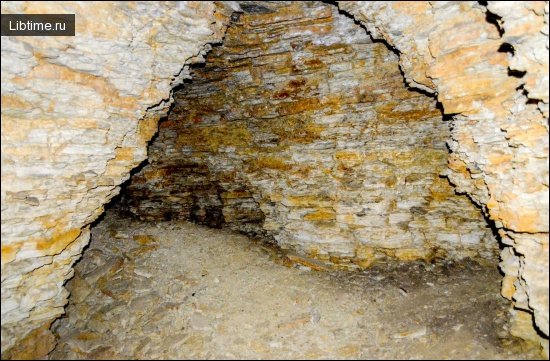
Most passages in Kryvchenska Cave are wide and high, with ceilings shaped into a distinctive "gothic" arch. The grottoes themselves are confined to the zones of most intense fracturing, where the rock has broken apart most extensively. The largest of these is the Grotto of Boulders, which measures 70 m in length, 40 m in width and 7 m in height, and is covered with enormous blocks of fallen rock.
Is the cave wet or dry?
Kryvchenska Cave is a dry cave, though water still drips slowly from its vault. This dripping water is calcium-sulfate water with a mineralization of 2,390 mg/l. In certain grottoes — notably the Stalactitic and Limestone grottoes — the slow movement of this mineral-rich water has produced fringed calcite formations along the walls and ceilings.
What gives Crystal Cave its name?
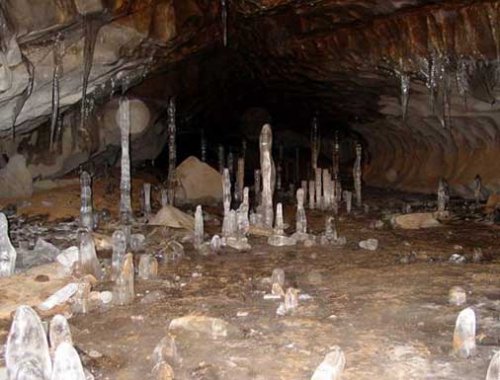
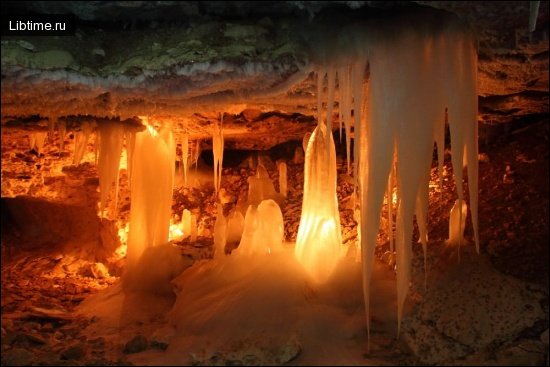
The name Crystal Cave comes from the secondary gypsum crystals that coat the walls of some galleries in colours and sizes that vary throughout the cave. These crystalline encrustations, formed as mineral-laden water deposited gypsum over long periods, are the cave's most striking visual feature and the reason it is celebrated among Podillia's gypsum caves.
What is the climate inside the cave?
The interior climate of Kryvchenska Cave is remarkably stable, which helps preserve its delicate crystal formations. Key conditions inside the cave include:
- Air temperature: a near-constant 10.5–10.8 °C
- Relative humidity: 93–99%
- Air velocity: 0.152–0.183 m/sec
- Oxygen content: 22.3%
- Carbon dioxide content: 0.045%
This constant temperature and high humidity, combined with the gentle airflow, create the stable microclimate typical of deep gypsum caves and make Kryvchenska Cave a notable site for speleologists studying karst environments.