Kizelovskaya Cave in Kizel: Giant Grotto, Ice Stalactites, and Cave Pearls
 libre
libre
Kizelovskaya Cave is a three-storied karst labyrinth on the northern outskirts of the town of Kizel in Russia, formed in Visean limestones of the Lower Carboniferous and stretching roughly 800 meters in total length.

Kizelovskaya Cave: Overview
Kizelovskaya Cave is a horizontal limestone cave system that ranks among the better-known caves of the western Ural foothills. Its defining traits are a multi-level layout, a stable cool microclimate, and mineral and ice formations that change with the seasons. Unlike vertical shaft caves measured by depth, Kizelovskaya is measured by passage length — about 800 meters — and by the number and size of its chambers.
The cave sits within a karst setting where soluble carbonate rock has been dissolved by water over geological time, producing connected voids on three superimposed levels. This combination of accessibility near a town, a labyrinthine plan, and decorative speleothems makes it a frequent subject of regional cave study and amateur exploration.
Location and How to Get There
Kizelovskaya Cave is located on the northern edge of the town of Kizel, which serves as the nearest settlement and the natural staging point for a visit. The cave's position right at the town outskirts means access does not require a long wilderness approach, distinguishing it from remote systems that demand multi-day expeditions to reach.
Geographic Coordinates
The cave lies in the Kizel area of the Perm region in the western Urals of Russia. Visitors planning a trip should confirm precise coordinates and current access points locally, as entrances to karst caves can be affected by water levels, rockfall, and seasonal ice. The town of Kizel provides the road access, parking, and orientation needed before walking to the entrance on its northern outskirts.
Nearest Town: Kizel
Kizel is the closest town to the cave and the reference point for directions, supplies, and local guidance. Founded around historic mining activity in the Ural foothills, the town gives the cave its name and forms the practical base for reaching the northern-outskirts entrance. Travelers typically organize transport, equipment checks, and any local permissions from Kizel before heading to the site.
Geology and Formation
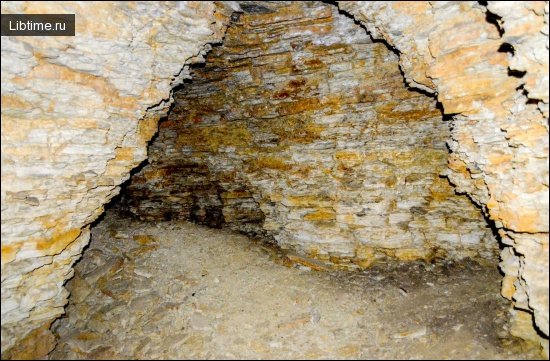
Kizelovskaya Cave was formed by water dissolving carbonate bedrock, the classic process that creates karst cave systems. The host rock is limestone of the Visean stage, and the resulting voids developed into a connected, multi-level labyrinth rather than a single straight passage.
Visean Limestones of the Lower Carboniferous
The cave developed in Visean limestones of the Lower Carboniferous, rocks laid down roughly 330 to 345 million years ago when the region lay beneath warm shallow seas. These carbonate beds are highly soluble in mildly acidic groundwater, which is what allowed an extensive passage network to open up. The age and chemistry of Visean limestone explain both the cave's length and its calcite decorations, since the same dissolved carbonate that hollowed out the passages is later redeposited as speleothems.
Cave Classification and Geological Characteristics
Kizelovskaya Cave is classified as a solutional limestone cave, distinct from caves cut in other rock types. Gypsum caves such as the giant maze systems of Optymistychna Cave and Korolivka in Ternopil Oblast, Ukraine — formed in Miocene Badenian gypsum — develop through dissolution of sulfate rather than carbonate rock, while limestone caves like Kizelovskaya rely on the dissolution of calcium carbonate. This distinction matters for the kinds of formations present: limestone systems favor calcite speleothems, whereas gypsum systems can produce selenite crystals and different mineral textures. Cave sediment analysis and clastic cave deposits in such systems are studied in journals like the Journal of Cave and Karst Studies to reconstruct how passages and chambers evolved.
Cave Layout and Structure
Kizelovskaya Cave is organized as a three-storied labyrinth containing 20 grottoes joined by passages and narrow corridors. The layout is the cave's most distinctive feature, giving it a maze-like character across three vertically stacked levels rather than a simple linear gallery.
The Three-Storied Labyrinth
The cave has three superimposed levels, or storeys, which is unusual and gives Kizelovskaya its labyrinthine reputation. Each level connects to the others through the broader passage system, so exploration involves moving both horizontally between grottoes and vertically between storeys. This stacked structure reflects successive phases of groundwater flow at different elevations over the cave's formation history.
Grottoes, Passages, and Corridors
Kizelovskaya Cave contains 20 grottoes — chamber-like open spaces — connected by a system of passages and narrow corridors. The grottoes vary in size, and the corridors that link them range from comfortable walking passages to tight squeezes. This alternation of open chambers and constricted connectors is what makes the cave feel like a genuine labyrinth and requires careful route-finding to navigate without getting disoriented.
The Giant Grotto
The Giant grotto is the largest chamber in Kizelovskaya Cave, located in the far part of the system and reaching about 25 meters in both length and height. As the climax of a trip through the cave, the Giant grotto rewards the journey through the narrower connecting corridors with a large open space. Its position deep in the cave means reaching it involves passing through much of the labyrinth first.
Cave Dimensions and Physical Measurements
Kizelovskaya Cave measures about 800 meters in total length, spread across its three levels and 20 grottoes. The standout single measurement is the Giant grotto at roughly 25 meters long and 25 meters high. These figures place Kizelovskaya among the substantial caves of its region in passage length, though it is modest compared with the world's largest systems.
| Measurement | Value |
|---|---|
| Total length | ~800 meters |
| Number of grottoes | 20 |
| Levels (storeys) | 3 |
| Giant grotto (length × height) | ~25 m × ~25 m |
| Typical air temperature | ~4°C |
| Icefall (height × width) | 3 m × 1 m |
Microclimate and Air Temperature
The air temperature in most of the grottoes of Kizelovskaya Cave stays nearly constant at about 4°C year-round. This stability is typical of cave interiors, which buffer the swings of surface weather and settle close to the local mean annual temperature. The cool, steady climate of the inner cave contrasts sharply with the entrance zone.
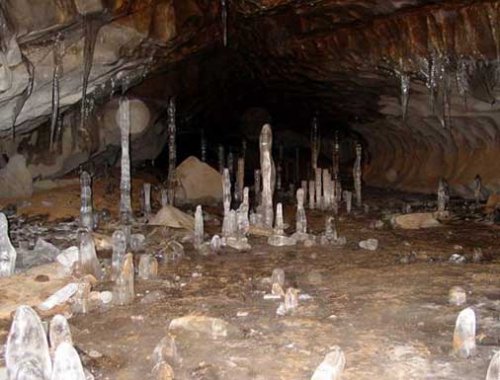
Near the entrance, in the part of the cave closest to the surface, the temperature drops below 0°C in winter. This seasonal freezing zone is what allows ice formations to develop near the mouth of the cave while the deeper grottoes remain frost-free at their steady 4°C. The boundary between the freezing entrance and the constant-temperature interior is a key feature of the cave's microclimate.
Cave Formations and Decorations
The ceiling and walls of Kizelovskaya Cave are decorated in many places with calcite deposits, and the cave also hosts cave pearls and, in winter, transparent ice formations. These decorations fall into two categories: permanent mineral speleothems built from redeposited calcite, and seasonal ice features that appear only in the cold entrance zone.
Calcite Deposits
Calcite deposits cover the ceiling and walls of the cave in many places, formed as carbonate-rich water seeps through the limestone and deposits calcium carbonate. These are the same family of mineral formations — speleothems — that produce stalactites and flowstone in caves worldwide. In caves elsewhere, related calcite forms such as helictites and selenite crystals add further variety, but at Kizelovskaya the prominent permanent decoration is its calcite encrustation.
Cave Pearls
Cave pearls have been found in Kizelovskaya Cave. Cave pearls are small, rounded concretions that form when a drip of mineral-rich water keeps a grain in gentle motion in a shallow pool, allowing concentric layers of calcite to build up around it like a pearl in an oyster. Their presence indicates pools with steady dripping water and is a prized find for cave photographers documenting the system.
Ice Stalactites, Stalagmites, and the Icefall
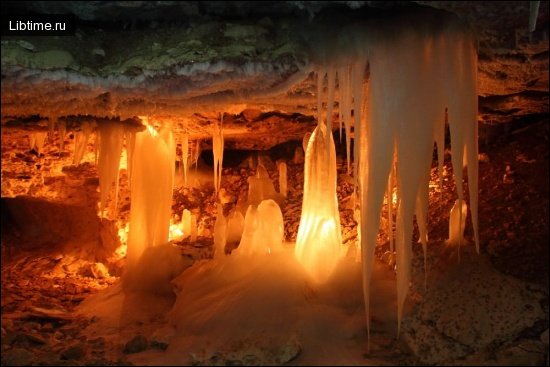
In winter, the near part of the cave where the temperature drops below 0°C produces transparent ice stalactites and stalagmites. The same freezing conditions create a striking icefall measuring 3 meters high and 1 meter wide. These ice decorations are seasonal — they grow in the cold months and melt back as the entrance zone warms, making winter the best time to see this aspect of the cave.
Wildlife and Cave Ecosystem
Caves like Kizelovskaya host specialized cave-dwelling organisms adapted to permanent darkness, stable temperature, and high humidity. Such cave ecosystems are typically sparse and fragile, depending on nutrients carried in by water and animals rather than on sunlight. Any disturbance — trampling, pollution, or excessive collection of specimens — can have an outsized impact on these low-energy communities, which is why cave biology is studied carefully and specimens of rare cave invertebrates are collected only under strict scientific protocols.
Endangered Species and Habitat Protection
Protecting endangered species and their habitat is a recurring theme wherever caves and their surrounding lands are managed, and it links cave conservation to broader land-stewardship work. At protected sites such as Vasco Caves Regional Preserve near Livermore and Brentwood in California — managed by the East Bay Regional Parks District in partnership with the Contra Costa Water District — habitat protection covers vulnerable species including fairy shrimp, kit foxes, red-legged frogs, and tiger salamanders, alongside native plant restoration and grassland management. While Kizelovskaya's own fauna differs, the same conservation principle applies: safeguarding cave-associated species means controlling access and limiting human impact.
Visiting Kizelovskaya Cave
Visiting Kizelovskaya Cave means entering a multi-level limestone labyrinth where route-finding, cool temperatures, and seasonal ice all shape the experience. Because the cave is a genuine maze with narrow corridors and three levels, it is best approached with proper preparation, light, and ideally the guidance of people who know the system. Anyone planning a trip should treat it as a caving activity rather than a casual walk.
Cave Exploration and Descending Techniques
Exploring Kizelovskaya Cave involves moving horizontally through grottoes and corridors and shifting between its three vertical levels, which calls for basic caving technique and reliable navigation. In deeper or more vertical caves, exploration relies on specialized descending and rope-ascending techniques; the world's deepest known cave, Veryovkina Cave in the Arabika Massif of Abkhazia, requires expedition teams to rig ropes, establish camps at extreme depths, and ascend through water, with risk assessment and decision-making central to every push. Kizelovskaya is far more accessible than such record-breaking systems, but the same core principles — knowing your route, managing your light, and not exceeding your skill — apply at every scale of cave exploration.
Safety, Equipment, and Emergency Procedures
Safe visits to Kizelovskaya Cave depend on the right equipment and a clear plan for emergencies. Essential gear and precautions include:
- A helmet with a mounted headlamp, plus at least two backup light sources.
- Warm, durable clothing suited to a constant ~4°C interior and a sub-zero entrance zone in winter.
- Sturdy footwear with good grip for wet, uneven, and icy surfaces.
- A buddy system — never enter a labyrinthine cave alone.
- Leaving a trip plan with someone on the surface, including expected return time.
- Awareness of the winter icefall and ice formations, which make the near part of the cave slippery.
Emergency response in caves hinges on prevention, communication, and conservative decision-making, since rescue underground is slow and difficult. Membership organizations for cavers, such as the National Speleological Society, publish guidance on safety, training, and evacuation that visitors to any cave can learn from before a trip.
Cave Photography and Documentation
Photographing Kizelovskaya Cave captures its calcite deposits, cave pearls, and winter ice features, and helps document the system for study and conservation. Cave photography demands portable lighting, patience, and care not to damage fragile formations while setting up shots. The discipline has been raised to an art by photographers such as Robbie Shone, whose cave images for National Geographic show how documentation can also serve education and advocacy for cave preservation.
Conservation and Resource Protection
Conserving Kizelovskaya Cave means protecting its formations, its delicate ecosystem, and the water system that created it. Calcite speleothems and cave pearls take centuries to millennia to form and are easily broken or smudged, so visitors should never touch, collect, or disturb them. Litter, graffiti, and careless traffic degrade caves permanently, which is why responsible caving emphasizes "leave no trace" practices.
Resource protection also extends to the broader karst environment, since groundwater feeds the cave and carries the nutrients its life depends on. Effective cave conservation typically combines controlled access, education of visitors, and the involvement of volunteers and scientific bodies — the same model seen at managed preserves and championed by caving organizations worldwide.
Comparison with Other Major Caves
Kizelovskaya Cave is a modest but characterful limestone labyrinth when set against the world's record-holding cave systems. Comparing it with famous caves clarifies what kind of cave it is and where it fits:
- Veryovkina Cave — in the Arabika Massif of Abkhazia, the deepest known cave on Earth, a vertical system explored to extreme depth, in contrast to Kizelovskaya's roughly horizontal, length-based layout.
- Krubera Cave — also in the Arabika Massif, long held the world depth record and is another giant vertical system studied by speleologists including Alexander B. Klimchouk.
- Optymistychna Cave — near Korolivka in Ternopil Oblast, Ukraine, one of the world's longest gypsum maze caves, formed in Miocene Badenian gypsum and explored by the Lviv speleoclub Cyclop.
- Botovskaya Cave — a vast horizontal maze in Eastern Siberia, comparable to Kizelovskaya in being length-based but on a far larger scale.
Against these, Kizelovskaya's ~800 meters and 20 grottoes make it a regional cave rather than a world-ranking one, yet its three-storied structure, stable microclimate, calcite decorations, and seasonal ice give it a distinct identity worth visiting and protecting. For more on the science and culture of caves, explore further reading on speleology and related travel destinations.