Kiselevsky Cave in Asha, Russia: Length, Depth, and Geology Guide
 libre
libre
The Kiselevsky Cave (also called the Chabaevsky Cave) is a limestone karst cave on the left bank of the Kiselevsky brook near the town of Asha in the Russian Federation. It is best known for its meridional main corridor, a 150-meter underground stream, and a spacious central grotto, with a surveyed total length of about 1,000 meters and a depth of 40 meters.
Kiselevsky Cave: Overview
The Kiselevsky Cave is a horizontal-to-stepped corridor cave developed in Upper Devonian limestone in the Asha district of the Russian Federation. The cave combines a single dominant passage with branching side galleries, modest speleothem decoration, and an active watercourse, making it a recognizable site for both regional speleologists and casual visitors.

For readers exploring underground sites more broadly, the Kiselevsky Cave sits within the wider field of cave science covered across our Speleology section, which documents karst landforms, formations, and exploration worldwide.
Location and Geographic Coordinates
The Kiselevsky Cave lies on the left bank of the Kiselevsky brook, a small stream that flows into the Sim River, a few kilometers from the town of Asha in the Russian Federation. Its position along the brook valley places it within a limestone karst zone typical of the southern Ural foothills, where surface streams have cut into soluble bedrock over geological time.
How to Get There: Access Directions
Reaching the Kiselevsky Cave begins from the town of Asha, the nearest settlement, from which the cave is only a short overland distance along the Kiselevsky brook. Visitors typically travel to Asha first and then follow the brook valley upstream toward the entrance. Because the approach crosses unpaved natural terrain rather than a developed tourist road, sturdy footwear and a local guide or map are advisable.
Cave Entrance and Approach
The cave entrance opens on the left bank of the Kiselevsky brook, close to the watercourse that gives the cave its name. The approach follows the streambank, and the entrance leads directly into the main meridional corridor that defines the cave's layout. As with most natural karst entrances, conditions near the opening can be wet and slippery, especially during snowmelt and rainfall.
Geology and Formation
The Kiselevsky Cave was formed by the dissolution of Upper Devonian limestone by circulating groundwater, the classic process behind karst cave development. Slightly acidic water moving along joints and bedding planes in the carbonate rock gradually widened them into passable galleries, producing the corridor-and-branch pattern seen today.
Upper Devonian Limestone Layers
The host rock of the Kiselevsky Cave is limestone of the Upper Devonian, a thick carbonate sequence that is highly susceptible to chemical weathering. These limestone layers dissolve preferentially along fractures, which explains why the cave's main passage follows a consistent meridional (north–south) orientation guided by the underlying rock structure.
Calcite and Mineral Composition
Calcite, the crystalline form of calcium carbonate, is the dominant mineral both in the Kiselevsky Cave's bedrock and in its secondary deposits. As groundwater saturated with dissolved limestone seeps into open passages and releases carbon dioxide, it re-precipitates calcite to build flowstone, rimstone, and dripstone features. This same calcite chemistry distinguishes limestone caves like Kiselevsky from gypsum caves, where the soluble mineral is calcium sulfate rather than calcium carbonate.
Cave Structure and Layout
The Kiselevsky Cave is structured around one principal corridor running in a meridional direction, with several side branches diverging from it. This layout gives the cave a predominantly linear character rather than the dense three-dimensional maze form found in some other systems, while still offering enough lateral passages to reward exploration.
Main Corridor and Side Branches
The main corridor of the Kiselevsky Cave is the backbone of the system, extending in a north–south line from which smaller side branches lead off. These branches vary in size and accessibility, and they account for much of the cave's surveyed length beyond the central passage.
Passage Dimensions and Characteristics
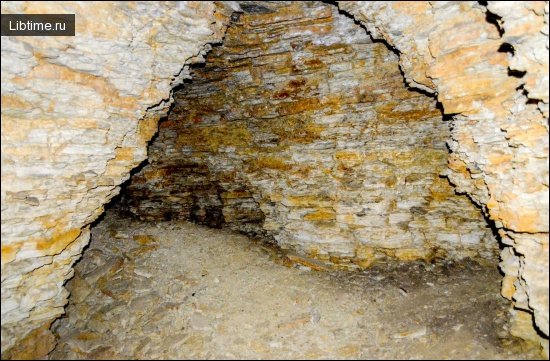
The passages of the Kiselevsky Cave range from tight side galleries to broad corridor sections, with the floor in many places strewn with fallen limestone blocks. The far part of the main passage carries an active stream, and ceiling heights and widths shift considerably along the route, so visitors encounter both comfortably walkable stretches and lower, narrower constrictions.
The Largest Grotto
The largest grotto in the Kiselevsky Cave measures roughly 70 meters long, 45 meters wide, and 8 meters high, making it the most impressive open chamber in the system. The floor of this grotto is covered with blocks of limestone that have detached from the ceiling and walls, a common feature in mature limestone galleries.
Underground Stream and Water Features
An underground stream flows for about 150 meters through the far part of the Kiselevsky Cave's main passage, representing the active hydrological component that continues to shape the cave. Flowing water like this is the engine of karst development, dissolving and transporting rock, and it also influences local humidity and the formation of calcite deposits along its course.
Cave Formations and Decorations
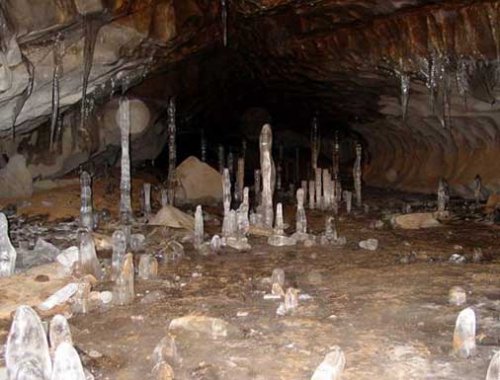
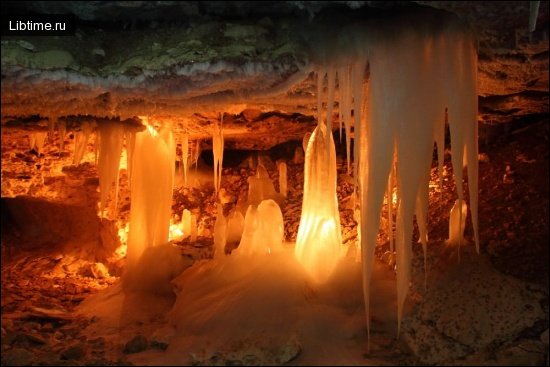
The Kiselevsky Cave contains modest but characteristic calcite speleothems, including rimstone pools and small dripstone features, formed where mineral-laden water enters the air-filled passages. These decorations are concentrated in specific sections rather than spread uniformly throughout the cave.
Gurs and Stalagmites
In some places the Kiselevsky Cave displays gurs — rimstone dams built up by flowing, calcite-rich water — alongside small stalagmites rising from the floor. Gurs form where thin films of water spill over a lip and deposit calcite at the edge, gradually creating terraced pools, while stalagmites grow from the steady drip of mineral water onto the cave floor.
Flowstone and Stalactite Decorations
Flowstone sheets and stalactites add to the Kiselevsky Cave's calcite decoration, forming on walls and ceilings where seeping water spreads out or hangs in slow drops. Stalactites grow downward from the ceiling as the counterpart to the floor-growing stalagmites, and where the two meet over long periods they can join into columns. These speleothems develop extremely slowly, which is one reason cave preservation matters: a broken formation may take thousands of years to regrow.
Total Length and Depth
The total surveyed length of the Kiselevsky Cave is about 1,000 meters, and its depth reaches 40 meters. These morphometric measurements place it among the notable caves of its region, though it is far smaller than the world's longest systems. For comparison, gypsum mazes such as Ukraine's Optymistychna Cave extend for well over 250 kilometers, illustrating how widely cave dimensions vary depending on the host rock and the structure of the passages.
Discovery and Exploration History
The Kiselevsky Cave was documented and surveyed by speleologists working in the Asha district, who mapped its main corridor, side branches, stream passage, and principal grotto to establish its dimensions. As with many regional caves of the Russian Federation, its exploration history is tied to organized caving clubs and expeditions that recorded the cave's morphology and produced the length and depth figures still cited today.
Exploration Expeditions and Surveying
Surveying the Kiselevsky Cave involved measuring passage lengths, the dimensions of the largest grotto, the 150-meter stream reach, and the 40-meter vertical extent of the system. This kind of systematic morphometric work — the same methodology applied to major systems such as Eastern Siberia's Botovskaya Cave, one of the longest caves in the Russian Federation — is the foundation of cave science, allowing different sites to be compared and catalogued. Volunteers and members of regional caving organizations frequently carry out such surveys, and many national bodies, like the National Speleological Society, coordinate documentation and offer volunteer opportunities for those interested in cave exploration.
Cave Fauna and Paleontology
Limestone caves like the Kiselevsky Cave can preserve clastic sediments and faunal remains that record past environments, and across the karst regions of Eurasia such caves have famously yielded bones of the extinct cave bear, Ursus spelaeus. Cave sediment analysis of clastic deposits — the silts, sands, and gravels washed in by underground streams — helps researchers reconstruct the climate and hydrology of a cave's past, complementing the study of any animal remains found within.
Connection with the Priest's Grotto
The Kiselevsky Cave is sometimes discussed alongside nearby grottoes that share the same limestone karst setting, a pattern common in karst country where neighboring cavities can develop in the same rock unit. A comparable relationship exists far to the west in Ukraine's Ternopil region, where the gypsum Priest's Grotto sits within a celebrated cluster of caves, showing how individual caves are often best understood as parts of a wider underground landscape rather than in isolation.
Nearby Caves and Regional Context
The Kiselevsky Cave belongs to a broader world of caves that ranges from the limestone systems of the Russian Federation to the great gypsum mazes of Ukraine and the show caves of Slovakia. Understanding any one cave is easier with this regional context, because host rock, climate, and exploration history together shape what each cave looks like.
- Botovskaya Cave — a vast horizontal maze in limestone in Eastern Siberia, ranked among the longest caves in the Russian Federation and studied by speleologists such as Alexandr Osintsev.
- Optymistychna Cave — located in the Borshchivskyi district of Ternopil Oblast, Ukraine, this gypsum cave is one of the longest in the world and the longest gypsum cave on Earth, explored largely by the Lviv speleological club.
- Cave Kryshtaleva and the Priest's Grotto — gypsum caves of the Ternopil region near villages such as Kryvche and Korolivka, formed in Neogene gypsum laid down by the ancient Sarmatian Sea, with some sites designated among the Natural Wonders of Ukraine.
- Demänovská Cave of Liberty — part of the Demänovský Cave System in the Demänovská Valley of the Low Tatras Mountains in Slovakia, near Liptovský Mikuláš and the resort of Jasná, carved by the Demänovka River and managed within the Low Tatras National Park by the Slovak Caves Administration under the State Nature Conservation of the Slovak Republic.
Researchers including Helena Hercman, Jaroslav Kadlec, Martin Chadima, and Hedi Oberhänsli have published cave and karst studies in outlets such as the Journal of Cave and Karst Studies, while historical figures connected to early cave documentation in the region — among them members of the Jesuit order and explorers like A. Král and Habriel Zhanzhynskyi — illustrate the long human fascination with these underground worlds.
Gypsum Caves Compared with Kiselevsky's Limestone
The Kiselevsky Cave is a limestone cave, which distinguishes it from the famous gypsum mazes of Ukraine where the soluble rock is calcium sulfate rather than calcium carbonate. This geological difference shapes the look of each cave's decorations and passages.
| Feature | Kiselevsky Cave (limestone) | Ukrainian gypsum caves |
|---|---|---|
| Host rock | Upper Devonian limestone (calcium carbonate) | Neogene gypsum (calcium sulfate) from the Sarmatian Sea |
| Typical structure | Single meridional corridor with side branches | Dense multi-level maze of intersecting passages |
| Characteristic formations | Calcite gurs, stalagmites, stalactites, flowstone | Gypsum crystals and gypsum rosette formations |
| Coloring | Limestone tones, with darker staining where manganese oxide is present | Translucent to colored gypsum crystals |
| Length scale | About 1,000 meters | Tens to hundreds of kilometers |
Mineral coloring in caves often comes from trace compounds: iron oxides produce reddish hues, while manganese oxide leaves dark brown to black coatings on rock surfaces. Gypsum rosettes — radiating clusters of bladed crystals — are a hallmark of gypsum caves rather than limestone ones like Kiselevsky.
Visiting Kiselevsky Cave
Visiting the Kiselevsky Cave requires basic caving preparation, since it is a natural, undeveloped cave rather than a fully equipped show cave with lighting and walkways. The stream passage, block-strewn grotto floor, and varying passage dimensions mean visitors should plan for wet, uneven conditions underground.
- Safety and equipment: bring a reliable headlamp with spare batteries, sturdy waterproof footwear, gloves, and a helmet; never enter alone.
- Physical requirements: some sections are low and narrow, so a reasonable level of fitness and the ability to stoop and scramble over limestone blocks are needed.
- Climate conditions: caves maintain a stable, cool temperature year-round with high humidity, so layered warm clothing is sensible even in summer.
- Families with small children: the wet floors, drops, and tight passages make undeveloped caves unsuitable for very young children without expert supervision.
- Cave preservation: do not break or remove formations, and avoid disturbing sediments or any fauna — speleothems grow back only over millennia.
Tourism and Guided Tours
Because the Kiselevsky Cave is undeveloped, the most responsible way to visit is with experienced local cavers or an organized group rather than as a casual unguided trip. In contrast, fully managed show caves elsewhere — such as the Demänovská Cave of Liberty in Slovakia — operate official websites with published opening hours, tour scheduling, set tourist routes, admission pricing, and accepted payment methods, and they restrict photography and videography to protect the cave. Travelers comparing developed and wild caves can read more nature and travel features in our Travel section.
For more articles spanning science, nature, and exploration, visit the Libtime homepage or browse the wider Speleology category.