Divya Cave: A Journey Through Russia's Stunning Limestone Grottoes Near Nyrob
 libre
libre
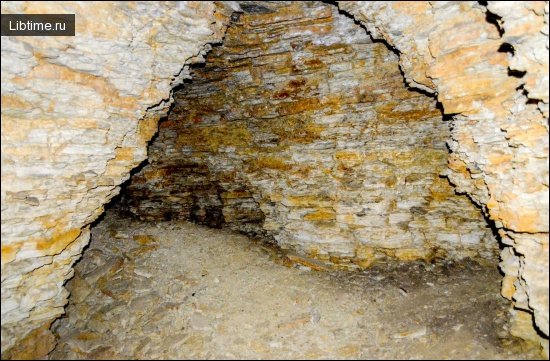
Divya Cave is a limestone cave in the Perm Region of Russia, located about 10 km north of the town of Nyrob on the right bank of the Kolva River. It contains 59 grottoes, nine underground lakes, and a rich array of mineral formations, with a constant year-round air temperature of about 4°C. The cave formed in Lower Permian limestones along two intersecting systems of tectonic fractures running north and west.
Divya Cave is among the most notable natural landmarks of the northern Perm Region and one of the longest caves in the Ural area. It sits within a steeply sloping uval (an elongated ridge) above the Kolva, and its scientific value rests on its extensive grotto system, its underground hydrology, and its varied secondary calcite formations.

Where is Divya Cave located?
Divya Cave lies in the Cherdynsky District of the Perm Region, in the West Ural Folding Zone of European Russia. The entrance opens in a steeply sloping uval on the right bank of the Kolva River, roughly 10 km north of Nyrob. This places the cave in the transitional belt between the Russian Plain and the Ural Mountains, near the structural boundary of the Pre-Ural Foredeep.
How to reach Divya Cave
Reaching Divya Cave involves travelling to the far north of the Perm Region, since the cave is remote and not served by paved roads to the entrance. The practical route is:
- Travel to Cherdyn or Nyrob, the nearest settlements in the northern Perm Region.
- Continue roughly 10 km north of Nyrob toward the Kolva River valley.
- Approach the right bank of the Kolva, where the uval housing the cave rises above the river.
- Complete the final stretch on foot, as the entrance sits part-way up the steep slope of the ridge.
Because the region experiences long, cold winters, summer is the most accessible season for visitors and researchers alike.
The right bank of the Kolva River
The Kolva River defines the immediate geography of Divya Cave, with the cave confined to the steep right bank where limestone outcrops are exposed. The river's incision into the bedrock helped expose the soluble Permian limestone in which the cave developed. The surrounding landscape belongs to the Kolvinskaya Saddle, a structural feature of the West Ural Folding Zone that influences both the regional drainage and the orientation of the rock layers hosting the cave.
How did Divya Cave form?
Divya Cave formed through the dissolution of Lower Permian limestone along zones of structural weakness created by tectonic fracturing. Two intersecting fracture systems — one trending north, the other west — guided the movement of groundwater, which gradually enlarged the fractures into the passages and grottoes seen today. This combination of soluble rock and pre-existing fracture geometry is characteristic of cave development in the Pre-Ural Foredeep.
Lower Permian limestone composition
The host rock of Divya Cave is limestone of Lower Permian age, locally including Permian silicified limestones that resist erosion and shape the cave's rugged interior. These carbonate rocks were deposited in shallow marine conditions hundreds of millions of years ago and later uplifted during the formation of the Ural region. Their solubility in slightly acidic groundwater is the fundamental reason a cave system could develop here at all.
Tectonic fracture systems
The layout of Divya Cave follows two systems of tectonic fractures oriented to the north and to the west. These fractures, produced by the structural stresses of the West Ural Folding Zone, acted as the initial pathways for water infiltration. Where the two systems intersect, dissolution was most intense, producing the larger grottoes; the overall grid-like arrangement of passages mirrors the underlying fracture pattern of the bedrock.
The grottoes and structure of Divya Cave
Divya Cave consists of 59 grottoes connected by passages, making it a branching, multi-chamber cave system rather than a single linear tunnel. The grottoes vary widely in size, from narrow connecting spaces to large open halls, and together they give the cave its reputation as one of the most extensive in the northern Perm Region.
The 59 grottoes of Divya Cave
The 59 grottoes of Divya Cave form an interconnected network shaped by the intersecting fracture systems. Each grotto represents a chamber where dissolution widened the rock along fracture intersections, and the passages between them follow the dominant north and west fracture trends. The total count of 59 distinguishes Divya Cave as a notably complex cave compared with simpler caves in the surrounding region.
Largest grottoes: Vetlan, Devy and Gvozdetsky
The three largest grottoes of Divya Cave are Vetlan, Devy and Gvozdetsky, each reaching up to 50 m in length, 15 m in width and 15 m in height. These dimensions make them spacious halls within the system, large enough to dominate the visitor experience and to host the most striking concentrations of mineral formations. Their scale reflects the points where the cave's fracture systems intersect most strongly.
Cave entrance characteristics and dimensions
The entrance to Divya Cave opens on the steep slope of the uval above the right bank of the Kolva River, set part-way up the ridge rather than at river level. This elevated, slope-side opening is typical of caves formed along valley walls, where river incision exposes the cave's outer passages. The position of the entrance on a steep slope is one reason access requires an on-foot approach across the hillside.
Cave classification and taxonomy
Divya Cave is classified as a karst cave — a solution cave formed by the chemical dissolution of carbonate bedrock. Within speleological taxonomy it is a fracture-controlled karst cave, since its passages follow tectonic fracture systems rather than bedding planes or coastal erosion. This classification places it alongside other dissolution caves of the Ural and Pre-Ural regions and distinguishes it from caves formed by lava, wind, or sea action. For broader background on how dissolution caves develop, see our Speleology coverage.
Climate and internal conditions
The interior of Divya Cave maintains a stable microclimate that contrasts sharply with the harsh seasonal climate of the surrounding northern Perm Region. While the surface endures long, cold winters and short summers, the deep cave environment stays close to a single temperature all year. This thermal stability is what allows delicate mineral formations to develop undisturbed.
Constant year-round air temperature
The air temperature inside Divya Cave holds at about 4°C and remains constant throughout the year. This steadiness results from the insulating mass of overlying rock, which buffers the cave from surface temperature swings. The constant cool temperature, combined with high humidity, creates the conditions under which stalactites, stalagmites, and other speleothems form slowly over long periods.
The underground lakes of Divya Cave
Divya Cave contains nine underground lakes fed by groundwater seeping through the fractured limestone. These lakes reflect the cave's hydrogeology: water that infiltrates from the surface and percolates along fractures collects in the lowest grottoes, where it forms still, cold pools. The presence of multiple lakes underlines the active role of groundwater both in forming the cave and in sustaining its formations today.
The Lake Grotto and its waters
The largest of the nine lakes lies in the Lake Grotto, measuring about 6 m long and 2 m deep. Its clear, cold water is part of the groundwater system that continues to circulate through the cave's fracture network. The chemistry of this water — rich in dissolved carbonate from the surrounding limestone — is the same chemistry that, on evaporation and degassing, deposits the calcite that builds the cave's formations.
Formations and decorations inside Divya Cave
Divya Cave is richly decorated with secondary calcite formations, collectively known as speleothems, that grow where mineral-laden water emerges into the air-filled grottoes. The variety of these formations — dripstone, flowstone, and rarer crystalline types — is one of the cave's defining features and a major reason for its scientific and aesthetic interest.
Stalactites, stalagmites and stalagnates
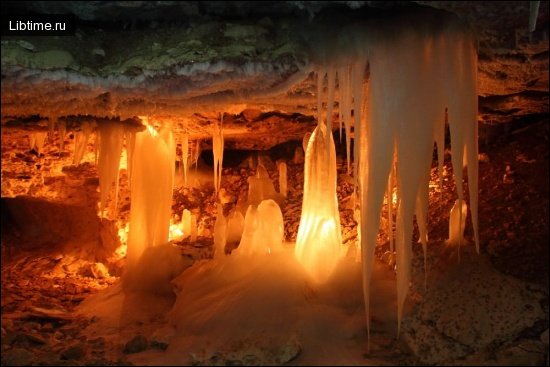
The most familiar formations in Divya Cave are stalactites hanging from the ceiling, stalagmites rising from the floor, and stalagnates (columns) formed where the two meet and fuse. Each grows as carbonate-saturated water deposits thin layers of calcite over centuries. For a fuller explanation of how these structures develop, see Cave Formation.
Helictites, corallites and draperies
Beyond the common dripstones, Divya Cave hosts helictites, corallites, and draperies — more delicate and unusual speleothems. Helictites twist in seemingly gravity-defying directions, corallites form knobby clusters resembling coral, and draperies hang in thin, curtain-like sheets. Their presence signals the cave's stable microclimate, since such fragile formations only survive where air movement and temperature remain consistent.
Cryogenic calcite formations
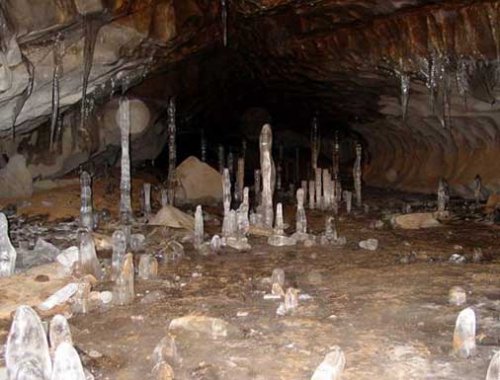
Divya Cave also preserves cryogenic calcite, a class of formation that develops when carbonate-bearing water freezes slowly in near-freezing cave conditions. Cryogenic calcite is significant because it records past periods when the cave was even colder than today, linking the formations to the region's glacial and permafrost history. Studying these deposits helps researchers reconstruct shifts in the permafrost boundary across interglacial periods in the northern Ural region.
Atmospheric precipitation and isotopic composition
The water that builds Divya Cave's formations originates as atmospheric precipitation, and its isotopic composition carries a record of past climate. Researchers use isotopic analysis of cave calcite and waters to determine how regional precipitation patterns and temperatures have changed over geological time. The ratios of oxygen and hydrogen isotopes locked into the calcite act as a natural archive, allowing scientists to date formations and infer the climate under which each layer grew. This kind of hydrogeological and hydrochemical research connects the cave's groundwater chemistry to broader questions about interglacial periods and the migration of the permafrost boundary in the Perm Region.
Visiting Divya Cave
Visiting Divya Cave requires preparation, because the cave is remote, undeveloped, and subject to access controls intended to protect its fragile formations. Unlike commercialized show caves, Divya Cave has minimal visitor infrastructure, so trips are typically organized through experienced guides or speleological groups familiar with the site. If you are planning a wider trip to the region, our Travel section offers related guidance.
Access control and permits
Access to Divya Cave is restricted to protect its speleothems and lakes from damage, and visitors should expect to arrange permission and a knowledgeable guide before attempting entry. The remoteness of the site, the steep slope leading to the entrance, and the cold, wet interior all make independent visits hazardous. Responsible access — limiting group size, avoiding contact with formations, and carrying out all waste — is essential to preserving the cave for future study.
Administrative and service infrastructure
The administrative oversight of Divya Cave falls under regional authorities of the Perm Region responsible for natural landmarks, with documentation and study supported by speleological organizations. Field exploration in the area has historically been carried out by groups such as the Berezniki Municipal Speleological Expedition. Because there is no on-site service infrastructure — no lighting, walkways, or facilities — all logistics for a visit must be self-supplied or arranged through an expedition.
Research history and documentation of Divya Cave
Divya Cave has been studied and described over more than two centuries, with early mentions in the records of explorers of the Russian Empire and detailed speleological surveys conducted during the Soviet Union era and afterward. Early observers including N.P. Rychkov, V.N. Berkh, and later researchers such as G.A. Maksimovich and E.I. Luzina contributed to documenting the cave's grottoes, lakes, and formations. Topographic surveys mapped the 59 grottoes and established the dimensions of the largest halls, building the body of metadata by which the cave is now identified and referenced.
Divya Cave is catalogued in encyclopedic and knowledge-base sources, including the Great Russian Encyclopedia and structured databases such as Wikidata, which integrate the cave into the Google Knowledge Graph and link multilingual encyclopedia entries across languages. Scholarly studies of the cave's hydrochemistry and isotopic record are indexed through research platforms such as ResearchGate and have involved institutions including the University of Innsbruck for isotopic analysis. These identifier systems and cross-references make Divya Cave traceable across scientific literature and reference works, anchoring its place among documented Russian natural landmarks.