Kueshta Cave in Russia: A Geological Wonder on the Sim River
Kueshta Cave is a through cave on the right bank of the Sim River in the Iglinsky District of Bashkortostan, Russia, formed in gypsum and anhydrite of the Permian system. It lies 1.5 km west of the village of Kuznetsovka, roughly 6 km downstream from Kaltovka, and ranks among the recognized natural monuments of the region. Its main corridor stretches 410 meters, and the cave's total length reaches 571 meters.
Where is Kueshta Cave located?
Kueshta Cave sits on the right bank of the Sim River in the Iglinsky District of Bashkortostan, a republic within Russia. The cave entrance opens into a low watershed escarpment known locally as Mount Kueshta, which the gypsum and anhydrite beds of the Permian system compose. This places the cave firmly within the broader story of protected areas in Russia, where karst formations in Bashkortostan are catalogued as natural monuments.
Position along the Sim River
The Sim River defines the immediate geography of Kueshta Cave, which stands 1.5 km west of Kuznetsovka and about 6 km downstream from Kaltovka. The river bank and the cave's through structure are linked: water moving through the landscape over geological time helped open the passage that visitors follow today.
Mount Kueshta and the surrounding landscape
Mount Kueshta is the low watershed escarpment that hosts the cave, built from the soluble gypsum and anhydrite that make this part of Bashkortostan prone to karst features. The surrounding terrain reflects the regional geology of the southern Urals foothills, where the soft Permian rock yields readily to dissolving groundwater. Historically, this territory fell within the Russian Empire and later the Soviet Union before becoming part of the modern Russian Federation, and protected-area numbering systems in Russia track such monuments through regional registers.
How did Kueshta Cave form?
Kueshta Cave formed through the dissolution of gypsum and anhydrite of the Permian system, the soluble sulfate rocks that make up Mount Kueshta. Groundwater seeping through joints and bedding planes slowly enlarged them into passages, producing the through cave seen today.
Gypsum and anhydrite of the Permian system
The gypsum and anhydrite of the Permian system are the key to Kueshta Cave's existence. These minerals dissolve far more readily than limestone, so caves in gypsum can develop relatively quickly and tend to have smooth, rounded passages. The same rock type underlies much of the karst landscape of Bashkortostan.
How the through cave was formed
A through cave like Kueshta has openings at both ends, allowing a route to pass entirely through the rock mass rather than terminating in a dead end. At Kueshta, flowing water exploited the soluble Permian beds, widening fractures into the broad corridor and linked grottoes. The stream that still runs along the cave floor is the present-day remnant of the water that carved the system.
Cave structure and measurements
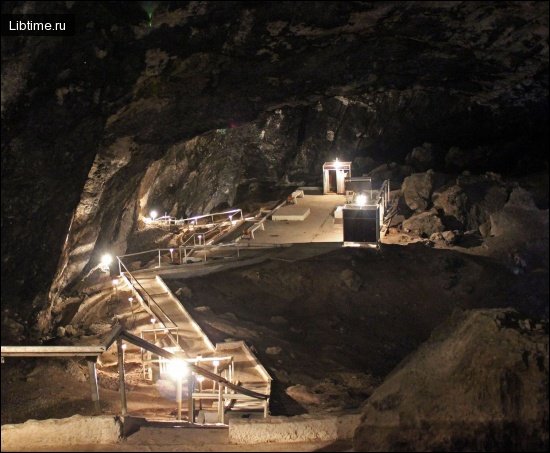
Kueshta Cave consists of a 410-meter main corridor and four grottoes, giving a total surveyed length of 571 meters. The grottoes are joined by wide passages reaching up to 8 m across and up to 4 m high, making the interior unusually spacious for a gypsum cave.
Main corridor and total length
The main corridor of Kueshta Cave runs 410 meters, while the combined length of all passages and grottoes brings the total to 571 meters. This difference reflects the branching grottoes and connecting galleries that extend off the principal route.
The four grottoes
Four grottoes punctuate the interior of Kueshta Cave, linked by generous passages up to 8 m wide and 4 m high. These chambers give the cave its character, opening into larger volumes between the connecting galleries.
Kruzhkovtsev Grotto
Kruzhkovtsev Grotto is the largest chamber in Kueshta Cave, measuring 45 m in length, 21 m in width, and 6 m in height. Located in the far part of the cave, it is also the most thermally stable space, which makes it central to the cave's microclimate.
Connecting passages
The passages connecting the grottoes of Kueshta Cave reach up to 8 m in width and up to 4 m in height. Their scale lets explorers move between chambers without crawling, an uncommon comfort in cave systems of this length.
Interior features of Kueshta Cave
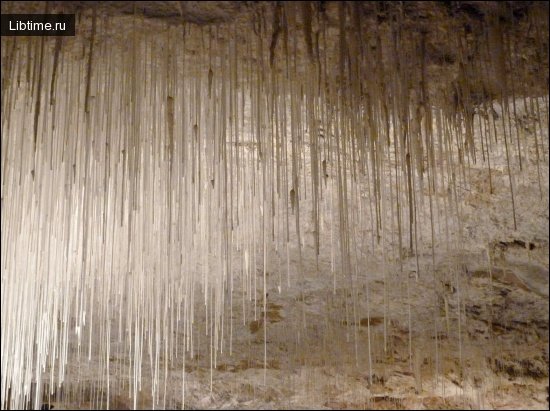
The interior of Kueshta Cave is defined by a clay-covered floor and a slow underground stream. Viscous clay coats the ground, strewn in many places with fallen stone fragments, while water threads its way along the bottom of the cave.
Cave floor and clay deposits
Viscous clay covers the floor throughout Kueshta Cave, layered in many spots with broken stone. These deposits make footing soft and sticky, and they record the slow sediment-laden flow of water through the system over long periods.
The underground stream
An underground stream flows along the bottom of Kueshta Cave, working its way over a chaotic pile of stones. In places the stream widens to 2.5 m and deepens to about 0.7 m, and in the far reaches of the cave it never freezes.
Climate and air temperature inside Kueshta Cave
The air temperature inside Kueshta Cave swings from about 11° in summer down to roughly -3° in winter, though the deepest chamber stays much milder. This seasonal range is typical of a through cave, where two openings allow air to circulate.
Seasonal temperature variations
In summer the air in Kueshta Cave rises to about 11°, while in winter it can drop to -3°. The through configuration, with openings at both ends, lets outside air move through the corridor and drives these seasonal changes.
Microclimate of Kruzhkovtsev Grotto
Kruzhkovtsev Grotto holds a far steadier microclimate than the rest of Kueshta Cave: even in the coldest winters its air temperature does not fall below 6°. Because of this stable warmth, the stream passing through this far part of the cave does not freeze, sustaining flowing water year-round.
How to get to Kueshta Cave
Kueshta Cave is reached from the villages of Kuznetsovka and Kaltovka in the Iglinsky District of Bashkortostan, with the entrance set 1.5 km west of Kuznetsovka on the right bank of the Sim River. The approach is rural, so plan around the river and the surrounding escarpment rather than paved roads.
Directions from Kuznetsovka and Kaltovka
From Kuznetsovka, the cave lies 1.5 km to the west, while from Kaltovka the route follows the Sim River roughly 6 km downstream. Travellers typically use mapping tools and geographic coordinates to locate the entrance along the river bank, since signage in this remote part of Bashkortostan is limited.
Accessibility and parking
Access to Kueshta Cave is best suited to visitors prepared for a short walk over uneven riverside terrain, as there are no developed parking areas or paved approaches at the cave itself. Vehicles are generally left near the nearest village, and the remaining distance is covered on foot. This stands in contrast to commercialized cave sites elsewhere, and visitors should treat Kueshta as a remote, undeveloped natural monument.
Hiking trails and routes
Reaching Kueshta Cave involves following informal trails along the Sim River rather than marked tourist routes. Hikers should expect muddy banks, the soft clay common to the area, and the need to navigate by river landmarks. Good footwear and a plan for the river crossing or bank-side approach are essential.
Exploring Kueshta Cave
Exploring Kueshta Cave means moving through a 571-meter through system with spacious grottoes, a stream underfoot, and clay-coated floors. The cave's broad passages make it more approachable than many gypsum caves, but the slick clay, stone piles, and flowing water still demand caution and proper gear.
Adventure activities and skill levels
Kueshta Cave suits a range of skill levels because its main corridor and connecting passages are wide and high enough to walk through, while the stream sections and stone piles add genuine challenge for more experienced cavers. The following describes the typical demands:
- Beginners can follow the main corridor where the passages reach up to 8 m wide and 4 m high.
- Intermediate explorers tackle the stream sections, where water widens to 2.5 m and deepens to 0.7 m.
- Experienced cavers push through the chaotic stone piles toward Kruzhkovtsev Grotto in the far part of the cave.
Safety tips and recommended equipment
Safe exploration of Kueshta Cave depends on equipment matched to wet, slippery, low-temperature conditions, since winter air can fall to -3° and the floor is covered in viscous clay. Recommended preparations include:
- A reliable headlamp plus a backup light source.
- Sturdy, waterproof boots with grip for clay and stream crossings.
- Warm, layered clothing for temperatures that range from 11° down to below freezing.
- A helmet for protection against the stone fragments and low passages.
- Never exploring alone, and informing someone of your route and expected return.
Photography and scenic views
Photography in Kueshta Cave rewards patience, as the spacious grottoes and the stream offer striking subjects but demand long exposures in the dark. Bring a tripod, supplementary lighting, and protection against the damp clay for your gear. The entrance, framed by the Mount Kueshta escarpment above the Sim River, also makes a memorable scenic shot.
Nearby attractions and landmarks
Kueshta Cave sits within a region of Bashkortostan rich in karst landscapes and protected natural monuments, with the Sim River valley itself a draw for nature travellers. The villages of Kuznetsovka and Kaltovka anchor the local geography, and the wider Iglinsky District offers further gypsum-karst features for those exploring the area. For travellers comparing cave destinations, Kueshta represents the remote, undeveloped end of the spectrum, where the appeal lies in solitude and raw geology rather than visitor centres.
If your interest in caves runs beyond geology and into their meaning across cultures, it is worth noting how differently caves register in the human imagination. Caves recur throughout Jewish tradition as spaces of both shelter and revelation. The Torah describes the Cave of Machpelah, purchased by Abraham as a burial place for Sarah and later for Isaac, Rebeccah, Jacob, and Leah, while the Midrash adds that Adam was buried there too. The Talmud recounts how Rabbi Shimon bar Yohai and his son Rabbi Elazar hid in a cave for years, where mystical teachings later associated with the Zohar are said to have taken shape. The prophet Elijah encountered God at the mouth of a cave, and Moses was placed in the cleft of a rock on Mount Sinai to glimpse the divine. Writers such as Avivah Gottlieb Zornberg have explored how kabbalistic thought reads caves as both womb and tomb, places of spiritual transformation that echo the inward turn of the High Holy Days much as the blast of the Shofar calls for renewal.
That symbolism has real-world counterparts that pilgrims and travellers visit, ranging from the highly commercialized to the genuinely remote. In Israel, the Keshet Cave in the Galilee is a natural limestone arch on the Adamit Mountain Ridge within Adamit Park, near the Bezet Stream and the Namer caves, not far from Rosh HaNikra on the Israel-Lebanon border above the Mediterranean Sea. Elsewhere, the Trummelbach cave waterfalls in the Alps of Switzerland and show caves like Indian Echo Caverns in Pennsylvania in the United States illustrate how cave sites are developed for visitors in different countries, from Germany and Ireland to Virginia and New York. Kueshta, by contrast, remains an unspoiled natural monument best appreciated on its own quiet terms.
Documentation of caves like Kueshta increasingly lives in open knowledge systems. Wikimedia Commons serves as a media repository for cave imagery and entrance documentation, while Wikidata records each cave as a structured entity, classifying it by instance type, linking geographic coordinates, and connecting multilingual names and external identifiers into a knowledge graph. Projects coordinated by teams such as the Russian WLE team contribute photographs of protected areas in Russia, helping number and catalogue natural monuments in Bashkortostan for researchers and travellers alike. To explore more destinations like this, browse our Travel and Speleology sections, or return to the main page for more articles about nature and science.