Borodinskaya Cave: Exploring Khakassia's Limestone Wonder in Batenevsky Ridge
 libre
libre
Borodinskaya Cave is a 1,020-metre limestone cavern in the eastern part of the Batenevsky Ridge, formed in the basin of the Koksa River, a left tributary of the Yenisei.

Borodinskaya Cave: overview and location
Borodinskaya Cave lies within a limestone ridge dissected by a steep gorge in the eastern Batenevsky Ridge of southern Siberia. The entrance opens on the gorge slope as a deep well, after which the passages descend gradually into the rock to a maximum depth of 60 metres. With a total surveyed length of 1,020 metres and an internal volume of roughly 12,000 cubic metres, Borodinskaya ranks among the more substantial show-grade caves of the region, combining large open chambers with permanent ice and a rich set of mineral formations.
Geographic setting in the Batenevsky Ridge
The Batenevsky Ridge that hosts Borodinskaya Cave is a band of folded sedimentary rock running through the Kuznetsk Alatau borderlands, where ancient limestones are exposed and easily dissolved by water. The cave entrance sits on the slope of a narrow gorge that cuts directly through one of these limestone outcrops, which is why the approach is steep and the opening is a vertical shaft rather than a horizontal mouth. This setting places the cave in karst terrain, where surface and underground drainage have carved the chambers over a long geological span.
Koksa River basin and the Yenisei tributary system
Borodinskaya Cave drains into the basin of the Koksa River, which is a left tributary of the Yenisei, one of the great river systems of Siberia. Water moving through the fractured limestone of the Koksa basin is the engine that dissolved the rock and built the cave, and the same network of streams continues to feed the moisture that keeps the formations growing. Locating the cave within the Yenisei tributary system also explains its cold-continental water supply, which is central to the permanent ice found inside.
How the cave was formed: limestone geology
Borodinskaya Cave was dissolved out of limestone by slightly acidic groundwater, the classic process that creates karst caverns worldwide. Rainwater and snowmelt absorb carbon dioxide, turn mildly acidic, and seep along joints and bedding planes in the limestone, widening cracks into passages and passages into grottoes over many thousands of years. As that same carbonate-laden water later drips into open chambers and releases its dissolved load, it rebuilds calcite as stalactites, stalagmites, drapery and pearls — so the cavity and its decorations come from two phases of one chemical cycle.
Cave entrance and the 6-metre well
The entrance to Borodinskaya Cave is a vertical well about six metres deep, set on the slope of the gorge that dissects the limestone ridge. Descending the well drops visitors into a wide, high gallery — up to five metres tall — that slopes gently downward into the body of the cave. Because the way in is a shaft rather than a walk-in portal, reaching the interior requires basic vertical caving technique and proper equipment, which is one reason access is managed through experienced groups.
Layout and dimensions of the cave
Borodinskaya Cave is organised as a descending sequence of grottoes and connecting passages that branch from the entrance gallery. Beyond the well, the main gallery leads toward the largest chambers, with smaller grottoes and named passages opening off the route. The layout was documented in a detailed survey that assigns each chamber and passage a number, giving cavers a reliable reference for navigating the system.
Total length, depth, and volume
Borodinskaya Cave has a total surveyed length of 1,020 metres, a vertical depth of 60 metres, and an internal volume of about 12,000 cubic metres. These figures place it firmly in the category of large caves, with enough vertical range and open space to hold both a sizeable glacier and chambers measuring tens of metres across. The combination of length and depth means a full traverse involves significant descent and climbing within the system.
Map of Borodinskaya Cave (by Zh.L. Tsykina)
The standard map of Borodinskaya Cave was produced by Zh.L. Tsykina and numbers every grotto and passage for navigation.

1 - Light grotto; 2 - Temple grotto; 3 - Grandiose grotto; 4 - Jeanne's grotto; 5 - Waiting grotto; 6 - Distant grotto; 7 - Dry tree grotto; 8 - Poklonovy passage; 9 - Wandering grotto; 10 - Vstrechny passage.
The eight grottoes of Borodinskaya Cave
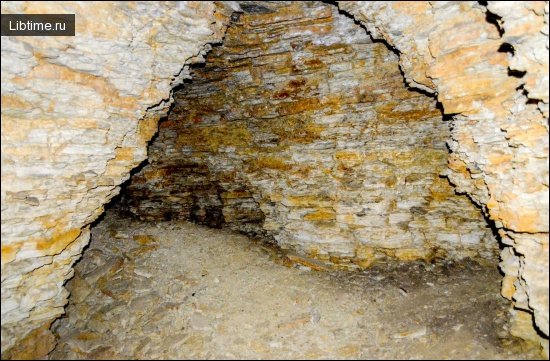
Borodinskaya Cave contains eight grottoes, the largest being the Grandiose, Temple and Wandering grottoes. The floors of these chambers are generally covered with clay and strewn with fallen blocks of limestone, on which many of the cave's formations stand. Each grotto has its own character, from the cathedral-like volume of the Grandiose to the formation-rich Temple, and the map by Zh.L. Tsykina ties them together with the named connecting passages.
Grandiose Grotto
The Grandiose Grotto is the largest chamber in Borodinskaya Cave, measuring 160 metres long, 50 metres wide and up to 20 metres high. Its scale gives the grotto a hall-like openness rare in caves of this region, and its northern part holds some of the most striking decoration in the system. The floor here, as throughout the cave, is clay overlain with limestone blocks.
Temple Grotto
The Temple Grotto is best known for the Upper Pagoda, the cave's largest stalagmite, which rises five metres tall and reaches 1.5 metres in diameter. The grotto's name reflects the temple-like impression created by these massive vertical formations standing on the block-strewn floor. It is one of the principal highlights for visitors moving through Borodinskaya Cave.
Wandering Grotto
The Wandering Grotto is the third of the three largest chambers in Borodinskaya Cave, reached via the cave's connecting passages from the central area. It rounds out the trio of major grottoes alongside the Grandiose and Temple chambers and forms part of the deeper route through the system, linked through passages such as the Vstrechny passage shown on the survey map.
Light, Jeanne's, Waiting, Distant, and Dry Tree grottoes
Five smaller grottoes complete the eight chambers of Borodinskaya Cave, each labelled on the Tsykina survey:
- Light grotto (1) — the first chamber encountered, named for its position near the entrance gallery.
- Jeanne's grotto (4) — a named side chamber off the main route.
- Waiting grotto (5) — one of the intermediate grottoes within the descending sequence.
- Distant grotto (6) — set deeper in the system, reflecting its remoteness from the entrance.
- Dry Tree grotto (7) — a further named chamber, connected to the network of passages.
These chambers are linked by the Poklonovy passage (8) and Vstrechny passage (10), which thread the smaller grottoes into the larger Grandiose, Temple and Wandering halls.
Speleothems and mineral formations
Borodinskaya Cave is decorated with a full suite of calcite speleothems, from towering stalagmites to delicate cave pearls. These formations grow where carbonate-rich water drips from the ceiling or flows over the walls and floor, depositing thin layers of calcite over centuries. The diversity here — stalagmites, stalactites, drapery, pearls and organ pipes — is what makes the cave notable to speleologists.
Stalagmites and the Upper Pagoda
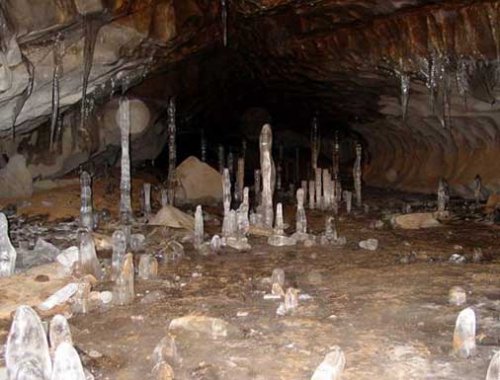
The stalagmites of Borodinskaya Cave rise from the limestone blocks that litter the floors of its grottoes, fed by water dripping from above.

Stalactites and ceiling formations
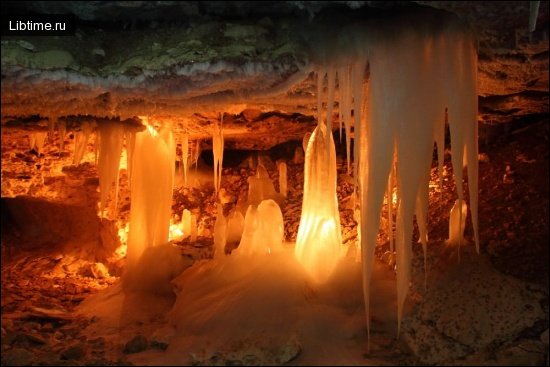
Small stalactites hang from the ceilings of several grottoes in Borodinskaya Cave, formed as the downward-growing counterparts of the stalagmites below. They develop where mineral-laden water seeps through the roof and leaves a trace of calcite with each drop, slowly extending the formations from the ceiling over long periods.
Calcite drapery and cave pearls
The northern part of the Grandiose Grotto holds calcite drapery of dazzling whiteness, where flowing water has laid down thin, curtain-like sheets of mineral along the walls. The same area of Borodinskaya Cave has yielded cave pearls — small, rounded concretions formed when calcite builds up in concentric layers around a nucleus in shallow pools. Together the drapery and pearls make the Grandiose Grotto the decorative centrepiece of the cave.
Organ pipes formations
Organ pipes have been recorded in some of the grottoes of Borodinskaya Cave, a formation type named for the clustered, tubular shapes that resemble the pipes of a musical organ. They form where water moves along the rock in adjacent channels, building parallel calcite columns or fluted structures. Their presence adds to the range of speleothems that distinguish this cave within the Batenevsky Ridge.
The glacier and icefall near the entrance
Not far inside the entrance, Borodinskaya Cave holds a powerful glacier that descends as an icefall over the sloping floor of the gallery. This permanent underground ice forms because the vertical entrance well traps cold, dense air and the constant supply of water freezes in the chilled lower passages. The icefall is one of the cave's signature features, encountered early in the descent before the larger grottoes open up.
Microclimate and underground ice
The microclimate of Borodinskaya Cave sustains its ice year-round because cold winter air sinks into the deep entrance shaft and is held there through the warmer months, keeping the lower chambers below freezing. In caves of this type, known as cold-trap or sack caves, the shape of the entrance prevents warm air from flushing the cold out, so glaciers and icefalls persist even in summer. Visitors should expect sub-freezing conditions near the ice and plan clothing accordingly.
Exploration and research history
Borodinskaya Cave has been studied and surveyed by speleologists, with the detailed map of its grottoes and passages credited to researcher Zh.L. Tsykina. That survey work established the cave's measured length, depth and volume and gave names and numbers to its chambers, providing the reference framework still used to describe the system today. Ongoing interest from caving groups reflects the cave's combination of large chambers, permanent ice and varied formations.
Planning your visit to Borodinskaya Cave
A visit to Borodinskaya Cave is a caving expedition rather than a casual outing, because access begins with a six-metre vertical well and continues through cold, sometimes icy passages. Anyone planning to go should arrange to join an experienced group, carry proper lighting and warm gear, and treat the trip as one to a wild cave with no built infrastructure. The rewards are the Grandiose Grotto, the Upper Pagoda stalagmite and the underground glacier.
How to get there
Borodinskaya Cave is reached overland to the eastern Batenevsky Ridge and then on foot to the gorge that holds the entrance. Because the cave sits in remote karst terrain in the Koksa River basin, the final approach involves walking to the gorge slope where the entrance well opens. Travellers typically coordinate the route with local caving clubs familiar with the access tracks.
Guided tours and safety requirements
Guided caving is the safest way to experience Borodinskaya Cave, given the vertical entrance and the ice near the start. Key safety requirements include:
- Vertical descent equipment and competence for the six-metre entrance well.
- Reliable headlamps plus backup lighting for every person.
- Warm, layered clothing for sub-freezing conditions at the glacier.
- Sturdy footwear with grip for clay floors and limestone blocks.
- Travelling as a group with at least one experienced caver who knows the layout.
The walking difficulty inside ranges from gentle slopes in the entrance gallery to scrambling over fallen blocks and negotiating icy ground, so a reasonable level of fitness is needed.
Best time to visit and what to bring
Because Borodinskaya Cave keeps a near-freezing microclimate all year, the interior conditions change little between seasons, but the surface approach is easiest in dry, snow-free months. Bring warm clothing regardless of the date, since the glacier zone stays cold even in summer. Essentials include a helmet, primary and spare lights, gloves, food and water, and any vertical gear required for the entrance well.
Conservation and protected status
Borodinskaya Cave's formations — its drapery, cave pearls, organ pipes and the Upper Pagoda stalagmite — are fragile and slow-growing, so responsible visitors avoid touching or breaking speleothems and pack out everything they bring in. Calcite formations damaged by handling do not recover on any human timescale, which is why caving etiquette and any local protection measures matter for preserving the cave for future explorers. Keeping the underground ice and mineral decorations intact is part of leaving the cave as it was found.
For more underground destinations and field notes, explore our Speleology section, or browse related Travel guides on the site.