Bajeyskaya Cave: Exploring Russia's Hidden Ordovician Conglomerate Wonder
 libre
libre
Bajeyskaya Cave is a 5,500-metre-long karst system on the right bank of the Stepnoi Bajeyskaya River, about 4 km northeast of the settlement that shares its name. Formed in Ordovician conglomerates, it ranks among the larger caves of its region, reaching a depth of 170 metres and enclosing a volume of roughly 240,000 cubic metres. The cave is undeveloped and wild, drawing experienced cavers rather than casual tourists, with a 20-metre vertical entrance well, branching tectonic passages, two underground streams, and a sizeable subterranean lake.
Overview of Bajeyskaya Cave
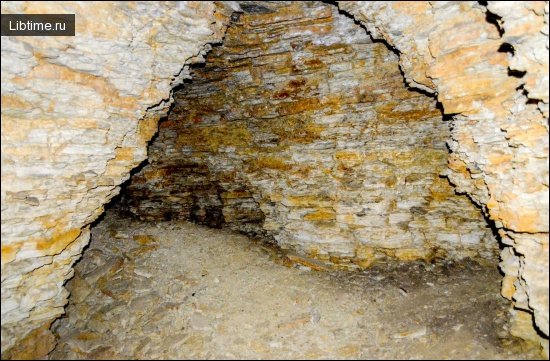
Bajeyskaya Cave is a multi-level conglomerate cave whose grottoes and passages follow tectonic fissures running in northwest and northeast directions.

The cave appeals primarily to speleologists and adventurous visitors comfortable with vertical descents and unlit passages. There is no infrastructure inside — no walkways, no lighting, and no guides on site — so a trip here is an expedition rather than a sightseeing stroll. For broader context on how caves like this form and what to expect underground, the Speleology section covers the wider subject.
Location and Geography
Bajeyskaya Cave sits on the right bank of the Stepnoi Bajeyskaya River, 4 km northeast of the eponymous settlement. The river valley defines the local landscape, and the cave entrance opens within the slope above the watercourse. Its position in remote terrain means the surrounding area is sparsely populated, with limited roads and services nearby.
How to Get There
Reaching Bajeyskaya Cave requires travelling to the Bajeyskaya settlement and then covering the final 4 km northeast on foot or by suitable off-road vehicle. Because the approach crosses undeveloped country, visitors should plan for a self-supported trip:
- Confirm the route to the settlement in advance, as signage is minimal.
- Allow extra time for the final stretch between the settlement and the cave entrance.
- Travel with a local guide or someone who has visited before, since the entrance is not obvious from a distance.
- Carry navigation tools and a charged communication device, as mobile coverage is unreliable.
Access Requirements and Permissions
Access to Bajeyskaya Cave is informal but demands caving competence rather than a ticket, because the cave has no managing operator on site. The 20-metre entrance well makes a rope and rigging mandatory, so descent should only be attempted by those trained in vertical caving or accompanied by a qualified group. Visitors are responsible for their own safety, and it is sensible to notify someone of your plans before entering, given the absence of rescue facilities at the cave itself.
Geological Features and Formation
Bajeyskaya Cave formed in Ordovician conglomerates, a sedimentary rock made of cemented pebbles and gravel, which is comparatively unusual as a cave-forming medium. The passages developed along tectonic fissures, so the layout of the cave directly mirrors the underlying fracture pattern of the rock. For more on the processes behind cave development, see Cave formation.
Ordovician Conglomerates
The Ordovician conglomerates that host Bajeyskaya Cave are ancient sedimentary rocks dating back hundreds of millions of years. Water moving through the rock dissolved and eroded the cement binding the pebbles, gradually enlarging fissures into passable galleries. This conglomerate setting explains why the cave's mineral formations stay small — conglomerate does not yield calcite as freely as pure limestone does.
Tectonic Fissures and Passage Orientation
The grottoes and passages of Bajeyskaya Cave are confined to tectonic fissures oriented in northwest and northeast directions. These fractures acted as the initial pathways for water, which then widened them over time. As a result, the cave's corridors run along straight, fault-controlled lines rather than meandering randomly, producing a recognisable geometric structure that experienced cavers can read as they navigate.
Cave Layout and Dimensions
Bajeyskaya Cave begins with a vertical well 20 metres deep and then branches into a network of grottoes, streams, and a lake reaching a total surveyed length of 5,500 metres. The layout combines vertical and horizontal elements, with the entrance shaft dropping into a system that extends to a depth of 170 metres. Below are the key features encountered along its length.
The Entrance Vertical Well
The cave opens with a vertical well 20 metres deep, the defining obstacle of any visit. This shaft must be descended on a rope, which immediately filters out unprepared visitors and sets the tone for the rest of the system. The well leads down into the network of fissure-controlled passages that make up the bulk of the cave.
Lion's Grotto
Lion's Grotto is the largest chamber in Bajeyskaya Cave, measuring 40 metres long and 20 metres wide. Its scale makes it the most impressive single space within the system and a natural orientation point underground. From this grotto, the various fissure passages of the cave radiate toward the streams and lake deeper inside.
Underground Streams and Lake
Two streams flow through Bajeyskaya Cave, one of them named Porcelain, with a measured flow rate of 1.5 litres per second. These watercourses are part of the active hydrology that continues to shape the cave. The system also contains a notable underground lake measuring 35 metres long, 12 metres wide, and 3.5 metres deep — a substantial body of still water in the cave's interior. Water levels in such cave systems can shift seasonally with snowmelt and rainfall, so the streams and lake may appear larger or more forceful at certain times of year.
Total Length, Depth, and Volume
The total length of Bajeyskaya Cave is 5,500 metres, with a depth of 170 metres and a volume of 240,000 cubic metres. These figures place it among the more extensive cave systems formed in conglomerate rock. The combination of considerable length and depth, together with vertical and water hazards, defines the cave as a serious caving objective.
Cave Formations and Mineral Deposits
Mineral formations in Bajeyskaya Cave are poorly developed compared with classic limestone caves, a direct consequence of its conglomerate host rock. What formations exist are modest in size, and much of the cave's character comes instead from its raw rock surfaces, water features, and floor sediments.
Stalactites, Stalagmites, and Growths
The dripstone in Bajeyskaya Cave is represented by small stalactites, stalagmites, and lumpy growths rather than the towering columns found in well-developed limestone caves. These features form slowly as mineral-laden water drips and evaporates, but the conglomerate setting limits their growth. Visitors should expect subtle, small-scale decorations rather than dramatic formations.
Floor Deposits: Clay, Pebbles, and Rock Blocks
The floor of Bajeyskaya Cave is covered with a thick layer of clay, pebbles, and blocks of fallen rock. These deposits accumulate from water transport and from the breakdown of the cave ceiling and walls over time. The clay in particular makes passages slippery and physically demanding, adding to the effort required to move through the system.
Cave Ecosystem and Wildlife
Like many cave systems, Bajeyskaya Cave hosts a specialised underground ecosystem adapted to permanent darkness, stable cool temperatures, and high humidity. Caves provide shelter for creatures that cannot survive in surface conditions, and the presence of running water and a lake supports a damp, life-sustaining environment within the rock.
Bat Colonies and Underground Life
Bats are the most prominent inhabitants of caves of this kind, roosting in chambers and passages and emerging at night to feed. Their colonies are sensitive to disturbance, so visitors should avoid shining lights directly at roosting animals or making loud noise near them. Beyond bats, cave systems frequently shelter small invertebrates adapted to lightless habitats — for example, the eyeless cave-dwelling arachnid Eukoenenia spelaea recorded in cave environments elsewhere — illustrating how even sparse underground ecosystems support rare, specialised species.
Archaeological and Paleontological Significance
Caves are among the richest archives of ancient life, frequently preserving animal bones, sediments, and human traces that survive nowhere else. Their stable conditions protect fragile remains for tens of thousands of years, which is why cave excavation has repeatedly reshaped our understanding of prehistory. While Bajeyskaya Cave itself is studied mainly for its geology, the wider story of cave paleontology shows what such systems can hold.
Ancient Fauna and Bone Discoveries
Cave floors and sediments often yield the bones of extinct fauna, most famously the cave bear, Ursus spelaeus, whose remains fill many Eurasian caves. Paleontologists recover such bones through careful, layered excavation, recording the exact position of each find so that the age and context can be reconstructed. These deposits help researchers trace which animals lived in or near a cave and how climates changed over millennia.
Artifacts and Findings
Stone tools are the most durable artifacts recovered from caves, and the techniques used to make them allow archaeologists to date and attribute occupation layers. The Levallois technique — a sophisticated method of striking pre-shaped flakes from a prepared stone core, characteristic of the Mousterian period of the Paleolithic — is a key marker associated with Neanderthal and related populations. The wider record of cave archaeology spans everything from Neanderthal and Cro-Magnon remains to the toolkits that document how early humans adapted to their environments.
Exploration History and Development Status
Bajeyskaya Cave remains undeveloped, with no commercial infrastructure, lighting, or formal tourist access, which keeps it firmly in the domain of sport and scientific caving. Its survey figures — 5,500 metres of passage and 170 metres of depth — reflect the work of cavers who mapped the system rather than any tourism authority. This lack of development preserves the cave in a natural state but also places the full burden of safety on each visiting party.
Visiting the Cave
Visiting Bajeyskaya Cave is an undertaking for prepared, fit, and properly equipped cavers rather than casual day-trippers. The 20-metre entrance well, the slippery clay floor, the streams, and the lake all demand both technical skill and good physical condition. There are no opening hours, tickets, or staff, so every visit is self-organised and self-reliant.
Safety and Caving Tips
Safety in Bajeyskaya Cave depends entirely on preparation, because no rescue service is stationed at the site. Anyone entering should observe a few essential precautions:
- Never descend the entrance well without proper rope, harness, and rigging skills.
- Wear a helmet with a reliable headlamp and carry at least two backup light sources.
- Go in a group and tell someone outside your planned route and expected return time.
- Be cautious near the streams and lake, especially when water levels are high.
- Watch your footing on clay-covered, block-strewn floors that are slippery and uneven.
- Avoid disturbing bats and other wildlife, and take all litter back out with you.
Visitor Amenities and Facilities
Bajeyskaya Cave has no visitor amenities or facilities of any kind — no entrance building, no toilets, no signage, and no refreshment points. Visitors must bring everything they need, including water, food, lighting, and first-aid supplies, and plan to leave no trace behind. This complete absence of infrastructure is part of what makes the cave a genuine wilderness caving destination rather than a managed show cave.
Nearby Caves and Natural Heritage Sites
Bajeyskaya Cave belongs to a worldwide family of caves that draw explorers, scientists, and travellers, and comparing it with other notable sites highlights what makes each special. The table below sets it alongside a selection of caves and heritage locations across Eurasia and Africa, each with its own distinctive draw.
| Site | Location | Known for |
|---|---|---|
| Bajeyskaya Cave | Stepnoi Bajeyskaya River | Conglomerate cave, 5,500 m long, underground lake and streams |
| Baishiya Karst Cave | Xiahe County, Gansu, Tibetan Plateau | Denisovan fossil evidence and Buddhist pilgrimage |
| Denisova Cave | Siberia | Type site of the Denisovans |
| Beyyayla Cave | Beyyayla village, Eskişehir, Turkey | Hidden Anatolian cave between two provinces |
| Cave Aya | Aya Bay, Lake Baikal | Petroglyphs and lakeshore geology |
| Važecká Cave | Važec, Upper Liptov, Slovakia | Dripstone formations and cave bear finds |
| Sakazhia Cave | Imereti, Georgia | Transcaucasian prehistoric settlement |
Baishiya Karst Cave, set high on the Tibetan Plateau in Xiahe County, Gansu, within the Ganjia Basin, is one of the most significant prehistoric caves in the world. It was here that the Xiahe mandible was found and later studied by researchers including Zhang Dongju and Chen Fahu of Lanzhou University, working with the Max Planck Institute for Evolutionary Anthropology. Protein analysis of the fossil identified it as Denisovan, and dating placed it at least 160,000 years old, demonstrating that archaic hominins lived in the low-oxygen, high-altitude environment far earlier than expected. Genetic links between Denisovans and Aboriginal Australians, alongside contributions from researchers such as Bo Li of the University of Wollongong, underline how a single cave can rewrite human history. Baishiya is also a living Buddhist pilgrimage site associated with Baishiya Temple, Padmasambhava, Tara, and the 10th Panchen Lama.
Around Lake Baikal — the deepest lake on Earth — a cluster of caves and cultural sites rewards travellers, often arranged through guides like RussiaEguide on tours reached via Irkutsk and the Circum-Baikal Railway. Cave Aya at Aya Bay, Cave Bolshaya Baidinskaya, Cave Mechta with its ice formations and natural monument status, and Vologodsky Cave with its local legends lie within reach of Olkhon Island, the Maloye Morye Strait, and the Tageran Steppe. Sagan-Zaba Bay preserves Bronze Age petroglyphs, while shamanism remains woven into the region's cultural tourism. The blue ice and frozen-lake phenomena of winter make Baikal a celebrated destination for landscape and ice-cave photography.
Further afield, the natural and archaeological heritage of cave country stretches across continents. In Turkey's Anatolia, Beyyayla Cave near Sarıcakaya and Eskişehir straddles the border of two provinces and is paired with hiking, rural hospitality, and outdoor adventure described by local hosts such as Ahmet and writers like Argun Konuk. In Slovakia's Nízke Tatry and Upper Liptov, Važecká Cave near Liptovský Mikuláš — recorded by figures including F. Havránek and O. A. Húska under the Slovak Caves Administration — displays dripstone in Gutenstein limestone beside the Biely Váh. In Georgia's Imereti and Transcaucasia, Sakazhia Cave near Kutaisi sits among heritage sites such as Bagrati Cathedral, Gelati Monastery, Motsameta Monastery, and the Tskaltsiteli Gorge near Godogani, with artifacts held at the Simon Janashia Museum of Georgia. Each, like Bajeyskaya Cave, shows how underground spaces connect geology, wildlife, and human history.
For more guides on caves, landscapes, and the science behind them, browse the Travel, Speleology, and science sections, or return to the homepage to explore further.