What Types of Forests Are There: Major Types Explained
 libre
libre
Forest types are homogeneous stretches of woodland that differ in their outward and internal characteristics from neighbouring stretches while remaining uniform in their natural and historical conditions. In other words, a forest type groups together areas that share the same soil, moisture regime, dominant tree species, undergrowth and wildlife.

What Types of Forests Exist
Three broad forest types are recognised worldwide by climate and latitude: boreal forests (taiga) in the cold high latitudes, temperate forests in the mid-latitudes, and tropical forests near the equator. Within and alongside these sit specialised variants — cloud forests on misty mountains, mangroves along tropical coasts, Mediterranean forests in dry-summer zones, montane and subtropical forests — each shaped by its own rainfall, temperature and soil. Foresters also recognise much finer local types, such as the spruce and pine forest groups of the Russian taiga described later on this page.
Forests have existed on Earth for hundreds of millions of years. The first land plants appeared in the Silurian Period, and by the Paleozoic, tree-like genera such as Calamophyton and the larger Archaeopteris were forming the earliest true forests. Through the Triassic Period and Cretaceous Period, forests spread across the supercontinents and were grazed and browsed by dinosaurs including Tyrannosaurus rex. The University of California Museum of Paleontology (UCMP) and UC Berkeley document this long evolutionary record of plant and vegetation evolution on land.
How Forest Types Are Classified
Forest classification combines ecological systems built on dominant species and habitat with administrative and legal definitions used for land management. Ecological schemes identify forest types within the natural range of each forest-forming species; administrative systems classify land by canopy cover, use and ownership.
Morozov and Sukachev's Forest Classification System
The founder of the study of forest stand types was the forester G. Morozov, and his student V. Sukachev developed the doctrine and proposed his own classification of forest types. Forest types are defined within the habitat of each forest-forming species — spruce, larch, oak and beech forests — under varying geographic site conditions. These are not arbitrary schemes but what is actually seen in nature, every day and every hour. Different forest types genuinely exist: it is enough to walk into a pine forest, look into a "suramen" or a "subor", to be convinced — here they are, different forest types, with different soils, different woodland inhabitants, and different undergrowth and ground cover. Sukachev divided the spruce stands of the taiga zone into several groups and types.
Administrative and Legal Definitions of Forests
Administrative and legal definitions describe a forest by measurable land-cover thresholds rather than by ecology. The Food and Agriculture Organization (FAO), in its Global Forest Resources Assessment 2025, defines forest as land spanning more than 0.5 hectares with trees taller than 5 metres and a canopy cover of more than 10 percent. Land-use and land-cover classifications used by bodies such as the United States Department of Agriculture and the World Resources Institute distinguish managed plantations, protected areas and naturally regenerating forest, which matters because the same patch of trees can be counted differently depending on the definition applied.
Major Global Forest Biomes
The major global forest biomes follow a latitude gradient: boreal forests ring the far north, temperate forests occupy the mid-latitudes, and tropical forests dominate the equatorial belt, with cloud, montane, Mediterranean, subtropical and mangrove forests as distinctive regional variants. Each biome differs in temperature, rainfall, biodiversity and the amount of carbon it stores.
Boreal Forests (Taiga)
Boreal forests, also called taiga, form the largest land biome on Earth, stretching in a near-continuous band across the far north of North America, Europe and Asia. The Siberian Taiga and the Canadian Boreal Forest — visible in places such as Jasper National Park and across Alberta — are the two great expanses of this biome, dominated by cold-tolerant conifers and underlain in many places by frozen ground.
Boreal Forest Climate and Extreme Conditions
The boreal forest endures one of the harshest climates of any forested biome, with long, severe winters and short, cool summers. Temperatures can plunge below −40°C in winter and the growing season often lasts only a few months, so trees must complete most of their annual growth in a brief window. Precipitation is relatively low, much of it falling as snow, which gives the taiga a cool, often waterlogged character despite modest rainfall.
Tree Species and Adaptations in Boreal Forests
Conifers dominate the boreal forest because their adaptations suit the cold and the short season. Spruce, pine, fir and larch carry narrow, waxy, needle-shaped leaves that resist freezing and water loss, and their conical shape sheds heavy snow. Most are evergreen, allowing photosynthesis to begin the instant temperatures rise rather than waiting for new leaves, while larches drop their needles to survive the coldest sites. Dark needles also absorb what little warmth the weak northern sun provides.
Boreal Forest Wildlife and Survival Mechanisms
Boreal forest wildlife survives through migration, hibernation, fat storage and seasonal coat changes. Mammals such as moose, lynx, wolves, bears and snowshoe hares are insulated by thick fur, with several species turning white in winter for camouflage in snow. Many birds migrate south to escape the cold and return to breed in summer, while bears enter prolonged winter dormancy. These survival mechanisms allow a surprising diversity of fauna to persist in a biome where food is scarce for much of the year.
Boreal Forests and Permafrost
Large areas of boreal forest sit on permafrost, permanently frozen subsoil that shapes the forest type above it. Where permafrost is continuous, drainage is poor, trees grow sparse and stunted, and peat-forming bogs spread between them; where it thaws, the ground can collapse into "drunken forests" of tilted trees. Because frozen soils and peat lock away enormous quantities of organic carbon, the relationship between boreal forests and permafrost is central to global carbon storage.
Temperate Forests
Temperate forests grow in the mid-latitudes of the Eastern United States, Europe, China and similar regions, where four distinct seasons and moderate rainfall support both deciduous and evergreen trees. Temperate deciduous forests shed their broad leaves each autumn — oaks, maples, beeches and hickories turning colour before winter dormancy — while temperate evergreen and coniferous stands keep their foliage year-round. Soils are typically deep and fertile, enriched by the annual fall of leaf litter and active nutrient cycling.
Temperate forests carry rich flora and fauna structured into canopy, understory and shrub layers, with deer, bears, foxes, songbirds and countless insects. They are also among the most heavily cleared forests on Earth: the broad-leaved woodlands of Europe and the Eastern United States were felled for farmland over centuries, a history of temperate forest clearing that began long before modern deforestation. The Black Forest of Germany, associated with the era of Charlemagne, and Poland's Niepołomice Forest are surviving fragments of Europe's once-vast temperate woodland.
Pennsylvania illustrates how climate, geology and soil produce a mosaic of temperate forest types within a single region. Across the Appalachian Mountains, the Ridge and Valley province and the Allegheny Front, varied bedrock and elevation create northern hardwood forests of beech, birch and maple at higher, cooler sites; oak-hickory forests on drier slopes; and mixed mesophytic forests of high hardwood species diversity in sheltered coves. The Great Lakes region adds beech-maple forests, while near Lake Erie and the Atlantic Coastal Plain the species composition shifts again.
- Conifer stands — hemlock, white pine and spruce occupy cool ravines and higher elevations among Pennsylvania's conifer species.
- Riparian and wetland forests — silver maple, sycamore and willow line the Delaware River and other waterways, with swamp forests and specialised habitats in poorly drained ground.
- Glaciated peat forests — in the glaciated north, peat-forming wetlands support tamarack and black spruce.
- Barren and bedrock forests — serpentinite rock, shale and limestone barrens host stunted, drought-tolerant communities found nowhere else.
A defining episode in the Eastern United States was the loss of the American chestnut. Once a dominant canopy tree, the American chestnut was devastated by chestnut blight, an introduced fungal disease that swept through Pennsylvania and the wider Appalachian Mountains in the early twentieth century, reshaping the composition of these temperate forests toward oaks and hickories.
Tropical Rainforests
Tropical rainforests are the most biologically rich forests on the planet, growing in the warm, wet equatorial belt where rainfall is high and temperatures stay constant year-round. The Amazon, the Congo Basin Forest and the rainforests of Madagascar and Southeast Asia hold a large share of all terrestrial biodiversity, with towering emergent trees, a dense closed canopy, a shaded understory and remarkably high primary production. Many tropical rainforest soils are surprisingly poor and thin, because nutrients are held in the living biomass and recycled rapidly rather than stored in the ground.
Not all tropical forests are perpetually wet. Tropical moist forests experience mild seasonality, while tropical dry forests endure a pronounced dry season and adapt by dropping their leaves to conserve water. Mangrove forests form a distinct tropical coastal ecosystem, with salt-tolerant trees rooted in tidal mud; the Sundarbans, shared between India and Bangladesh, is the largest mangrove forest on Earth and a stronghold of coastal biodiversity. Tropical rainforests everywhere face severe deforestation and human threats, from logging and burning to clearance for agriculture.
Field research organisations study this richness directly. Operation Wallacea, run by the Wallacea Trust, sends expedition teams — including biologists such as Bas Fransen, Emily Wilkinson and Meaghan Weeden — to sites like Madagascar's Ranomafana National Park to survey endemic species and monitor forest health, generating long-term biodiversity datasets used by conservation scientists.
Amazon Rainfall Regulation Mechanisms
The Amazon rainforest helps generate the very rain that sustains it through a process of moisture recycling. Trees draw water from the soil and release it as vapour through transpiration; over the basin, this moisture rises, forms clouds and falls again as rain, with a single water molecule recycled several times as air moves inland from the Atlantic. "Flying rivers" of atmospheric vapour carry this moisture across the continent, and rivers such as the Solimões River and the wider Amazon channel the runoff. Large-scale deforestation weakens this rainfall regulation mechanism, risking a drier, less stable climate well beyond the forest itself.
Cloud Forests
Cloud forests are montane tropical forests perpetually bathed in mist, found on mountain slopes where moist air condenses into cloud at a characteristic altitude. The Monteverde Cloud Forest Reserve in Costa Rica is among the most studied examples, alongside cloud forests on tropical mountains worldwide. These montane forests show clear elevation zones, with the species composition changing band by band up the slope.
Cloud Forest Climatic Conditions and Humidity
Cloud forests are defined by near-constant humidity and frequent cloud cover rather than by heavy rainfall alone. Because the trees intercept water directly from drifting mist — "horizontal precipitation" captured by leaves and moss — these forests stay wet even between rains. The cool, saturated air supports an extraordinary abundance of epiphytes, mosses, ferns and orchids draped over every branch, and a high proportion of endemic species found nowhere else, making cloud forests hotspots of forest biodiversity despite their small total area.
Forest Types of the Russian Taiga Zone
Within the taiga, Russian foresters distinguish many fine-grained forest types, and knowing them matters a great deal. Northerners have always understood the differences between stands and gave them apt names. From them comes the word "bor". When one says "bor", the eye immediately pictures pines, moss, woodland game birds, porcini mushrooms and slippery jacks. The soil in pine "bor" forests is sandy.
- "Dry bor" or "dune bor" — a pine stand on sandy riverside dunes, low-growing and rather dry.
- "Subor" — also a pine forest, but mixed with spruce, growing not on pure sand but on sandy loam.
- "Suramen" is associated with spruce and pine on light loams; "ramen" is a spruce forest on medium and heavy loam.
- "Bog" or "sphagnum pine" — a pine stand over raised sphagnum bogs.
Green Moss Spruce Forests (Ельники-зеленомошники)

Wood Sorrel Spruce Forests (Ельники-кисличники)
Wood sorrel spruce forests occur on gentle slopes with richer soils. Birch or aspen are sometimes present. Wood sorrel dominates the ground cover, and the trees here grow tall and well-formed.
Bilberry Spruce Forests (Ельники-черничники)
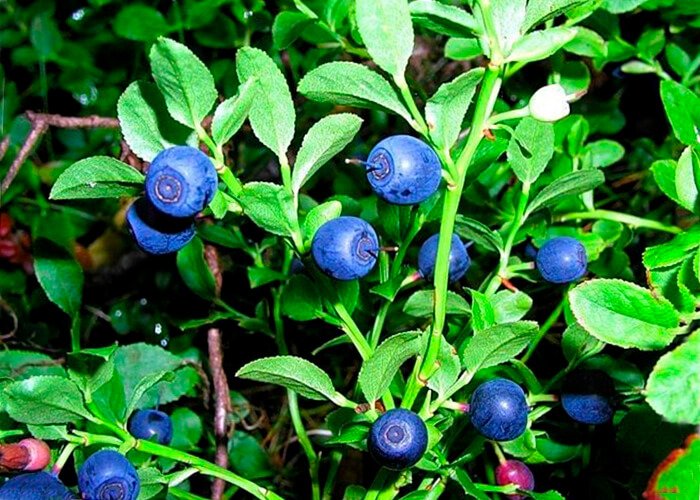
Bilberry spruce forests are the most widespread type, occupying level ground. The soil is wetter here, which means less air reaches the root system, so the trees are somewhat poorer. As the name suggests, bilberry grows abundantly throughout these stands.
Cowberry Spruce Forests (Ельники-брусничники)
Cowberry spruce forests are found on dry, poor soils. The trees grow worse than in the wood sorrel type, and cowberry dominates the ground cover.
Long Moss Spruce Forests (Ельники-долгомошники)
After the green moss group come the long moss spruce forests. Spruce still reigns here, occasionally allowing birch among it, but in this case spruce no longer exerts a decisive influence on the environment. All the spruces in long moss forests are poorer than in the green moss type: they shed their branches badly, are often covered with lichens, and have tapering, cone-shaped trunks.
There is almost no grass cover here — no point going for bilberries or cowberries. Instead, hair-cap moss (kukushkin len) reigns supreme, because long moss forests always have excess moisture. The tapering trunks are explained by the sparse, open canopy, which lets in more light.
Sphagnum Spruce Forests (Ельники сфагновые)
Sphagnum spruce forests form another group, with a large admixture of birch. Spruce grows poorly here and has little or no undergrowth. Sphagnum spruce forests occupy flat, low, very damp sites with peaty, boggy soils — in plain terms, mossy bogs. Sphagnum moss dominates the cover, along with sedge, while hair-cap moss grows on the hummocks.
Grass Spruce Forests (Ельники травяные)
The fourth group comprises grass spruce forests on damp, even wet, soil. Such stands run along the banks of rivers and streams and are flooded by spring meltwater. Birch sometimes lives among them. The trees are tapering in form but of good growth.
Complex Spruce Forests (Ельники сложные)
The fifth group, complex spruce forests, are good, highly productive stands — understandably so, given their fine, rich soils and a level of moisture that is neither too much nor too little. Spruce here either enters the first storey, leaving the second for broad-leaved trees, or forms the second storey itself. This group divides into two types: the linden spruce forest and the oak spruce forest.
The linden spruce forest, as the name implies, grows together with linden, which is content with the second storey. The oak spruce forest is found in the southern part of the forest zone, and it is here that spruce reaches its greatest height — 40 metres.
Pine Forest Types: Bor, Subor, and Sphagnum Pine
Pine forests are just as varied as spruce forests, and the two share a basic similarity: both are coniferous. The same broad groups recur, but now built around pine. There are pine green moss forests, which subdivide into cowberry pine forests, wood sorrel pine forests and bilberry pine forests.

Forest Canopy Structure and Light Penetration
The canopy is the layered roof of leaves and branches that controls how much light reaches the forest floor and thereby shapes everything beneath it. A dense, closed canopy — typical of tropical rainforests and the spruce green moss forests above — casts deep shade, suppresses grass and favours shade-tolerant mosses and herbs, while an open, sparse canopy, as in the long moss spruce forests, lets more light through and changes both undergrowth and tree form. Forests are generally structured into vertical layers: emergent and canopy trees on top, an understory of smaller trees, a shrub layer, and ground-level herbs and mosses.
Light penetration explains many of the differences foresters observe on the ground. Where the canopy is open, trunks taper more strongly toward a conical form, undergrowth thickens, and light-demanding berries and shrubs appear; where it is closed, the forest floor is dim and bare. The understory vegetation and shrub layers therefore act as a readable index of canopy density and site conditions.
Forests and Carbon Storage
Forests are among Earth's largest carbon stores, absorbing carbon dioxide through photosynthesis and locking it into wood, roots, leaf litter and soil. This carbon sequestration makes forests a central tool for climate regulation, alongside the ecosystem services they provide — water regulation, soil protection, biodiversity habitat and benefits to human health. Protecting existing forest keeps that stored carbon out of the atmosphere; clearing it releases the carbon back.
Carbon Sequestration Capacity by Forest Type
Different forest biomes store carbon in very different ways. Tropical rainforests such as the Amazon and the Congo rainforest hold most of their carbon in dense, fast-growing above-ground biomass, while boreal forests store a disproportionate share in deep peat and frozen permafrost soils rather than in their trees. Temperate forests fall between the two, with substantial carbon in both biomass and fertile soils.
- Tropical rainforests — highest biomass carbon, concentrated in living trees and rapid nutrient cycling.
- Boreal forests (taiga) — vast soil and peat carbon stores, vulnerable to permafrost thaw and fire.
- Temperate forests — balanced carbon storage across biomass and deep, organic-rich soils.
Climate Change Impacts on Different Forest Types
Climate change is altering every forest biome, but in different ways. In boreal forests, warming thaws permafrost, lengthens fire seasons and releases stored carbon, while shifting the range of cold-adapted conifers northward. Temperate forests face changing seasonality, drought stress, new pests and diseases, and altered flowering and leaf cycles. Tropical rainforests, including the Amazon, risk drying as rainfall recycling weakens, pushing parts of the forest toward savanna. Cloud forests are especially fragile, because a warming climate raises the altitude at which clouds form, lifting their life-giving mist clear of the mountaintops they depend on.
Threats and Deforestation Drivers
Deforestation is the leading direct threat to the world's forests, driven mainly by the conversion of forest to farmland, pasture and plantations. Logging, road building, mining and urban expansion fragment once-continuous forest into isolated patches, and this fragmentation exposes interiors to drying winds, invasive species and further clearance. Forest fires, increasingly frequent under hotter and drier conditions, compound the loss, while habitat destruction drives steep declines in wildlife populations, as monitored by organisations such as WWF and IUCN.
Commodities Driving Deforestation
A handful of globally traded commodities account for the majority of tropical deforestation. According to analysis by the World Resources Institute, clearing for beef, soy, palm oil, timber and pulp, and to a lesser extent cocoa and coffee, drives most forest loss in the tropics. These supply chains connect everyday consumer goods to the destruction of the Amazon, the Congo Basin Forest and Southeast Asian rainforests, which is why supply-chain reform and certification are central to slowing deforestation.
Forest Conservation Strategies
Forest conservation combines protecting intact forest, restoring degraded land and managing forest resources sustainably. Effective strategies pair legally protected areas with reforestation and natural regeneration, sustainable timber and harvest practices, and community-based forest management that gives local people a stake in keeping forests standing. Large international commitments, such as the Bonn Challenge to restore hundreds of millions of hectares of degraded land, and reforestation organisations including One Tree Planted, EcoMatcher and the conservation work of the California Academy of Sciences, channel funding and planting toward these goals.
Technology increasingly underpins these efforts. Satellite monitoring, drones and remote sensing now track deforestation in near real time, while field surveys by groups like Operation Wallacea ground-truth biodiversity. Individuals and communities contribute too — supporting certified products, funding tree planting, defending local woodlands and reducing consumption of high-deforestation commodities are all concrete actions that add up. Spending time in forests is itself linked to measurable benefits for human health, which strengthens the case for keeping them.
Global Forest Coverage Statistics
Forests cover roughly 31 percent of Earth's land surface, about 4 billion hectares, according to the FAO's Global Forest Resources Assessment 2025. That cover is unevenly distributed: a small number of countries, including the boreal nations and the great tropical basins, hold most of the world's forest, with the Amazon, the Congo Basin Forest and the boreal forests of Russia and Canada among the largest blocks. Net forest area continues to shrink, though the rate of loss has slowed compared with earlier decades, as gains from reforestation in China and elsewhere partly offset tropical losses. The Tongass forest of Alaska and protected areas such as Olympic National Park show how temperate rainforest, with its very high precipitation, persists where it is shielded from clearing.
Frequently Asked Questions About Forest Types
The three main types of forest, classified by climate and latitude, are boreal (taiga), temperate and tropical forests. Boreal forests are the cold, conifer-dominated woodlands of the far north; temperate forests, with their seasonal deciduous and evergreen trees, occupy the mid-latitudes; and tropical forests, the most biodiverse, grow in the warm, wet equatorial belt. Specialised variants — cloud forests, mangroves, Mediterranean, montane and subtropical forests — exist within these broad categories, and at the local scale foresters recognise far finer types such as the spruce and pine forest groups of the taiga described above. For more articles on the natural world, browse the Nature section and related reading on Agriculture.