How a River Flows to the Sea: Obstacles, Forests, and Why Rivers Matter
 libre
libre
A river's journey to the sea is a long struggle against natural obstacles — mountains, gorges, and steep drops — that it either goes around, cuts through, or plunges over as waterfalls. Look at a physical map: mountains are shown in brown, forests in green, and plains in yellow. Winding blue lines run through all of these colours. Those are the rivers. Let us look at the barriers a river overcomes on its way to the sea.

A river on its way to the sea
Why do rivers matter?
Rivers are enormously important, and they can be compared to the network of blood vessels in the human body. If the blood vessels are destroyed, a person falls ill or dies. In the same way, if rivers dry up, a country too is put in danger.
How does forest protect rivers?
Forest is a river's protector. When forests are destroyed, rivers grow shallow and the land turns into bare, barren steppe. In the places where North American Indians once hunted in dense thickets, Americans have cut down no less than 100 million hectares of forest over the past few decades — twice the entire area of France.
One progressive American agricultural specialist stated in an open report:
The depletion of the soil in the United States is happening at a rate that causes serious alarm. Roughly a quarter of all arable land and meadow has already been turned into desert or semi-desert.
By felling forests, timber companies earn millions of dollars in profit, while American grain farmers become poor. The soil is carried away from their fields by water and wind.
What is a river or stream bed?
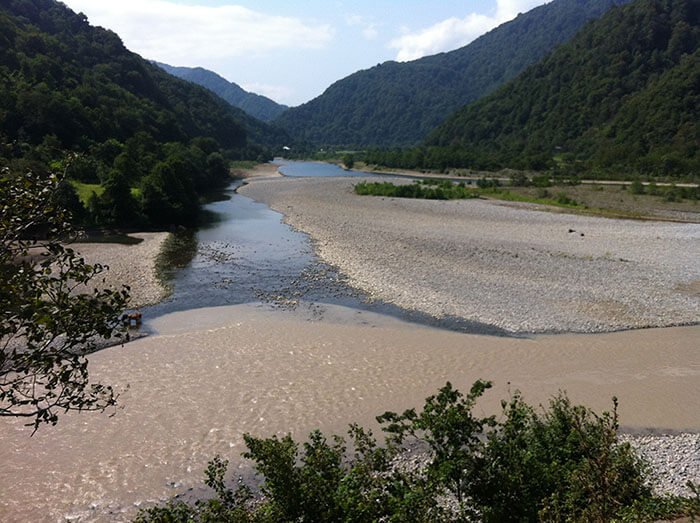
The bed of a stream or river can be thought of as its couch, and the water itself carves it out. Yet the channel bears little resemblance to a real "bed." It is better compared to a long, winding street along which water travels from the mountains down to the sea. On its way to the sea a river is guided by great "signposts" set out by nature. These "signposts" are the slopes, for nowhere is the surface of the earth perfectly level.
It should also be remembered that the earth is a huge sphere. The height of the slopes determines the speed and direction of the flow of water. More than once a river on its way to the sea is halted by mountains. Then it skirts around them or cuts a channel deep into the rock. Just as a powerful saw would, the Rhine and its tributaries have sliced the Rhenish Slate Mountains into large rectangular blocks.
In the same way the Elbe carved into the sandstone cliffs of "Saxon Switzerland." In the western part of South America some rivers have "planed" out a bed for themselves in rocky massifs more than a thousand metres deep.
When the forest is chopped, the chips fly,
says an old proverb. When it is water doing the work, the "chips" are huge fragments of rock swept along by the current. We find them in every mountain river. Yet at river mouths there is only sand and silt. Where did the stones go? On its way to the sea, water grinds down the rock fragments like a mill.
The Danube alone carries into the sea at least 35 million cubic metres of gravel and silt each year, and the Mississippi no less than 200 million. From this mass of material one could, in two thousand years, build the Saxon Ore Mountains with all their peaks. An even more diligent porter is the Yellow River (Huang He).
On its broad back this swift river carries 1,380 million tonnes of yellow, fertile loess into the sea. In 24,000 years it could fill the entire Yellow Sea. The high mountains, meanwhile, grow ever lower. A river on its way to the sea must also overcome other obstacles.
Quite unexpectedly a gorge may appear before it. What is it to do? Leap across? But water is too heavy, and besides, it is no athlete. Nor does a river like to turn aside from its course. And so, like a bold swimmer, it dives into the depths. This falling of a river is what we call a waterfall.
What are waterfalls and where do they form?

For a long time the record-holder for diving "into the depths" was considered to be the Bjølvefossen waterfall in Norway, with a drop of 866 metres.
In 1935, in Venezuela in South America, a new waterfall was discovered. Its drop is 1,010 metres. It was named Angel Falls after the pilot who found it. This is the greatest waterfall in the world, and the other "record-holders" fall well short of it. Here are their "records":
- The waterfall on the Merced River in the Yosemite Valley in California, USA — 792.5 metres.
- The three-tiered Sutherland Falls on the Arthur River in New Zealand — 580 metres.
- Victoria Falls on the Zambezi River in eastern Africa — 119 metres.

Victoria Falls is the widest in the world, measuring 1,800 metres across. Compared with the "top-class" record-holders, Niagara Falls in North America — world-famous as it is — is a mere dwarf. It "leaps" from a height of only 50 metres.
Yet the volume of water that tumbles over its 914-metre-wide ledge in a single minute would be enough to supply a city as large as Leipzig with water for an entire day.
The energy of the water crashing into the depths is so great that a basin 50 metres deep has formed at the foot of the falls. Above, at the lip, the water also strips more than a metre of land away each year. Over 30,000 years the waterfall has retreated significantly, eroding a narrow valley upstream.
And in another 5,000 years it will have retreated back to Lake Erie. By then little will likely remain to remind us that the Seneca Indian tribe lived in this region until the 17th century, and that here, on the border between the United States and Canada, a mighty hydroelectric station once stood. In this way a river shapes its channel on its long way to the sea.