Plumbing and Sanitation in Ancient Rome: Aqueducts, Toilets, and the Cloaca Maxima
 libre
libre
The first plumbing and water systems were built thousands of years before anyone thought to record the names of their inventors. Reference books tell us who devised the steam engine, the aircraft, the incandescent bulb and the radio, and when — yet we search in vain for the people who laid down the first aqueducts and water pipes. What survives instead is the physical evidence: stone-lined wells, gravity-fed channels and sewers left behind by ancient civilizations from the Indus Valley to Rome.
The history of the first water systems in ancient civilizations
Organized water supply and drainage appeared independently across several early cultures, long before the modern era. The engineering principle behind nearly all of them was the same: water flows downhill on its own, so channels, pipes and sewers were laid on carefully calculated slopes to move fresh water in and carry waste water away using gravity alone. This gravity-based flow, requiring no pumps, underpinned the water management of ancient India, China, Egypt and Mesopotamia alike.
Wells and baths in ancient India and China

The Chinese were accomplished well-builders, sinking deep shafts to reach groundwater, though it is far from certain they were the first to channel water to a settlement. In the Indus Valley, the Harappans went considerably further. A few decades ago, archaeologists in the region uncovered stone-lined wells, spacious bathhouses and flushing toilets connected to covered street drains. These Harappan sewage systems were dated to roughly 5,000 years old — among the earliest known examples of urban sanitation anywhere on Earth.
The Minoans of Bronze Age Crete added another early milestone: indoor plumbing. Their palaces featured clay pipes carrying fresh water, drainage channels for waste, and flushing latrines fed by cisterns and rainwater, all decades and centuries ahead of comparable systems elsewhere in the Mediterranean.
Ancient Egyptian water management and drainage systems
Ancient Egypt built its prosperity on managing the flooding of the Nile, developing basin irrigation, dykes and canals to spread and store floodwater across farmland. Beyond agriculture, Egyptian builders installed copper drainage pipes in temple complexes and provided some elite households with bathrooms and simple latrines drained into pits. Egyptian water management therefore combined large-scale flood control with small-scale domestic drainage, a dual approach that echoed through later civilizations.
Irrigation channels of ancient Mesopotamia
Mesopotamia, the land between the Tigris and Euphrates, depended on an extensive network of irrigation channels to farm an otherwise arid plain. Communities dug canals to divert river water to their fields, along with drainage ditches to prevent waterlogging and salt build-up. Mesopotamian cities also constructed some of the earliest known baked-brick sewers and cesspit latrines, showing that the separation of clean supply from waste removal was already a practical concern in the Bronze Age.
Plumbing and water supply in ancient Rome
Ancient Rome was among the first states to pipe water into its capital from distant forests and mountains on a massive scale. By the beginning of our era, the water supply feeding Rome ran as far as the longest water main in modern Germany — the roughly 200-kilometre line linking Bremen with the Harz mountains. This was the backbone of Roman urban development: a reliable public water supply that made dense city living, public baths and fountains possible.
Water sources in the Sabine and Alban Hills
Rome's engineers tapped springs high in the Sabine and Alban Hills and led the water down to the city set on seven hills beside the Tiber River. The earliest of these lines, the Aqua Appia, was commissioned in 312 BC under the censor Appius Claudius, followed by the Aqua Anio Vetus, which drew on the Anio river. Choosing pure, high-altitude sources was deliberate: elevation gave the water the height it needed to flow the whole way into the city by gravity.
Aqueducts: an engineering wonder of ancient Rome
Where mountains blocked the path, Roman engineers drove tunnels through them, and where valleys interrupted the line, they carried the channel across on tiers of stone arches — the aqueducts. These structures maintained a gentle, continuous downward gradient over huge distances so that the water never stopped moving. The durability of the Roman aqueducts is astonishing: many still stand today, and their surviving arches remain among the most recognizable monuments of Roman engineering. Their longevity reflects both the quality of Roman concrete and the precision of the surveying that set each slope.
Lead pipes and mountain tunnels
From the mountain springs, the water was carried into the city partly through large lead pipes, the standard plumbing material of the Roman world. Lead pipes (from the Latin plumbum, the root of the word "plumbing") were easy to cast and shape, which is why they were used so widely. They also carried a hidden cost: lead leaching into drinking water is a genuine health hazard, and although Romans could not have understood it in modern terms, the writer Vitruvius already warned that clay pipes gave healthier water than lead. Modern assessments suggest fast-flowing water and mineral scale limited the exposure, but the lead pipes of ancient plumbing remain a cautionary chapter in the history of water systems.
Construction timeline and engineering methods
Rome's aqueduct network was built up over roughly five centuries, from the Aqua Appia in 312 BC through eleven major lines serving the imperial city. Construction relied on careful levelling instruments to hold gradients as shallow as a fraction of a metre per kilometre, on tunnelling crews working from both ends of a bore to meet in the middle, and on masonry arcades where the ground fell away. The scale of the effort turned water supply into a permanent state project rather than a one-off feat, and the resulting infrastructure directly supported the stability and reach of the Roman Empire.
Maintaining Rome's water network
A standing workforce of some seven hundred labourers and technicians was always on call to repair faults anywhere in this enormous water network. Oversight fell to a water commissioner; Frontinus, appointed to the post under Emperor Nerva, wrote a detailed treatise on the aqueducts, their sources, capacities and the fraud he uncovered among people illegally tapping the supply. This administrative machinery — inspection, maintenance and enforcement — was as much an innovation as the pipes themselves.
Water outlets in patrician homes

Roman patricians who had grown rich through war and trade could obtain a private water connection in the home, effectively an early form of indoor plumbing reserved for the elite. Securing one meant buying a tap stamped with the imperial seal from the city's water official — a licence as much as a fitting. These household connections marked a clear social-class distinction: running water indoors was a privilege of the wealthy, while ordinary residents drew their water from the public fountains in the streets.
Water consumption: a million cubic metres a day
Roman water taps were cast from costly metal but shared one telling flaw: they could not be shut off. Water in Rome ran from the taps day and night, and over a single day the city used a colossal amount — around a million cubic metres, the volume of a whole lake, spent usefully and wastefully alike. That quantity would be enough to fill a large modern reservoir to the brim in about six days. The constant flow was not carelessness so much as a design choice: continuous movement kept the pipes flushed and the public fountains always supplied.
Sanitation and sewage in ancient Rome
Alongside its water supply, Rome built one of antiquity's most extensive sanitation systems, though its logic differed sharply from modern ideas. Roman sewers were designed primarily to drain surface water and keep the streets from flooding; carrying away human waste was a secondary function. This distinction — drainage versus waste removal — explains many puzzling features of Roman public health, and it has been closely studied by researchers such as Ann Olga Koloski-Ostrow of Brandeis University, author of The Archaeology of Sanitation in Roman Italy.
The Cloaca Maxima: construction and purpose
The Cloaca Maxima, or "Great Sewer," was Rome's central drainage channel, begun under the Etruscan kings to drain the marshy ground of the future Forum Romanum and empty it into the Tiber River. Originally an open canal, it was gradually vaulted over with stone and expanded by Roman engineers into a covered trunk sewer. Its main job was managing storm water and standing water rather than sewage, and the Romans even personified it with a protective deity, Cloacina, later merged with the goddess Venus. Sections of the Cloaca Maxima remain in use as part of Rome's drainage to this day, a testament to the longevity of Roman engineering.
Public latrines and foricae
Roman cities provided communal public toilets known as foricae — long benches of stone or wood pierced with holes, seating many people at once with no partitions between them. These public latrines drained into channels flushed by waste water from the baths, and reflected a Roman attitude to privacy quite unlike our own, since using the toilet was a social, communal act. For cleaning, users shared a tersorium, a sponge fixed to a stick rinsed in water or vinegar. The foricae were far from safe or clean: they could harbour vermin, emit dangerous sewer gases that sometimes ignited, and connect directly to the pests and hazards below, which is one reason many superstitious Romans associated latrines with the whims of the goddess Fortuna and kept protective images nearby.
Central fountains and public baths
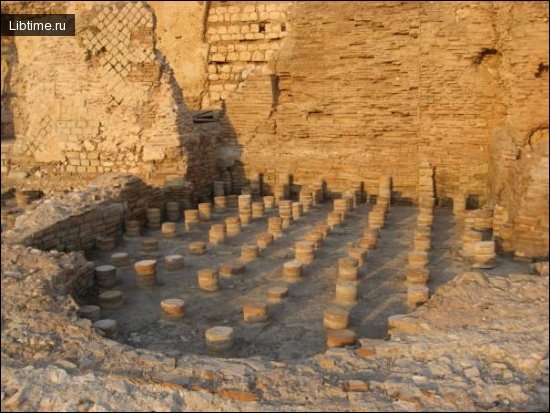
Public fountains supplied everyday drinking and washing water for the majority of Romans, while the great public baths, or thermae, were the centre of hygiene and social life. Bathhouses offered heated rooms, hot and cold pools and a routine of bathing that Romans regarded as thoroughly clean. In practice the shared, infrequently changed bath water — often used by the sick and healthy together — could spread infection rather than prevent it, so the thermae's real contribution was as much social and cultural as it was sanitary.
Disease transmission through public facilities
Despite their impressive plumbing, Romans suffered heavily from intestinal parasites and waterborne disease. Archaeological studies of latrine deposits and preserved remains show that whipworm, roundworm and amoebic dysentery were common across Roman settlements, and parasite levels did not fall — and may even have risen — compared with earlier, less "sanitary" societies. Several factors drove this: shared toilet sponges spread infection, warm bath water incubated microbes, and a crucial agricultural practice closed the loop. Because germ theory lay nearly two millennia in the future, Romans could not connect their facilities to the illnesses those facilities helped transmit.
Waste as fertilizer and street sanitation
Roman farmers routinely collected human excrement from cesspits and latrines to spread on fields as fertilizer, a resourceful practice that also seeded food crops with parasite eggs and re-infected the population through the food supply. Many Roman homes had private latrines placed over cesspits rather than connected to the street sewers — households deliberately avoided sewer connections, since an open link to the Cloaca Maxima could let rats, smells and backflow into the house. Street sanitation elsewhere was patchy, with waste and refuse a persistent problem in the crowded quarters of Rome and its port at Ostia.
Archaeological evidence for Roman sanitation
Most of what is known about Roman toilets, drains and baths comes from archaeology rather than written records, since ancient authors rarely described such everyday matters in detail. Excavated latrines, sewer channels, pipes and even fossilized parasite eggs allow researchers to reconstruct how these systems worked and how well they protected health. The University of Cambridge and other institutions have applied modern laboratory analysis to sediment and human remains to trace disease and diet across the Roman world.
Finds at Pompeii and Herculaneum
Pompeii and Herculaneum, buried and preserved by the eruption of Mount Vesuvius in AD 79, offer the fullest picture of Roman domestic sanitation anywhere. Their streets, private latrines, cesspits, water pipes and public fountains survive largely intact, showing how toilets were commonly placed in or beside kitchens and how upper-class homes maintained private facilities apart from the public foricae. Analysis of cesspit contents at these sites has revealed diet, parasites and waste-disposal habits in remarkable detail, making the two towns central to the study of Roman public health.
Remains of Roman water systems in Germany: Mainz, Cologne, Trier and Aachen
In old Germany, then a Roman province, the Romans built many water systems whose remains are still found today in the cities of Mainz, Cologne, Trier and Aachen. Similar frontier infrastructure survives along Hadrian's Wall in Britain, where forts such as Housesteads Fort preserve communal military latrines fed by drainage channels. These provincial remains show how Roman sanitation and water supply spread with the empire, carrying the same engineering across thousands of kilometres from the capital.
Comparing ancient and modern water systems
Ancient and modern plumbing share the same physical foundation — moving water by gravity along controlled slopes — but differ profoundly in purpose and safety. Roman aqueducts still impress engineers today, yet a modern city like New York depends on filtered, chlorinated supplies and sealed sewers that isolate waste from drinking water entirely, something no ancient system achieved. The gap is less about raw engineering skill than about understanding disease.
How Roman and modern sanitation concepts differ
The decisive difference between Roman and modern sanitation is the deliberate separation of fresh water and waste water, driven by the germ theory of disease. Roman sewers mixed drainage and sewage and discharged untreated into the Tiber, and Romans reused waste as fertilizer without any sense of contamination. Modern sanitation, by contrast, treats sewage, keeps supply and waste in wholly separate networks, and relies on routine maintenance and inspection by firms such as Sanitary Plumbing to keep those networks sealed. The Roman achievement was scale and durability; the modern achievement is preventing the disease that scale alone could not stop.
Comparison with other ancient civilizations
Rome was neither the first nor the only civilization to master water and waste — it was the one that industrialized the effort. The Harappans of the Indus Valley had covered street sewers and household toilets far earlier; the Minoans of Crete had flushing indoor plumbing; Mesopotamia dug irrigation canals and brick drains; and the Maya civilization built pressurized water features and reservoirs in the Americas. What set Rome apart was the sheer scale, standardization and reach of its aqueducts, baths and sewers, spread deliberately across an entire empire rather than confined to single cities.
The decline of Roman water systems during the Great Migration
During the age of the great migrations — the movements of Germanic, Slavic and other peoples between the 3rd and 7th centuries AD — much of what many hands had built was destroyed, including the water systems of ancient Rome. As aqueducts fell into disrepair and cities shrank, Europe entered the Middle Ages with far less running water than the Roman world had enjoyed. Water could laugh at human short-sightedness: once again people had to carry it by hand from springs and wells, and centuries would pass before urban plumbing recovered the reach the Romans had achieved.