Doctors of Chinese Medicine: History, Pioneers, and Ancient Healing Traditions
 libre
libre
Traditional Chinese Medicine doctors emerged as a distinct professional class in China even before the Three Kingdoms period, building a body of knowledge that still informs how licensed practitioners diagnose, treat, and prevent illness today. The tradition combines acupuncture, Chinese herbal medicine, therapeutic exercise, and a holistic view of health that has spread far beyond China into modern integrative clinics.

What is Traditional Chinese Medicine
Traditional Chinese Medicine (TCM) is a complete system of health care that originated in China more than two thousand years ago and treats the body, mind, and spirit as one interconnected whole. Rather than targeting an isolated symptom, TCM aims to restore balance across the entire person, which is why it is often described as a holistic and preventative approach to medicine.
Definition and core terms of Chinese medicine
The foundational concept in Chinese medicine is Qi, the vital energy believed to flow through the body along channels called meridians. Health, in this framework, is the smooth and balanced movement of Qi, governed by the complementary forces of yin and yang; illness is understood as a blockage, deficiency, or imbalance in that flow. These philosophical foundations distinguish TCM from Western biomedicine and shape every diagnostic and treatment method that follows.
Key practices and methods of Chinese medicine
Chinese medicine works primarily through a small set of core practices, each aimed at rebalancing the body's energy and function:
- Acupuncture — inserting fine needles at specific points along the meridians to regulate the flow of Qi.
- Chinese herbal medicine — individualized herbal formulas combining multiple ingredients to treat the root cause and the symptoms together.
- Cupping — applying suction cups to the skin to stimulate circulation and relieve muscular tension.
- Tui na and therapeutic massage — manual techniques that manipulate soft tissue and acupressure points.
- Therapeutic exercise — movement systems such as qigong and tai chi that support the prevention and treatment of disease.
Medicine of ancient China: formation and development
The history of Chinese medicine reaches back many centuries before the common era, evolving through the earliest dynasties into a systematized body of clinical knowledge. Understanding this medicine of ancient China shows how modern acupuncture and herbal practice inherited principles refined over thousands of years.
Medical practices of the Shang dynasty and early dynasties
Medical practice in China during the Shang dynasty and the early dynasties already combined ritual, herbal remedies, and close observation of illness, laying the groundwork for the theoretical medicine that appeared later. Over these centuries Chinese healers accumulated the empirical experience that would eventually be codified into classic texts and organized medical theory.
Development of communal hygiene
At the turn of the first and second centuries BCE, the rapid growth of cities in China gave rise to the development of communal hygiene. Careful inspections of the sanitary condition of major centers began, and public latrines and sewer works were constructed.
A regulated schedule for government officials (a rest day after every five working days), state hospitals, and care for pregnant women all testify to significant progress in hygiene in China. A record from 186 CE mentions that a certain Bi Fun built a watering machine for the sanitary cleaning of cities.
The Great Silk Road and the exchange of medical knowledge
During the same period another event occurred that would later carry great significance for medicine. An envoy of Emperor Wu Di named Zhang Qian twice traveled to Central Asia and northern India — in 138–126 BCE and again in 115 BCE.
These journeys opened communication between China and the lands lying to its west. The caravan route known in history as the Great Silk Road served not only merchants, advancing trade, but also physicians, enriching their knowledge and expanding their arsenal of therapeutic methods and remedies.

The systematization of medical knowledge and the first books
By the end of the first century BCE so much data on Chinese medicine had accumulated that it became necessary to revise and edit at least part of the books published by that time. Extensive work in this direction was carried out in 22 BCE by Li Zhu-cho.
He processed seven treatises on various questions of treatment and eleven prescription reference works, systematizing and unifying much information that had been written in the obscure ancient literary language "guwen." The chronicles note that in 5 CE the government convened those engaged in medical practice in order to generalize, systematize, and record the most valuable medical knowledge — an early example of the state's role in standardizing Chinese medicine.
The consolidation of feudal order proceeded amid intense class struggle. At the turn of the era, mass uprisings of slaves and impoverished peasants broke out one after another, and dissatisfaction with the new forms of life was voiced even by some groups within the ruling class. Under pressure from both sides, the First, or Western, Han dynasty collapsed, giving way in 25 CE to the Second, or Eastern, Han.
Its first emperor, Liu Xiu, was compelled to grant freedom to slaves of various categories and to reduce certain taxes on the peasantry. But the empire had scarcely recovered from internal upheaval before it had to wage wars against the Xiongnu. Only at the end of the first century did the Chinese army, led by the general Ban Chao — who managed to win over the tribes of the "Western Region" (Eastern Turkestan and Central Asia) — inflict a decisive defeat on the enemy.
The Great Silk Road was restored once more, and caravans carried along it silk, valued in the Mediterranean at its weight in gold, along with iron and articles of white ceramics and lacquer. Chinese merchants reached the Persian Gulf and traded briskly there not only with Arabs but with Romans. Yet the peaceful flourishing did not last long. In 184 CE the "Yellow Turbans" movement began.
The rebels burned government offices, seized the lands of great feudal lords, and freed slaves. Only after twenty years of struggle did the ruling class manage to suppress the popular movement. But it had already so shaken the foundations of the Han empire that it soon fell, and China was divided into three warring parts.
Eminent doctors of Chinese medicine
The great physicians of ancient China gave the tradition its clinical backbone, each advancing a distinct field — surgery, internal medicine, and pharmacology — that later practitioners still study. Their biographies show how Chinese medicine developed through individual mastery combined with careful documentation.
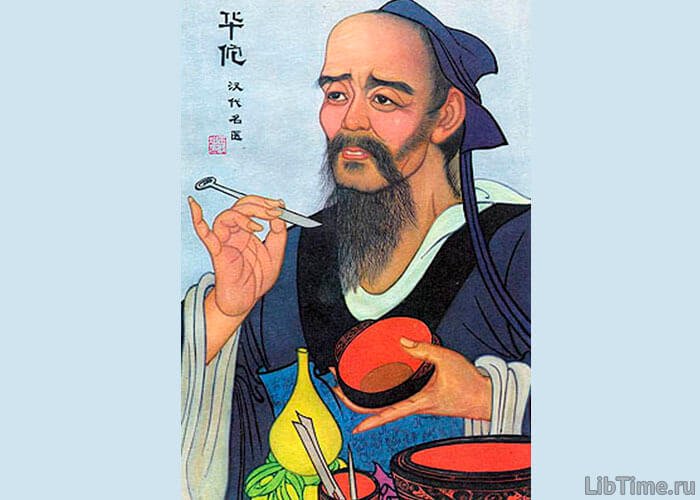
Hua To — founder of surgery in China
The name Hua To is linked in China with everything relating to surgery, and he is regarded as the founder of that field of medicine. Hua To was born in 141 CE in the district of Qiao near Nanjing, in Bo county, Anhui province, and died in 208 CE. He was the foremost physician of his time, a scholar with broad knowledge across every area of medicine.
According to his contemporaries, Hua To attained great mastery in both diagnosis and treatment, but his achievements in treating surgical conditions were especially remarkable, which is why he is rightly considered the founder of surgery in China.

History has preserved much information about the life and work of Hua To. It was reliably known that in his practice he widely applied general anesthesia, giving patients special narcotic decoctions and using for this purpose hashish, opium, and Indian hemp.
Under this general anesthesia he performed operations, including on the organs of the abdominal cavity. He washed surgical wounds with a special solution and skillfully sutured them. Open wounds Hua To treated with solutions, ointments, and plasters, and for bone fractures he applied fixation of the injured limb.
Giving much attention to questions of personal hygiene and the prevention of disease, Hua To constantly promoted the use of therapeutic physical exercise for the prevention and treatment of illness — an early expression of the preventative philosophy that still defines Chinese medicine, and a reminder that medical gymnastics was integral to his method.
He developed a system of physical exercises based on the "movements of five animals: the crane, deer, monkey, bear, and tiger" (the "wu-qin-xi" method). This gymnastics is still used by Chinese medicine today and is considered among the most valuable of the many physical culture methods.
The biography of the famous surgeon abounds in accounts testifying to his high moral character and outstanding surgical skill. Here, for example, is the description of one case from Hua To's rich practice.
"The emperor's brother, the renowned general Guan Gun, was wounded in the arm by a poisoned arrow. Hua To, examining the wound, said it had been inflicted not by an ordinary bow but by one drawn with the aid of a special device. The poison saturating the arrow was 'wu-tou.' It had passed through skin and muscle and penetrated the bone. 'If the wound is not treated as soon as possible, the whole arm will have to be amputated,' Hua To concluded.
Having obtained permission to operate, he gave Guan Gun a pain-relieving medicine to drink, then took a pointed knife, cut the soft tissues around the wound, and exposed the bone. It could be seen that the poison had penetrated the bone, which had turned dark blue. The surgeon scraped away with his knife everything saturated with poison. Then he took a special powder and dusted it inside the wound, and sutured the outside with thread.
Some time later, the biographer continues, Hua To was invited to attend the prince of the state of Wei, Cao Cao, who suffered from severe headaches.
"Your illness,"
said the surgeon after examining the prince,
"is lodged in the brain. I will give you the medicine 'mafei tang,' and you will fall asleep. I will open the skull with a sharp instrument and use the best means to cure the brain, then apply a plaster to the wound and suture it."
"How will you open the skull?"
Cao Cao asked in astonishment.
"But Guan Gun was ill too,"
Hua To replied,
"I scraped the poison from the bone, and he recovered."
"Bone,"
Cao Cao objected,
"can be scraped and cut, but the skull cannot be opened. You know that Guan Gun and I are enemies, and you have come here with an evil purpose, for which you will pay with your life."
Accused of an attempt on the prince's life, Hua To, awaiting execution, told the jailer where the books he had written were hidden and entrusted him to preserve them. The jailer fulfilled the request, but his wife, fearing persecution for such an act, secretly burned Hua To's works. Only a few pages survived, dealing with remedies for treating domestic animals."
Hua To wrote, according to his contemporaries, many works. Among them are named the books:
"Nei zhao tu" ("Depiction and Explanation of the Inner Person"), "Zhong zang jing" ("Book of What Is Hidden Within the Body"), "Hua To fang" ("Prescriptions of Hua To"), and others.
His disciples and physicians of later generations wrote much about Hua To's work, but the recipes for the narcotic agents he used for general anesthesia, and the medicines the scholar used in treating surgical conditions and operations, remained the secret of a few of his students and were then lost entirely.
Hua To's outstanding medical knowledge, his high surgical technique, and his lofty moral character earned him a fame that has not faded to this day. His tomb is protected by the people, and his memory lives in the hearts of ordinary people. His life served, and still serves, as a vivid example of the high moral qualities of a physician and a citizen.
Other great physicians and their contributions to medicine
A contemporary of the famous surgeon Hua To was the founder of Chinese internal medicine, Zhang Zhong-jing. He was born in 150 CE and died in 219 CE during the Eastern Han dynasty. His birthplace is considered to be Niyang county in the northern part of Hubei province.

He was a broadly educated man for his time and served as an official (mayor) of the city of Changsha in Hunan province. Zhang Zhong-jing became interested in medicine early and studied it thoroughly, having the opportunity to learn from the most renowned physicians. The scholar collected all the knowledge available before him about medicines and their action, about prescriptions and dosage forms, and verified, systematized, and described all of it.
In addition, he studied febrile diseases and the action of various medicines against them, which became the basis of a major sixteen-volume work on febrile diseases, the "Shang han lun." In its twenty-two chapters Zhang Zhong-jing set out 357 methods of treating these diseases, which in his view were caused by external factors, and divided them into six groups depending on symptoms and the character of the pulse. He based their treatment on two principles:
- the individualization of treatment;
- treatment by acting on the individual symptoms of the disease.
In his famous work the scholar set out 112 of the most important prescriptions he used in cases of fever. In studying medicines, Zhang always dwelt in detail on defining the indications and contraindications for their use in different clinical syndromes — and this was something new in Chinese medicine.
A highly progressive scholar who constantly fought against conservatism, Zhang nonetheless always warned against careless and rash actions in treatment, urging that the patient first be examined thoroughly, the symptoms weighed, and the illness identified before treatment was begun.
Zhang Zhong-jing was skilled at distinguishing the symptoms of disease that signaled approaching danger to life, and he identified symptoms characteristic of a patient's hopeless condition. In his interpretation of the causes of disease, Zhang Zhong-jing stood firmly on materialist positions.
He lived at a time when the philosophical doctrine of the five "basic factors" and the six so-called "qi," influencing the spread and outcome of disease, was widespread in China. There was much that was idealist and mystical in this doctrine, against which Zhang actively spoke out, never using it in his interpretation of illness.
Somewhat later the physician Huang Su-he reworked Zhang's book on febrile diseases, generalized the subsequent experience, and identified and more clearly described diseases such as cholera, typhus, rheumatism, and others. This work has survived to our day under the general title "Golden Safe." It has been reissued many times and still serves as a reference manual for folk physicians today.
Later a certain physician, Ko Hong, on the basis of Zhang Zhong-jing's works and subsequent practical experience, wrote three books — "Shang han lun," "Qing kun ma lue," and "Qing kun yu han qing" — which were, and still are, a valuable teaching aid in the training of Chinese physicians.
Zhang Zhong-jing is rightly called the progenitor of internal medicine in China, just as Hua To is called the progenitor of surgery.

Later masters continued this lineage of scholarship. Li Shizhen compiled the monumental Compendium of Materia Medica (Bencao Gangmu), one of the most comprehensive pharmacological texts in Chinese history, while Hua Shou advanced the study of the meridian system. Together with the foundational classic Huangdi Neijing (the Yellow Emperor's Inner Canon), these works form the literary spine that modern Chinese medicine training still draws upon.
Treatment methods in Chinese medicine
Chinese medicine treats illness through several complementary methods, chief among them acupuncture, herbal formulas, and dietary and lifestyle guidance, all applied according to an individualized diagnosis. Each method aims to correct the underlying imbalance rather than merely mask a symptom.
Acupuncture and pain management
Acupuncture manages pain by inserting fine needles at specific points to stimulate the nervous system and regulate the flow of Qi, which practitioners and many patients report reduces both acute and chronic pain. It is one of the most researched components of Chinese medicine and is frequently used as a non-surgical option for back pain, joint pain, headaches, and even as a considered alternative for those weighing knee surgery.
Specializations in acupuncture
Acupuncture has developed distinct specializations, each adapting needle technique to a particular clinical goal:
- Chinese Head Acupuncture — scalp points used for neurological conditions and stroke rehabilitation.
- Sports medicine acupuncture — treatment of athletic injuries and musculoskeletal recovery.
- Fertility and women's health acupuncture — supporting menstrual regulation, fertility, pregnancy, and menopause.
- Pain-management acupuncture — targeted relief for chronic and post-operative pain.
Institutions such as the Chengjiang Acupuncture School and academic centers like China Medical University Hospital (CMUH) in Taichung have formalized much of this training, and researchers including Ching-Liang Hsieh and Yu-Chen Lee have published clinical studies on acupuncture for stroke and neurological recovery.
Sensations and side effects of acupuncture
During acupuncture, most patients feel a mild tingling, heaviness, warmth, or a dull ache around the needle — a sensation traditionally called "de qi" that signals the point has been activated. Side effects are generally minor and may include slight bruising, temporary soreness, or brief lightheadedness, which is why treatment should always be performed by a licensed acupuncturist using sterile, single-use needles.
Chinese herbal formulas and supplements
Chinese herbal medicine treats patients with carefully combined formulas rather than single herbs, pairing ingredients so that they reinforce one another and offset potential side effects. A trained practitioner adjusts the formula to the individual's diagnosis, and quality-controlled, professionally prescribed herbs are essential to safety, since unregulated products can carry contamination or interaction risks. Historically, ethical practice has also required avoiding ingredients derived from endangered species, an issue tied to wildlife smuggling that reputable clinics reject in favor of sustainable substitutes.
Gastroenterology in Chinese medicine
Chinese medicine addresses digestive disorders — a field aligned with gastroenterology — by treating conditions such as bloating, chronic indigestion, irritable bowel symptoms, and appetite disturbances through herbal formulas, acupuncture, and dietary therapy. The emphasis is on restoring the healthy function of the digestive system as a whole rather than suppressing a single symptom, consistent with the holistic model that runs through all of Chinese medicine.
Conditions and diseases treated by Chinese medicine
Chinese medicine is used to treat a wide range of conditions, from chronic pain and neurological disorders to women's health, digestive complaints, and mental health concerns. Its practitioners often work alongside conventional physicians, and the specialties treated include:
- pain management, sports injuries, and post-stroke neurological rehabilitation;
- women's health and fertility, including menstrual disorders, infertility, pregnancy support, and menopause;
- dermatology and allergic diseases;
- internal medicine, endocrinology and diabetes education, and immunology;
- oncology support, pediatrics, and family and community medicine.
Treatment of anxiety and stress
Chinese medicine treats anxiety and stress by combining acupuncture, calming herbal formulas, and lifestyle guidance to regulate the body's response and restore balance to the mind and body together. Because TCM views mental and physical health as inseparable, treatment for depression and anxiety is approached as part of overall wellbeing rather than as an isolated diagnosis.
Combining Chinese medicine with modern medicine
Combining Chinese medicine with conventional Western medicine — an approach known as integrative medicine — lets patients use acupuncture and herbal therapy alongside pharmaceutical treatment, surgery, and diagnostics. Many hospitals now house integrative programs, and institutions such as Oregon Health & Science University (OHSU) and its OHSU Center for Women's Health in Portland, OR, have explored acupuncture as a complement to reproductive and women's care overseen by a Reproductive Endocrinologist (RE).
Clinical trials in Traditional Chinese Medicine
Clinical trials in Traditional Chinese Medicine test acupuncture and herbal therapies using controlled research methods to establish which treatments produce measurable benefits. Academic centers including China Medical University Hospital (CMUH) and its Department of Traditional Chinese Medicine, along with researchers such as Hung-Rong Yen, Sheng-Teng Huang, and Lun-Chien Lo, have contributed peer-reviewed studies, while professional bodies like the World Federation of Chinese Medicine Societies and the World Congress of Chinese Medicine Societies work toward international standards.
Comparison with other traditional medicine systems
Traditional Chinese Medicine differs from other traditional systems — such as India's Ayurveda — in its specific theory of Qi, meridians, and yin-yang, though scholars including Charles Leslie and Nathan Sivin have shown that these systems share a common emphasis on balance and holistic care. TCM's adoption across the Sinosphere and its later spread internationally have made it one of the most widely practiced traditional medical systems in the world.
Criticism and debate about the effectiveness of Chinese medicine
Chinese medicine faces ongoing scientific criticism, with skeptics arguing that some of its theoretical foundations lack biological evidence and that certain claims fall into the category of pseudoscience. Supporters counter that specific interventions — acupuncture for particular kinds of pain and nausea, and several standardized herbal formulas — are supported by clinical trials, and that the honest position is to distinguish evidence-backed treatments from those still unproven. This debate also includes valid concerns over the safety of some herbs and the historical use of endangered-species ingredients, which reputable practitioners now avoid.
How to choose a Chinese medicine doctor
Choose a Chinese medicine doctor who is a licensed acupuncturist with verifiable training, board certification, and experience in the condition you want treated. Practical criteria to check include:
- Credentials and training — a degree from an accredited institution such as the Fujian University of Traditional Chinese Medicine, and licensure recognized in your state or country.
- Professional memberships — affiliation with bodies such as the American Association of Acupuncture and Oriental Medicine, the American TCM Society, or the United Alliance of New York State Licensed Acupuncturists.
- Specialization — experience in your specific need, whether pain management, fertility, dermatology, or internal medicine.
- Clinic information — clear appointment scheduling, transparent locations and hours, and accessible patient support.
- Reputation — patient testimonials, documented case studies, and any recognition by outlets such as CNN or NBC.
Many established practices are multi-generational family clinics whose practitioners trained in China before becoming licensed abroad, and a strong practice will explain its holistic, patient-centered philosophy and how it integrates with your conventional care during a first consultation.