How to Grow Onions: Seeds, Bulbs, Pots and Water Methods
 libre
libre
Onions are one of the most widely used food crops in the world, valued fresh, fried, pickled, and as a base for countless dishes. The onion (Allium cepa) is eaten in nearly every cuisine and is processed in large volumes by the meat- and fish-canning industries for fillings and seasonings. Because demand is so steady, growing onions is rewarding for both home gardeners and commercial farms, and it can be done from seeds, sets, or transplants. After tomatoes, the onion is among the most popular vegetables on the table.
Why grow onions: value and uses
Onions earn their place in the garden because they combine culinary versatility, long storage life, and genuine health benefits. The flavor ranges from sharp and pungent in storage types to mild and sugary in sweet varieties, so a single crop can supply everything from caramelized onions to fresh salad rings. Homegrown onions also outperform many store-bought bulbs on freshness and on the range of varieties available, since seed catalogs offer dozens of cultivars that never reach supermarket shelves.
Onions deliver real nutritional value as well as flavor. They are low in calories, contribute vitamin C, B6, folate, and potassium, and supply sulfur compounds and the antioxidant flavonoid quercetin that give onions their reputation as a healthful food. Red onions in particular carry anthocyanin pigments in their skins. Including a variety of onions in year-round meal planning is an easy way to add flavor without fat or salt.
Medicinal properties of onions
Onions have been used medicinally since antiquity, prized for antibacterial and preservative qualities long before the chemistry was understood. 
Onion varieties and types
Onions divide into bulbing onions grown for storage and bunching onions grown for green tops, and the right variety depends on how you intend to grow and use the crop. Bulbing onions form a swollen storage bulb and are classified by day length — short-day, intermediate-day, and long-day — while bunching onions and scallions produce slim, leek-like stems harvested young. Sweet onions, red onions, and yellow storage onions each suit different culinary roles, from raw eating to long winter keeping.
Day length is the single most important trait when choosing a bulbing variety, because onions are biennials that bulb in response to daylight hours:
- Short-day onions bulb when days reach about 10–12 hours and suit southern regions below the 35th parallel — examples include the 1015Y Texas SuperSweet Onion, Texas Grano 502 Onion, Texas Early White Onion, Red Creole Onion, and Yellow Granex Bulbing Onion.
- Intermediate-day onions bulb at roughly 12–14 hours and perform across a wide middle band — Candy Hybrid Onion F1, Onion Candy F1, Red Rock Bulbing Onion, Gold Coin Onion, and Vidora Hybrid Onion F1 are common choices.
- Long-day onions need 14–16 hours and are grown in northern regions for excellent storage — Walla Walla Bulbing Onion, Copra, Patterson, Red Wing, Newberg, Red Burgundy Onion, and Onion Red Baron belong here.
Sweet Spanish onions deserve their own mention because they are large, mild, and a favorite for fresh use rather than long storage. The Walla Walla Onion from the Pacific Northwest and the famously sweet Vidalia-style Granex types are juicy and low in pungency. Specialty shapes such as the flat Cipollini Red Onion and the elongated Torpedo Onion add variety for roasting and grilling.
Varieties for growing from seed (chernushka)
Growing onions from seed gives the widest variety selection and is the route to large storage bulbs in a single season where the climate allows. Traditional regional seed varieties suited to direct sowing include Krasnodarsky, Lugansky, Strigunovsky, and Karatalsky. Hybrid F1 onion seeds such as Candy Hybrid Onion F1, Onion Blush F1, Onion Expression F1, and Vidora Hybrid Onion F1 offer uniformity, vigor, and disease tolerance that open-pollinated types may lack.
Varieties for growing from sets
Onion sets are small, immature bulbs grown the previous season and replanted to produce a mature onion quickly and reliably. Lugansky and Strigunovsky are dependable for set production. Sets are the easiest method for beginners because they tolerate cold, establish fast, and sidestep the slow, fragile seedling stage — though they offer fewer varieties than seed and are slightly more prone to bolting than transplants.
Varieties for green tops (bunching onions, chives)
Bunching onions and scallions are grown for their tender green stems rather than a bulb, and they regrow repeatedly through the season. Welsh bunching onion (lук-batun) and chives (shnitt) are the classic perennial choices, while named bunching cultivars include the Evergreen Bunching Onion, White Lisbon Bunching Onion, Red Beard Bunching Onion, Warrior Bunching Onion, Tokyo Onion, and the productive White Bunching Onions. The Egyptian Walking Onion and Thom Multiplying Onion are perennial multipliers that spread on their own and supply green onions almost year-round.
Varieties for forcing green tops in early spring
For the earliest spring greens, multiplier and shallot types force quickly into leaf when planted densely. Kubansky Yellow shallot and the D-322 cultivar are traditional forcing choices that produce abundant green onions before bulbing crops are ready.
Shallots and their characteristics
Shallots are a distinct, mild-flavored member of the onion family that multiplies into a cluster of small bulbs from a single planting. They store well, divide readily for replanting, and carry a refined, slightly sweet taste prized in cooking. Shallots can be grown from sets or seed and are an efficient way to produce many small bulbs from limited space, making them a useful companion to standard bulbing onions.
Choosing onion seeds: quality and preparation
Good onion seed is the foundation of a good crop, because onion seed is short-lived and germination drops sharply with age. Onion seed typically stays viable for only one to two years, far less than most vegetable seeds, so buy fresh seed each season and check the packet's germination test date. Reputable suppliers such as Harris Seeds, Hoss, and similar seed houses publish germination rates, seed count per packet, and pricing, and many offer organic, non-GMO, and pelleted options.
Seed format and packaging affect both planting and price:
- Regular (raw) seed is least expensive and sold by count or weight, ideal for dense sowing and large plantings.
- Pelleted seed is coated to a uniform round size for easier, more precise spacing — useful for direct seeding and seeders, though it costs more and may germinate slightly slower.
- Organic and non-GMO onion seed suits gardeners growing to organic standards; onions are not sold as GMO, so "non-GMO" simply confirms conventional breeding.
- Packet sizes range from small home packets of a few hundred seeds to bulk quantities for market growers.
Before sowing, test older seed for viability by germinating a small sample on damp paper, and store unused seed cool, dark, and dry in a sealed container to preserve what life remains. Proper seed storage slows the natural decline in germination and protects your investment.
Methods of growing onions
Onions can be grown three ways — direct seeding, sets, or transplants — and each balances cost, speed, and the size of bulb you can expect. Direct seeding is cheapest and offers the most varieties but takes a full season and demands weed control during the slow seedling stage. Sets are the fastest and most forgiving. Transplants split the difference, giving seed-level variety choice with a head start on the season.
The table below compares the methods at a glance:
| Method | Variety choice | Speed | Best for |
|---|---|---|---|
| Direct seeding | Widest | Slowest | Large storage bulbs, long seasons |
| Sets | Limited | Fastest | Beginners, quick green onions |
| Transplants | Wide | Medium | Big bulbs in shorter seasons |
Growing onions from seed (direct sowing)
Direct sowing onion seed means planting chernushka straight into prepared ground in late March to early April, as soon as the soil can be worked. Sow in several rows spaced 15 down to 7.5 cm apart, or in bands 6–8 cm wide set 20–15 cm apart, at a depth of 3–4 cm. Cover the seed with humus or a humus-and-soil mix for the best emergence.
Sowing depth matters more than gardeners expect. If seed is buried too deep, especially in heavy soil, the seedlings may emerge roots-up or fail altogether because of the peculiar way the onion's single cotyledon develops. A finer, lighter covering gives the cotyledon the easiest path to the surface.
Growing onions from sets
Growing onions from sets is the simplest method, producing a mature bulb fast from a small pre-grown bulb pushed into the soil in spring. Plant sets pointed end up, just covered, spacing them 5–8 cm apart in rows. Sets establish quickly, tolerate cold, and bypass the fragile germination stage entirely, which is why they are recommended for first-time onion growers and for a quick crop of green onions.
Growing onions from transplants
Onion transplants are young seedlings — started indoors or bought as bunched plants — set out in spring to give big bulbs a head start. Start seed indoors 8–10 weeks before the last frost in flats of sterile seed-starting mix to avoid damping-off disease, keep them under a grow light for 12–14 hours a day so the seedlings stay stocky, and trim the tops back to about 8 cm to encourage strong roots. Harden off the seedlings gradually over a week before transplanting after the danger of hard frost has passed. Set transplants 8–10 cm apart, and use wide-row or grid spacing to maximize yield in a raised bed.
Cultivation techniques for growing onions
The onion is a long-day plant, and the gardener must respect this to get bulbs that store through winter. Once daylight begins shortening in the last days of June, the plant shifts toward bulbing; if a full leaf canopy has not formed by mid-July, the result is thick-necked onions ("tolstosheyki") that will not keep in storage. Early planting and steady care from April to June are therefore the keys to a storable crop.
Onion sowing dates
Early sowing is essential, paired with good growing conditions through April, May, and June. Onions are cold-hardy and tolerate temperatures down to about minus 5°C, which allows seed to be sown in late March to early April without risk from spring frosts. The earlier the leaf apparatus develops, the larger and better-keeping the eventual bulb.
Sowing depth and spacing
Sow onion seed 3–4 cm deep in rows 7.5–15 cm apart, or in 6–8 cm bands spaced 15–20 cm apart, covering the seed lightly with humus. On heavy soils keep the covering shallow so seedlings are not trapped below the surface. Correct depth and spacing at sowing set the plant up for even emergence and reduce the thinning work later.
Thinning the seedlings
Onion seedlings must be thinned, or the bed produces many small, lightweight bulbs instead of a few good ones. The onion is slow-growing, especially before it has 2–3 leaves, and during this stretch weeds outpace and smother it, stealing moisture and nutrients. Carry out the first thinning at the first true-leaf stage, leaving plants 1.5–2 cm apart and removing the weakest. After 3–4 leaves form, thin a second time to the final spacing of 5–6 cm. 
Fertilizing the soil for onions
Onions are demanding of soil fertility and respond strongly to feeding, but the type of fertilizer matters. In autumn apply 70 g of superphosphate and 25 g of potassium salt per square meter; in spring add 20 g and 10 g respectively plus 30 g of ammonium nitrate per square meter. Fresh manure is best avoided, as it pushes leaf growth at the expense of the bulb. Onions do well planted after potatoes or other vegetables that were manured the previous season — they need a fertile but well-structured soil fertility base.
Feeding onions through the season
Two well-timed feedings can lift the yield substantially. Give the first 10–15 days after emergence: 10–12 g ammonium nitrate, 7–10 g superphosphate, and 4–5 g potassium salt per square meter. Apply the second at the start of bulb formation, halving the nitrogen to 5–6 g while keeping the same phosphorus and potassium. Stop all feeding 20–30 days before harvest so the bulbs mature and firm up rather than continuing to grow soft tissue.
Organic feeds
Organic feeds are very beneficial for onions: wood ash, poultry manure, cow manure, and slurry all supply nutrients in available form. Ferment any of these, then dilute with water at 1:6–8 and apply 1–2 litres per square meter. Organic liquid feeds suit gardeners growing toward organic standards and complement, rather than replace, the mineral base feeding.
Watering onions and drip irrigation
Onions respond well to watering through the first two-thirds of their life, then need it withheld so the bulbs ripen and the necks dry down. Keep the soil systematically moist until mid-July when rain is short; rain after mid-July actually harms the crop by delaying maturity. Water deeply enough to wet the soil to 35–40 cm — on dry soil that can take 20–25 litres per square meter, which must be applied in several passes as it soaks in rather than all at once. Excess water, especially in low spots, stalls growth and yellows the leaves.
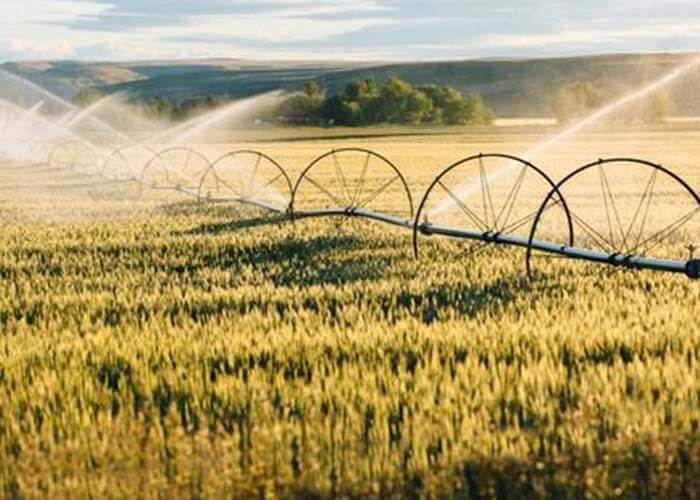
Drip irrigation is the most efficient way to give onions this steady, controlled moisture. A drip line laid along each row delivers water directly to the root zone, keeps the foliage dry to reduce disease, and makes it easy to cut watering off cleanly in mid-July. Install drip tape or emitter line at planting, set on a timer, and you avoid both the drought stress and the over-watering that plague hand watering.
Light, weeding, and loosening the soil
Onions demand full sun and a weed-free bed, because shading and competition prevent them from forming a marketable bulb. Small, slow seedlings are especially vulnerable — weeds will overtake them and ruin the crop if not removed early and often. Loosen the soil every 10–15 days, and always after rain, to conserve moisture and keep the bed open. Never bury the bulbs; in fact, draw soil slightly away from the swelling head so it sits exposed.
Regions and climate for growing onions
The right onion for your garden depends first on latitude, because day length determines when bulbing onions form their bulbs. Gardeners south of roughly the 35th parallel need short-day varieties, mid-latitude growers want intermediate types, and northern gardeners must plant long-day onions to get full-sized storage bulbs. The Pacific Northwest, with its cool summers around the North Cascade Mountains and growing areas like Walla Walla, favors long-day storage and sweet types; Idaho and similar northern zones likewise suit long-day onions, while the Gulf and Texas regions are short-day country.
Matching variety to region also dictates the planting schedule. In mild-winter southern areas, short-day onions are planted in fall for an early-summer harvest; in colder regions, onions go in during early spring for a late-summer crop. Regional cooperative extension services — such as Nebraska Extension and Lancaster Extension, where horticulturists like Sarah Browning publish growing guidance — are reliable sources for local planting dates, and growers like Melissa K. Norris share practical regional experience for home gardens.
Growing green onions for the table
Green onions are the fastest, easiest onion crop, harvested young for their slender stems rather than left to bulb. Sow bunching types thickly, or plant sets and shallots close together, and you can pull the first green onions in a few weeks and keep cutting through the season. Bunching cultivars such as Evergreen Bunching Onion and White Lisbon Bunching Onion regrow after cutting, and perennial multipliers like the Egyptian Walking Onion supply greens year after year with almost no replanting. Green onion production fits neatly into containers, raised beds, and small spaces, supporting year-round, farm-to-table food planning.
Harvesting and storing the onion crop
Onions are ready to harvest when the tops dry and the neck loses its rigidity — early September in southern areas, late September elsewhere. Lift the crop before wet weather arrives, because rain prompts the plant to start growing again and onions that resprout will not store. Where growing care was poor, ripening drags on and storage quality suffers.
Several techniques speed ripening near harvest:
- Seven to ten days before lifting, slice the roots with a spade at 4–5 cm depth, or simply tug the plants to loosen their grip on the soil.
- Draw the soil away from the bulbs to expose them to the sun.
- Stop all watering and feeding from mid-July onward.

Harvest only in dry weather. Pull the plants and lay them in a row so each bulb rests on the leaves of the one before; they will cure well over 5–6 days. Then knock the dried leaves off with the edge of your hand — if you need a knife or scissors, the onion was not fully ripe and will store less well, so do not rush the trimming.
An onion pulled from the ground continues to ripen as nutrients flow from the leaves down into the bulb, so leave the tops a while before cutting. Trim the roots, and store the cured bulbs in a cool, dry place. Onions can also be kept in braids: plait the dried leaves, working in twine for strength. Use any thick-necked onions first, since these will not keep through winter.
Common mistakes growing onions from seed
Most onion failures trace back to a few avoidable errors, and knowing them in advance saves a season. The frequent mistakes are:
- Wrong day-length variety — planting long-day onions in the south, or short-day onions in the north, so the bulbs never size up.
- Sowing too late — late seeding leaves too little time to build a leaf canopy before bulbing begins, producing thick-necked, non-storing onions.
- Sowing too deep — burying seed in heavy soil so seedlings emerge roots-up or die.
- Letting weeds win — failing to weed the slow seedling stage, the single biggest cause of small bulbs.
- Skipping thinning — leaving every seedling, which yields many tiny bulbs instead of good ones.
- Over-watering late — watering past mid-July, which delays ripening and worsens storage.
- Using old seed — sowing onion seed more than two years old and getting poor, patchy germination.
- Damping-off indoors — starting transplants in non-sterile mix and losing seedlings to damping-off disease.
Ordering and delivery of onion seeds by mail
Onion seeds, sets, and transplants can be ordered online and delivered by mail, which gives home gardeners access to far more varieties than local stores stock. Seed catalogs list each variety's day-length class, seed count, germination rate, organic or pelleted status, price, and current availability, so you can compare before adding items to the cart. Bulk mail delivery of seed suits market growers, while small packets serve home gardens; many suppliers also list customer reviews and ratings to help with selection. Create an account to track orders, save your garden list, and reorder proven varieties season after season.
While you plan the vegetable patch, it helps to browse related growing guidance — our Agronomy section covers crop care in depth, and the broader site spans topics from daily life to nature, science, and life. Onion seed pricing and promotions vary by season, so order fresh seed early each year to secure the varieties and germination quality you want, and store any surplus correctly to preserve it for the next sowing. Note the seed preparation guidance above before you sow.