Crop Irrigation: Boosting Water Efficiency and Knowing When to Irrigate
 libre
libre
What Is Crop Irrigation?
Crop irrigation is the artificial application of water to farmland to supplement rainfall and ensure plants receive the moisture they need throughout the growing season. It exists to counter the harmful effects of drought in arid southern regions and to correct moisture deficits under variable modern weather conditions. Irrigation not only raises crop yields but also makes those yields more stable from one season to the next.
The practice is among the oldest in agriculture, dating back thousands of years to civilizations that farmed the floodplains of the Nile River in Egypt, the Indus River in Pakistan, and the Ganges River in India. Today irrigation accounts for the largest share of human freshwater withdrawals worldwide and underpins much of global food production. Countries such as China, India, and the United States operate vast irrigated areas, and the mid-20th-century Green Revolution depended heavily on expanding irrigated land to feed growing populations.
According to the U.S. Geological Survey (USGS), irrigation is one of the largest categories of water use in the United States, second only to thermoelectric power. The agency's Water Resources Mission Area compiles national water-use data through the National Water Information System (NWIS), drawing on contributions from specialists such as Cheryl A. Dieter and Molly A. Maupin. These figures show how central irrigation has become to agricultural productivity across the Great Plains, the High Plains, the Midwest, and the irrigated valleys of California and Arizona.
Why Irrigation Matters in Drought-Prone Regions
Irrigation matters most in regions where rainfall alone cannot reliably support crop growth, because it converts uncertain harvests into dependable ones. In dry southern and continental climates, a single dry spell during a sensitive growth stage can devastate an unirrigated field, while an irrigated field carries on with little loss. This reliability is the core reason farmers invest in irrigation infrastructure despite its cost.
Irrigated land is consistently more productive than rainfed land growing the same crop. Comparisons by the United States Department of Agriculture, drawn from the Census of Agriculture and the Irrigation and Water Management Survey, repeatedly show irrigated acreage yielding well above rainfed acreage. That productivity gap is the economic justification for federal reclamation policies and for both government and private investment in irrigation schemes.
Crop Stability and Yield During Droughts
Crop stability during droughts is irrigation's most valuable benefit, because it removes the largest source of year-to-year yield variability. A field that receives supplemental water at the right moments avoids the sharp yield collapses that drought imposes on rainfed neighbors, smoothing both harvests and farm income across good and bad years.
Irrigation protects crops during the specific growth stages when water stress does the most damage. Even brief moisture deficits during flowering or grain fill can permanently reduce yield, so the security irrigation provides during these windows translates directly into higher, more predictable production. This is why irrigated systems hold their output during droughts that would otherwise cut rainfed yields substantially.
Climate Change and Water Scarcity Challenges
Climate change is intensifying both the need for irrigation and the difficulty of supplying it, because warming raises crop water demand while making water sources less reliable. Research published in Communications Earth & Environment by scientists including Trevor Partridge, Jonathan Winter, and Anthony Kendall — affiliated with institutions such as Dartmouth College and Michigan State University — used crop modeling and climate projections to map where irrigation will become more feasible or more strained by mid-century.
That modeling work indicates irrigation can serve as a climate adaptation strategy, cushioning heat stress on corn and soybeans under warming scenarios and expanding the benefits of irrigation in parts of the Midwest and Great Plains. At the same time, groundwater availability and recharge rates differ sharply by region, so irrigation feasibility across U.S. regions will diverge as climate change reshapes water deficits.
Groundwater depletion is the sharpest constraint. The Ogallala Aquifer beneath the High Plains — spanning Nebraska, Texas, and neighboring states — is being drawn down faster than it recharges, raising serious sustainability concerns for the millions of acres that depend on it. Where surface water from rivers and reservoirs is scarce, farmers lean harder on groundwater extraction, accelerating aquifer depletion and forcing difficult water resource management and agricultural policy decisions.
Water Use Efficiency in Crop Irrigation
Water use efficiency in crop irrigation means producing the maximum harvest from the smallest possible volume of applied water. Under artificial irrigation the goal is always to raise the efficiency of the water used, because water is both costly and, in many regions, genuinely scarce.
Improvements in irrigation technology have driven much of the gain in water-use efficiency over recent decades. Low-pressure delivery, weather-based scheduling, soil moisture sensors, and precise application equipment all reduce the water lost to evaporation, wind drift, deep percolation, and runoff. Capturing runoff for reuse and improving distribution uniformity across a field further stretch every unit of water applied.
Maximizing Yield with Minimal Water
Maximizing yield with minimal water depends on matching water delivery to the crop's actual need at each moment, rather than applying a fixed amount on a fixed schedule. Tools such as evapotranspiration calculations let growers estimate how much water a crop has used and how much to replace, so applications track real demand. Weather-based scheduling adjusts those estimates for temperature, wind, and rainfall.
Field practices that improve efficiency include leveling land so water spreads evenly, using filtration to keep emitters clear, and monitoring soil moisture directly. Together these measures cut waste, lower pumping energy costs, and protect the water table — the combined aim of water conservation and efficiency in modern agriculture.
Irrigation Norms and Soil Moisture Depth
An irrigation norm must wet the layer of soil that holds the bulk of the plant's roots, so the depth of soil moistening should be no less than 25–85 cm. Watering shallower than this leaves the deeper roots dry, while watering far deeper wastes water below the root zone where the crop cannot reach it.
Soil texture governs how much water a soil holds and how fast it absorbs it. Sandy soils have high infiltration rates but low water-holding capacity, so they need lighter, more frequent applications; clay soils hold more water but absorb it slowly, demanding slower application to avoid runoff. The U.S. Department of Agriculture Natural Resources Conservation Service (NRCS) provides soil property data that growers use to set application depths, and classic tools such as the Woodruff chart method help relate soil moisture depletion to irrigation timing.
Determining When to Irrigate
The right time to irrigate is before plants show visible signs of water stress, not after. The physiological state of the crop — the first signs of wilting — indicates the need for water, but irrigation should occur before wilting appears, because by then the plant's normal physiological processes are already disrupted.
Physiological Signs of Water Stress in Plants
Water stress disturbs a plant's internal processes well before wilting becomes obvious. As soil water grows scarce, photosynthesis declines, the intensity of respiration increases, and transpiration falls. These shifts disrupt the activity of the protoplasm, growth processes, and the formation of both vegetative and reproductive organs.
The damage from early water stress is often permanent. These disruptions cannot be undone even when the plant is fully supplied with water and mineral nutrients during later growth stages, which is why timing irrigation ahead of visible stress matters so much. Modern growers supplement visual inspection with soil moisture sensors and leaf canopy temperature monitoring, which detect stress earlier and more objectively than the eye can.
Lobov's Cell Sap Concentration Method
M. F. Lobov developed a method of scheduling irrigation based on the concentration of cell sap in plants, because that concentration is directly tied to soil water content — when soil water is low, cell sap concentration rises, and when soil water is plentiful, it falls. He proposed a simplified way to measure cell sap concentration in the field using a refractometer.
Lobov held that for most crops irrigation should be scheduled when cell sap concentration reaches about 8 atm. Irrigation norms run from 300 to 800 cubic meters of water per hectare: less water is needed early in the growing season, and more during critical periods and times of vigorous growth. During ripening, roughly 500 cubic meters per hectare is usually sufficient.
Crop Water Requirements by Type and Growth Stage
Every crop has its own water requirement that shifts across its phenological stages, so effective irrigation follows the crop's developmental calendar rather than a calendar of dates. Germination and seeding need light, frequent moisture; vegetative growth needs steady supply; and reproductive stages such as flowering and grain or fruit fill are the most sensitive windows, when stress causes the greatest yield loss. The USDA Crop Water Use app and similar tools help growers track these stage-specific needs.
Corn Growth Stages and Water Management
Corn water demand climbs from emergence to a peak around tasseling and silking, then tapers through grain fill. Across the Corn Belt, water management aims to keep corn well supplied through that pollination peak, when even short deficits sharply reduce kernel set and final yield. Early-season water is modest, but mid-season demand for corn is among the highest of any row crop.
Corn Root Depth and Soil Compaction Effects
Corn roots can reach well over a meter deep in loose, well-structured soil, letting the plant draw moisture from a large volume and ride out short dry spells. Soil compaction undermines this by blocking root penetration, confining roots to a shallow layer that dries out quickly. Compacted fields therefore need more frequent irrigation, because the corn cannot tap deep soil moisture reserves it would otherwise reach.
Corn Grain Fill Stage Irrigation Timing
The grain fill stage is a critical window for corn irrigation, because water stress here directly limits kernel weight and final grain yield. Maintaining adequate soil moisture through grain fill lets the plant keep moving sugars into the developing kernels, while a deficit forces early maturity and shrunken grain. Irrigation should continue until the crop nears physiological maturity rather than stopping once tasseling ends.
Cotton Reproductive Growth and Irrigation Timing
Cotton irrigation centers on the reproductive period, when the plant sets and fills bolls across the Cotton Belt of the southern United States. Water supply during squaring, flowering, and boll development determines how many bolls the plant retains and how large they grow, making this the decisive window for cotton yield. Adequate but not excessive water keeps the plant productive without driving wasteful vegetative growth.
Cotton Fruit Shedding Causes and Fruit Load Management
Cotton sheds squares and young bolls when it is stressed, and both water shortage and water excess can trigger this fruit shedding. Because cotton has an indeterminate growth habit, it will keep producing vegetation at the expense of fruit if conditions push it that way, so growers manage the fruit load by balancing irrigation with growth regulators such as mepiquat chloride. Careful irrigation timing keeps the plant holding its fruit rather than abandoning it.
Soybean Varieties and Water Needs
Soybean water use peaks during pod fill, the stage that most strongly determines yield, so irrigation through the reproductive period pays the highest return. Early vegetative demand is modest, but the weeks of flowering and seed fill require steady moisture, and a deficit then sharply cuts the number and size of seeds. Compared with corn, soybeans often use water somewhat more efficiently per unit of yield, an advantage in cost-benefit analysis for irrigated fields.
Determinate vs Indeterminate Soybean Varieties
Soybean varieties fall into determinate and indeterminate types, and the distinction matters for irrigation. Determinate soybeans stop vegetative growth once flowering begins, concentrating their water demand into a defined reproductive window; indeterminate varieties keep growing vegetatively while they flower and fill pods, spreading and prolonging their water need. Knowing which type is planted helps growers schedule the duration and intensity of irrigation correctly.
Cereal Crops: Spring Wheat Water Requirements
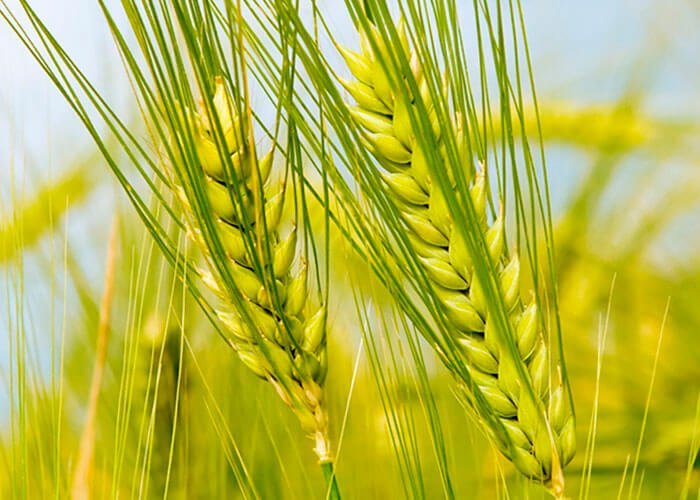
Spring wheat needs its water most during two critical stages — tillering and the onset of heading — when moisture shortage cuts both grain number and grain weight. Supplying water at these points produces a favorable balance between grain and straw and high grain quality, as the trial data below illustrates. The crop's earlier and later demands are lighter, so concentrating irrigation on these windows uses water efficiently.
Irrigation and Fertilization: Combined Management
Irrigation creates a powerful opportunity to fertilize crops, because nutrients can be applied dissolved in the irrigation water or sprayed during sprinkling as a foliar feed. Delivering water and nutrients together — fertigation — meets the plant's needs for both at the same moment and supports normal development. Right management of feeding and watering together is what produces, in cereals, the good grain-to-straw ratio and high grain quality noted above.
Root and Foliar Feeding Through Irrigation Water
Crops can be fed through irrigation in two complementary ways: root feeding, where fertilizer dissolved in the water reaches the roots, and foliar feeding, where nutrients are applied through sprinkler droplets onto the leaves. Both routes are practical with irrigation infrastructure already in place; for the distinction and best practice, see root and foliar plant feeding. Under irrigation, plants make better use of applied fertilizer overall.
Well-fed leaves drive higher productivity. When leaves are well supplied with nutrients, photosynthesis increases, and the larger flow of sugars that results raises yield. Fertigation systems also allow salt leaching, flushing accumulated salts below the root zone to prevent the salinity buildup that can otherwise damage irrigated soils.
Yield Data: Spring Wheat Under Varied Agrotechnics
Field trials on spring wheat show clearly how irrigation and fertilization compound each other's effects. The table below records yields of Gordeiforme 189 spring wheat under different agronomic treatments, demonstrating that irrigation alone nearly doubled the control yield and that combining irrigation with fertilizer raised both grain yield and grain weight further still.
Yield of Gordeiforme 189 spring wheat under different agrotechnics
(after G. A. Zak and N. S. Petinov)
| Trial variant | Grain yield (centners per hectare) | Absolute weight of 1000 grains (g) |
| Control (no fertilizer, no irrigation) | 14.6 | 37.5 |
| No fertilizer, with irrigation | 27.2 | 38.9 |
| P90 N90 before spring plowing, no irrigation | 45.3 | 39.8 |
| Two irrigations (1st at tillering, 2nd at start of heading), P90 before spring plowing + N45 before 1st + N45 before 2nd irrigation | 51.7 | 41.6 |
As the table shows, irrigation increases yield and improves grain quality, and the added fertilizer produces a large effect as well. Today crop irrigation in the field is carried out with new professional precision irrigation systems that can be operated by remote control.
Irrigation Methods and Systems
Irrigation methods fall into two broad families — gravity-fed surface systems and pressurized systems — and the right choice depends on the crop, the soil, the water source, and the budget. Surface irrigation moves water across the field by gravity through furrows or floods, while pressurized systems such as sprinkler and drip irrigation pump water through pipes to apply it more precisely. The water itself comes from surface sources such as rivers and reservoirs or from groundwater pumped from aquifers.
Choosing a method involves trade-offs in water-use efficiency, energy, labor, and capital cost:
- Flood and furrow irrigation — gravity-fed surface methods that are cheap to install but lose more water to evaporation and percolation; field leveling and surge flooding improve their uniformity.
- Sprinkler irrigation — applies water overhead through nozzles, useful for germination, frost protection, and weed suppression as well as routine watering.
- Drip and micro-irrigation — deliver water directly to the root zone through emitters, achieving the highest efficiency and the lowest evaporation losses.
- Subirrigation — raises the water table from below to wet the root zone, suited to certain soils and forage systems.
Rice illustrates how method choice depends on the crop and field. Rice irrigation traditionally relies on cascade flood across leveled fields with levee systems, but growers increasingly use side-inlet irrigation, furrow systems, and even center pivots to cut water use while still meeting the crop's heavy demand.
Center Pivot and Lateral Irrigation Systems
Center pivot systems are the most recognizable form of large-scale sprinkler irrigation, rotating a long pipe on wheeled towers around a central point to water a circular field. Lateral (linear) systems move the same pipe in a straight line to cover rectangular fields. Both dominate row-crop irrigation across the Great Plains and Midwest because they spread water evenly over large areas with modest labor.
Modern pivots run on low-pressure nozzle packages that cut pumping energy and water loss. Manufacturers such as Zimmatic supply pivot machines, while Senninger® and Hunter Agricultural Irrigation make the sprinkler and spray heads — products including the i-Wob®2, Xcel-Wobbler™, Xi-Wob™, mini-Wobbler™, LDN® Spray, and LDN® LEPA — that distribute water close to the crop. Remote platforms such as FieldNET let growers control and monitor pivots from anywhere.
Drip and Surface Irrigation Compared
Drip irrigation and surface irrigation sit at opposite ends of the efficiency and cost spectrum. Drip systems apply water slowly and directly to each plant through drip tape, polyethylene tubing, and emitters, wasting almost nothing to evaporation; suppliers such as Netafim build complete driplines, filtration, and pressure regulation for row crops, greenhouses, and nurseries. Subsurface drip can even water forage crops from buried lines.
Surface irrigation, by contrast, floods or furrows the field by gravity and costs far less to install, but loses more water and waters less uniformly. A working drip system needs supporting hardware — pumps, valves and control systems, PVC and flexible piping, filtration to protect emitters, and pressure regulators to keep flow even. For small plots and temporary crops, simpler tools such as soaker hoses, irrigation hose reels, and reel machines like Ocmis Irrigation Reels, Microrain, and VARIORAIN offer flexible, low-investment options.
Precision Irrigation with Remote Control
Precision irrigation with remote control lets growers apply exactly the right amount of water to each part of a field and adjust it from a phone or computer. These professional systems combine soil moisture sensors, weather-based scheduling, and telemetry — such as a ranch telemetry system — so water goes where and when the crop needs it. Digital farming platforms turn irrigation from a fixed routine into a responsive, data-driven operation.
Cost Comparison of Irrigation Methods
Irrigation methods differ widely in both installation and operating cost, and the cheapest to install is rarely the cheapest to run. Gravity-fed surface systems have the lowest upfront cost but use the most water and labor; pressurized systems cost more to install and pump but use water far more efficiently. The table below summarizes the typical trade-offs.
| Method | Install cost | Water efficiency | Best fit |
| Flood / furrow (gravity) | Low | Lowest | Level fields, rice, abundant water |
| Center pivot / lateral | Medium–high | Moderate–high | Large row-crop fields |
| Drip / micro-irrigation | High | Highest | High-value crops, scarce water |
| Hose reel / sprinkler | Low–medium | Moderate | Small or temporary fields |
For major row crops the economics turn on water and yield together. Cost-benefit analysis for corn and soybeans weighs the energy of pumping and the capital of equipment against the yield gain and stability irrigation provides — a calculation that increasingly favors efficient systems as water grows scarcer and more expensive.
Case Studies and Real-World Irrigation Applications
Real-world irrigation shows how growers match method to crop, climate, and water supply in widely different settings. In Southeast Missouri, agronomists at the Fisher Delta Center — including Bobby Phipps and Bob Bender — have studied irrigation timing for cotton and soybeans grown across the Mississippi River Valley, where surface water and shallow groundwater both feed the fields. The Delta's flat, fertile land suits both furrow and pivot systems.
Operations elsewhere illustrate the range of solutions. Growers such as Tasteful Selections in Bakersfield, CA, and producers around Harrisville, QLD, rely on precision systems and reel machines suited to their crops and climates, while suppliers including Southern Irrigation across British Columbia, Saskatchewan, and the wider Canada market, and dealers like Ryan Leatch, fit systems to regional cropping patterns. These cases underline a single lesson: there is no universal best method, only the method best matched to a field's crop, soil, water source, and economics.